How to Measure Business Success Beyond Profit and Build a Business That Feels Good

How to Measure Business Success Beyond Profit and Build a Business That Feels Good
How to Measure Business Success Beyond Profit and Build a Business That Feels Good

I’m cancelling some of my most profitable events for 2026.

And no, I have not lost the plot.

I have simply started listening to the other success metric most business owners ignore until their body, calendar, relationships or motivation finally force them to pay attention.

Because here is the truth that too many entrepreneurs learn the hard way:

A business can be profitable and still be costing you too much.

Not always financially. Sometimes the cost is your energy. Your creativity. Your joy. Your capacity. Your weekends. Your nervous system. Your ability to feel excited when you open your calendar instead of quietly wanting to fake your own disappearance.

Now, before anyone gets twitchy, let me be clear.

Profit matters.

Revenue matters.

Margins matter.

Cash flow matters.

We are not building businesses on vague vibes, wishful thinking and a pretty Canva graphic.

But if money is the only way you measure success, you can accidentally build a business that looks impressive from the outside and feels like a cage from the inside.

This article is about how to measure business success beyond profit so you can build something that is financially strong, energetically sustainable and actually aligned with the life you want to live.

You will learn how to assess your business using financial, energetic and operational barometers, how to identify what is draining you, how to spot when a profitable offer is no longer worth the cost, and how to redesign your business model without burning the whole thing to the ground.

Because profitable does not always mean worth it.

And sustainable success requires more than a spreadsheet.

What Does Business Success Really Mean?

Most business owners say they want success.

But very few sit down and define what success actually means beyond “more money”, “more clients” or “more growth”.

That is where things start to get dangerous.

Because if you do not define success properly, you will unconsciously inherit someone else’s version of it.

You might chase:

More revenue, even when your margins are terrible.

More clients, even when you are already over capacity.

More launches, even when your calendar is screaming.

More team members, even when your operations are messy.

More visibility, even when your delivery model cannot handle the demand.

More, more, more.

And then one day you wake up with the thing you thought you wanted and realise it does not feel the way you expected it to feel.

Success in business needs more than one barometer.

At minimum, you need to measure:

  1. Financial success: Is the business profitable, healthy and viable?
  2. Energetic success: Does the business feel sustainable, enjoyable and aligned?
  3. Operational success: Can the business run without you being the bottleneck?
  4. Lifestyle success: Does the business support your life, or consume it?

When you measure business success beyond profit, you make wiser decisions.

You stop keeping offers just because they make money.

You stop saying yes to clients who drain you.

You stop delivering services in ways that exhaust you.

You stop confusing busyness with growth.

And you start building a business that can last.

Why Profit Is Important, But Not the Whole Picture

Let’s not swing too far in the other direction and pretend money does not matter.

It does.

A business needs to make money. It needs to pay you. It needs to cover costs. It needs margin. It needs cash flow. It needs to be commercially viable.

Your financial barometer tells you whether your business model works on paper.

You need to know:

How much revenue is coming in.

How much profit is left after expenses.

Which offers have the best margins.

Which products or services are costing too much to deliver.

Which sales channels are converting.

Which activities create the highest return.

Which expenses are no longer justified.

These are basic business success metrics, and every business owner should track them.

But here is where many people get stuck.

They look at a profitable offer and assume they must keep doing it.

They look at a high-revenue event and assume it is automatically a good idea.

They look at a full calendar and assume that means growth.

Not necessarily.

A full calendar can be a sign of demand.

It can also be a warning sign that your model depends too heavily on your personal labour.

A profitable event can be a brilliant asset.

It can also be a monster behind the scenes.

A high-ticket service can look fantastic on the spreadsheet.

It can also be quietly destroying your enthusiasm for your own business.

Financial data tells you what is happening with the money.

It does not always tell you what the money is costing you.

That is why you need another barometer.

The Energetic Barometer: The Business Metric That Tells the Truth

Your energetic barometer is how your business feels to run.

Not in a fluffy, vague way.

In a practical, observable, decision-making way.

Your energy is data.

Your dread is data.

Your resentment is data.

Your excitement is data.

Your creativity is data.

Your calendar reaction is data.

If you open your calendar and feel your stomach drop, that is information.

If a certain client name makes you want to throw your laptop into the ocean, that is information.

If you keep delaying a task because it makes you feel heavy, bored or trapped, that is information.

If you come alive when teaching groups, speaking on stage, creating content or building frameworks, that is also information.

The energetic barometer in business is not about avoiding hard work.

Business is not always easy. There will always be admin, pressure, decisions, responsibilities and seasons that require more from you.

But there is a difference between work that stretches you and work that drains the life out of you.

There is a difference between healthy challenge and constant friction.

There is a difference between being tired after meaningful work and feeling depleted by something that no longer fits.

Your job as the business owner is to notice the difference.

How to Use Your Calendar as a Business Energy Audit

One of the easiest ways to assess your energetic barometer is to look at your calendar.

Your calendar does not lie.

It shows you what your business is actually asking from you, not what your brand photos suggest your life looks like.

Open your calendar for the past four weeks and ask:

Which appointments made me feel excited?

Which appointments made me feel dread?

Which tasks did I keep moving?

Which meetings felt unnecessarily heavy?

Which commitments required far more preparation than expected?

Which activities created energy afterwards?

Which activities left me needing to recover?

Which parts of the week made me think, “Oh no, not that again”?

That little “ugh” matters.

It does not mean you are lazy.

It does not mean you are ungrateful.

It does not mean you are bad at business.

It means something in your business model may need reviewing.

Common calendar clues include:

Back-to-back calls that leave no thinking space.

One-on-one sessions where you repeat the same advice over and over.

Events that take months of preparation for only a few days of delivery.

Client work that requires too much emotional labour.

Team meetings that could be replaced by better systems.

Admin tasks that should have been delegated years ago.

Launch activities that feel overly complicated.

Delivery formats that no longer suit your strengths.

Your calendar is one of the most honest business documents you have.

Use it.

When a Profitable Offer Is No Longer Worth It

This is the part business owners often struggle with.

What do you do when something is working financially, but not working energetically?

That is exactly where I found myself with my in-person boot camps.

I love teaching.

I love facilitating.

I love being in a room with my people.

I love helping business owners, course creators, coaches, consultants and experts get breakthroughs.

I love the magic that happens when people finally see what is possible for themselves.

And my boot camps are profitable.

So from the outside, cancelling them might look ridiculous.

But when I looked at the full picture, I had to be honest.

The financial barometer said, “This works.”

The energetic and operational barometers said, “This is costing too much.”

That is the kind of decision mature business owners need to be able to make.

Not every profitable offer deserves to stay in your business.

An offer may need to change if:

It takes too long to prepare.

It relies too heavily on you.

It requires too many staff or contractors.

It has capped revenue due to physical space or delivery limits.

It creates months of pressure before the income arrives.

It causes resentment, dread or exhaustion.

It prevents you from creating more scalable assets.

It no longer matches the season of life or business you are in.

This is not failure.

This is business evolution.

The Real Cost of In-Person Events

Let’s use events as a practical example.

In-person events can be powerful.

They create connection, momentum, community and deep learning experiences. They can position your brand beautifully. They can generate content, testimonials, sales and relationships that last for years.

But they are not simple.

Anyone who has run a proper in-person event knows there is a lot going on behind the scenes.

You have venue hire.

Staff.

Facilitators.

AV.

Registration desks.

Room setup.

Food and beverage.

Travel.

Accommodation.

Insurance.

Printing.

Photography.

Videography.

Marketing.

Sales pages.

Email campaigns.

Ads.

Social media.

Speaker preparation.

Resources.

Templates.

Slides.

Follow-up.

Customer service.

Last-minute ticket sales.

Last-minute changes.

Last-minute chaos, because events always come with a little bit of chaos.

Then there is the lead time.

For many in-person events, you are not just delivering for two days. You are marketing for months.

In my case, it can take six months of work and team costs to get everything ready.

Then there are two to three solid weeks of full-day work to research, write slides, build resources, create templates and prepare the training.

And yes, I write my own training.

Nobody else writes it for me.

That matters, because the preparation is not a quick little copy-and-paste job. It is deep intellectual work. It is curriculum design. It is experience design. It is thinking through how people will move from confusion to clarity, from idea to implementation.

That is valuable work.

But it has a cost.

So when you are evaluating whether an event is successful, do not only ask, “Did it make money?”

Ask:

How many months did it take to sell?

How many people were involved?

How much operational pressure did it create?

How much preparation time did it require?

How much recovery time did I need afterwards?

What opportunities did I have to say no to because this event consumed the calendar?

Could the same impact be created another way?

The profit has to be worth the human cost.

Capacity Limits: Why Some Offers Cannot Scale Without Changing the Model

Another key issue with in-person events is capacity.

If the room caps attendance, your ticket sales are capped too.

For example, if a venue only holds 100 people, you cannot sell 500 in-person tickets unless you change the venue, add dates or redesign the model.

A bigger venue may sound like the obvious answer, but bigger venues bring bigger costs.

More space.

More staff.

More AV.

More catering.

More pressure.

More risk.

Higher ticket prices.

More sales required just to break even.

This is where business owners need to be very honest with themselves.

Some offers can grow.

Some offers need to evolve.

Some offers are capped by design.

If an offer is capped, that does not automatically make it bad. Capped offers can be premium, intimate and highly valuable.

But you must understand the ceiling.

You need to know whether the return is worth the workload.

You need to ask whether the offer is the best use of your time, energy and intellectual property.

For me, the maths became clear.

An in-person boot camp capped at around 100 people has a physical limit.

Online, I can have around 250 people live and sell replay tickets afterwards. That may create around 500 total sales from one training asset.

At around $300 per ticket, that is still a strong income stream.

But when compared against the physical labour, team costs, overheads, long runway, preparation load and pressure of filling a room, it no longer felt like the best model for this season of my business.

That is the key phrase: for this season.

A decision can be right for one season and wrong for another.

How to Keep What You Love and Remove What Drains You

When something starts feeling heavy, the answer is not always to burn it down.

Please do not read this and immediately cancel half your business because you had one bad week.

The smarter question is:

What part do I actually love, and how else can I do that?

For me, the part I love is teaching.

I love translating complex ideas into simple steps.

I love helping people build offers, content, courses, systems, intellectual property and businesses that change their lives.

I love seeing the penny drop.

I love the educational transformation.

What I do not love is the stress, overheads, long runway and pressure that come with large-scale in-person event delivery.

So the question became:

How can I keep the teaching and remove the unnecessary weight?

The answer was not “stop teaching”.

The answer was “change the delivery model”.

That is an important distinction.

Many business owners throw away the wrong thing.

They think they are tired of their business, when really they are tired of the format.

They think they are bored with their topic, when really they are exhausted by the delivery method.

They think they need a whole new niche, when really they need better boundaries, pricing, systems or support.

Before you make a dramatic change, diagnose the friction properly.

How to Identify the Real Source of Business Friction

When you feel burned out, bored or resentful, do not stop at “I’m tired”.

Get specific.

Friction usually comes from one or more of these areas:

1. The Offer

Is the actual product or service still something you believe in?

Do you enjoy the transformation it creates?

Is the offer still relevant to your audience?

Is it profitable enough for the effort required?

Sometimes the offer itself is fine. Sometimes it has simply outgrown its original structure.

2. The Audience

Are you still working with the right people?

Do your clients energise you or drain you?

Are you attracting beginners when you now want to work with advanced clients?

Are you serving people who value your expertise, or people who constantly need convincing?

A brilliant offer delivered to the wrong audience can feel exhausting.

3. The Delivery Method

Do you prefer one-on-one or one-to-many?

Do you enjoy live delivery or recorded assets?

Do you like high-touch support or self-paced learning?

Do you thrive in intensives, memberships, workshops, retreats, consulting, speaking or digital products?

Your delivery preference matters.

It is not a weakness to dislike one-on-one work.

It is not a weakness to prefer group delivery.

It is not a weakness to want fewer calls and more scalable assets.

That is business model design.

4. The Operations

Is the offer hard to deliver because the backend is messy?

Are you missing systems?

Are clients asking the same questions because onboarding is unclear?

Are you manually doing tasks that could be automated, delegated or templated?

Sometimes the problem is not the offer. It is the operational machine around it.

5. Your Identity

Have you changed?

This one matters.

Your business may have been perfectly aligned five years ago, but you are not the same person you were five years ago.

You may have different priorities now.

Different capacity.

Different family responsibilities.

Different creative desires.

Different boundaries.

Different ambitions.

Different tolerance levels.

Your business needs to evolve as you do.

Otherwise, you end up trapped inside a version of success that belonged to an older version of you.

Should You Stop Doing One-on-One Work?

One of the most common shifts for experts, coaches, consultants and educators is moving from one-on-one to one-to-many.

This does not mean one-on-one work is bad.

Some people love it. Some people are brilliant at it. Some business models are built beautifully around high-level private consulting.

But if you are repeating the same explanations again and again, feeling drained by back-to-back calls, or resenting the amount of access clients have to you, it may be time to redesign.

You could replace repeated one-on-one delivery with:

A group coaching program.

A live workshop.

A recorded training.

A membership.

A self-paced course.

A template library.

A group Q&A session.

A private client portal.

A paid implementation day.

A certification program.

A blended model with fewer private touchpoints.

The goal is not to remove all human connection.

The goal is to stop using your personal time as the default delivery mechanism for every piece of value.

If you have explained something more than three times, it probably needs to become an asset.

Record it.

Document it.

Template it.

Teach it once and let it serve many.

That is how your intellectual property starts working harder than your calendar.

When to Hand Delivery Over to Your Team

Another question to ask is:

Am I doing work that someone else could do?

This one can sting a bit, especially for founders.

Many of us are used to being the expert, the face, the fixer, the teacher, the strategist, the salesperson and the delivery person.

But at some point, staying in every part of the business becomes expensive.

Not just financially.

Energetically.

If a task is trainable, it may not need to stay with you.

If someone else can follow a process, answer the question, run the onboarding, deliver the checklist, manage the setup or facilitate the implementation, your time may be better used elsewhere.

Your role as the founder is not to be the bottleneck.

Your role is to protect the work only you can do.

That may include:

Vision.

Thought leadership.

Content creation.

Speaking.

Strategic partnerships.

High-level teaching.

Curriculum design.

Offer creation.

Brand direction.

Sales strategy.

Team leadership.

There is no award for being the most exhausted person in your business.

If it is draining you and trainable, delegate it.

If it is repeated, document it.

If it is simple, systemise it.

If it is not yours to carry anymore, put it down.

Why Happier Business Owners Often Make Better Money

There is a very practical reason to care about how your business feels.

When you are happier in your business, you usually perform better.

You market better.

You sell better.

You create better content.

You make clearer decisions.

You lead your team better.

You respond instead of react.

You follow up more consistently.

You show up with more conviction.

You have more capacity for creativity.

Depleted you does not convert as well.

Resentful you does not write powerful content.

Overloaded you does not make strategic decisions.

Exhausted you does not build the next level.

This is why energy is not separate from revenue.

It is connected to it.

Your audience can feel when you are excited about what you are offering.

They can also feel when you are dragging yourself through the motions.

You do not need to be bouncing off the walls every day. That is not realistic, and frankly, it would be unbearable.

But you do need enough genuine energy for the business model you have built.

If your current model requires a version of you who no longer exists, it is time to redesign the model.

How to Redesign Your Business Without Starting Again

The good news is that you do not need to burn everything down.

Most of the time, you need thoughtful adjustments.

Small changes can completely transform how your business feels.

Here are some places to look.

Adjust the Delivery Format

Could a two-day event become a three-hour online workshop?

Could a live program become a recorded course with monthly Q&A?

Could private coaching become group coaching?

Could consulting become a VIP day?

Could a custom service become a template-based offer?

Adjust the Capacity

Could you reduce client numbers and raise prices?

Could you cap enrolments?

Could you run fewer launches?

Could you deliver quarterly instead of monthly?

Could you stop offering unlimited access?

Adjust the Pricing

If an offer feels heavy, it may be underpriced.

Sometimes resentment is not a sign that you hate the work. It is a sign that the exchange is off.

Review:

Ticket price.

Payment plans.

Margins.

Team costs.

Delivery hours.

Preparation time.

Post-delivery support.

Opportunity cost.

Adjust the Team Support

Who could support delivery?

Who could manage admin?

Who could run onboarding?

Who could answer common questions?

Who could prepare resources?

Who could support implementation?

Adjust the Asset Strategy

Could your live teaching become evergreen content?

Could your workshop become a replay product?

Could your client resources become a paid toolkit?

Could your process become a course?

Could your framework become part of a membership library?

This is where one live session can become a long-term business asset.

Even if only one person turns up live, you still have a recorded lesson.

That lesson can be added to your library, sold as a replay, used inside a membership, included as a bonus, repurposed into content or transformed into a course module.

That is how your expertise compounds.

How to Turn Live Teaching Into Evergreen Assets

One of the reasons I keep coming back to online teaching is because it creates leverage.

When I turn up online and teach for a couple of hours, the work does not disappear when the session ends.

It becomes an asset.

A recorded lesson can become:

A replay product.

A module inside Legends Lab.

A bonus for a future offer.

A training library resource.

A lead magnet excerpt.

A YouTube video.

A blog article.

A podcast episode.

A short-form video series.

A client onboarding resource.

A paid workshop bundle.

This is the beauty of educational content.

When structured properly, it can serve people again and again.

That does not mean live experiences have no value. They absolutely do.

But if your business depends only on live delivery, your energy will always be tied to output.

Evergreen assets allow your ideas to keep working when you are not actively performing them.

That is not lazy.

That is smart business design.

A Practical Business Success Audit

If you want to measure business success beyond profit, here is a simple audit you can run this week.

Set aside 60 minutes and review one offer, event, service or program.

Step 1: Review the Financial Barometer

Ask:

How much revenue does this offer generate?

What is the true profit after expenses?

What are the margins?

How much does it cost to market and sell?

How many team hours are involved?

How many of my personal hours are involved?

Is the return still worth the effort?

Step 2: Review the Energetic Barometer

Ask:

How do I feel when I see this on my calendar?

Do I look forward to delivering it?

Do I feel proud of it?

Does it energise me or drain me?

Does it create resentment?

Do I need a long recovery period afterwards?

Would I choose this again if I were designing my business from scratch today?

Step 3: Review the Operational Barometer

Ask:

Is the delivery process simple or chaotic?

Are there too many moving parts?

Does the offer rely too heavily on me?

Can my team support it without constant supervision?

Are clients getting a great experience?

What needs to be systemised, delegated or removed?

Step 4: Review the Scalability Barometer

Ask:

Is this offer capped by time, space or personal energy?

Can it be sold again without being rebuilt?

Can it become a recorded asset?

Can it be delivered to more people without reducing quality?

Does scaling it increase profit or just increase pressure?

Step 5: Decide What Needs to Change

You have four options:

Keep it as it is.

Improve the operations.

Change the delivery model.

Retire it completely.

Not everything needs to be cancelled.

But everything needs to earn its place.

Common Mistakes Business Owners Make When Measuring Success

Mistake 1: Only Tracking Revenue

Revenue is not profit.

And profit is not the whole picture.

A high-revenue offer with terrible margins, heavy delivery and constant stress may not be as successful as it looks.

Mistake 2: Ignoring Personal Capacity

Your business model must fit your real life.

Not your fantasy productivity self.

Not the version of you who needs no sleep, has no family, never gets sick and can run on caffeine and adrenaline forever.

Real capacity matters.

Mistake 3: Keeping Offers Because They Used to Work

Something can be right for one season and wrong for the next.

Do not keep an offer just because it was once your signature thing.

Your business is allowed to evolve.

Mistake 4: Confusing Discomfort With Misalignment

Not all discomfort means something is wrong.

Sometimes discomfort is growth.

Sometimes it is fear.

Sometimes it is the normal pressure of doing meaningful work.

The key is to look for patterns.

One hard week is not necessarily a sign to change your whole business.

Repeated dread is worth listening to.

Mistake 5: Waiting Until Burnout Before Making Changes

Do not wait until you are completely depleted before reviewing your model.

Regular check-ins prevent dramatic breakdowns.

A small adjustment made early can save you from a major reinvention later.

Key Takeaways

Measuring business success beyond profit helps you make better long-term decisions.

Profit matters, but it is not the only measure of success.

Your energy, creativity and capacity are business data.

Your calendar can reveal what is draining or fuelling you.

A profitable offer may still need to change if the human cost is too high.

In-person events can be powerful, but they must be assessed against overheads, preparation time, capacity and recovery.

One-to-many models, recorded assets and evergreen training can help you scale your expertise sustainably.

You do not always need to burn your business down. Sometimes you simply need to adjust the delivery, pricing, team support or format.

A sustainable business should make money and feel good to run.

FAQ

How do you measure business success beyond profit?

To measure business success beyond profit, assess your financial performance, energy, capacity, operations, lifestyle impact and scalability. Track revenue, margins and cash flow, but also review how your offers feel to deliver, how much personal time they require, whether they rely too heavily on you, and whether they support the life and business you actually want.

What are the best business success metrics for small business owners?

The best business success metrics include revenue, profit margin, cash flow, customer acquisition cost, conversion rates, client retention, delivery time, team capacity, customer satisfaction, founder energy, calendar sustainability and scalability. For service-based businesses, coaches, consultants and course creators, it is especially important to measure both financial and energetic return.

What is an energetic barometer in business?

An energetic barometer is a practical way of measuring how your business feels to run. It looks at what drains you, what fuels you, what creates dread, what creates momentum, and what gives you energy. It is not about making emotional decisions on a whim. It is about using repeated patterns in your energy and capacity as useful business data.

Can a profitable offer still be bad for your business?

Yes. A profitable offer can still be bad for your business if it drains too much time, energy, team capacity or operational resources. It may also be unsustainable if it creates stress, resentment, excessive preparation, poor margins or limited scalability. Profit matters, but the true cost of delivery must also be considered.

How do I know when to stop offering one-on-one services?

You may need to stop or reduce one-on-one services if you are constantly repeating the same information, feeling drained by calls, struggling to scale, resenting client access, or wanting to teach in a more leveraged way. You do not have to remove one-on-one completely. You can shift into group programs, workshops, memberships, courses or hybrid models.

How can I make my business more sustainable?

To make your business more sustainable, review your offers, pricing, delivery methods, team support and systems. Remove unnecessary complexity, delegate trainable tasks, turn repeated teaching into assets, create scalable offers, improve margins and design your calendar around your real capacity. Sustainable business growth comes from alignment between profit, energy and operations.

Should I cancel an offer if it drains me?

Not immediately. First, diagnose what is causing the friction. The problem may be the pricing, audience, delivery format, operations, boundaries or support structure. Once you know the real issue, you can decide whether to improve, redesign or retire the offer. Cancellation is only one option.

Conclusion

Cancelling profitable events might sound strange from the outside.

But business decisions should not be made from the outside.

They should be made from the truth of your numbers, your capacity, your values, your vision and the season you are actually in.

Profit is important. Always.

But profit without sustainability is not freedom. It is a prettier version of being trapped.

The goal is not to avoid work. The goal is to build a business where the work makes sense. Where the return is worth the effort. Where your calendar does not feel like punishment. Where your offers are commercially strong and energising to deliver.

You are allowed to change your business model.

You are allowed to retire things that used to work.

You are allowed to stop doing something simply because it no longer feels worth the cost.

You are allowed to keep the part you love and remove the part that drains you.

That is not weakness.

That is leadership.

Actionable Next Steps

This week, choose one offer, service, event or program and audit it properly.

Ask yourself:

Is it profitable?

Is it scalable?

Is it energising?

Is it operationally simple?

Is it still aligned with who I am and where the business is going?

Then decide whether to keep it, improve it, redesign it or retire it.

Do not wait until you are burnt out to make grown-up business decisions.

Your energy is not an inconvenience.

It is part of the business model.

If you are ready to build a business that is profitable, sustainable and aligned with how you actually want to work, this is exactly the kind of strategic work we do inside Legends Lab.

Inside Legends Lab, I help experts, coaches, consultants, speakers, course creators and business owners turn their knowledge into scalable offers, content, courses, memberships and business assets without building a calendar that eats them alive.

Come and join us inside Legends Lab and start building the next version of your business with more clarity, leverage and leadership.

Learn more here:

Build Your Brand & Business

Want Help Building Your Brand Properly?

If you want to learn how to build your personal brand, business systems, audience, and scalable online business properly, check out the Legends Lab program by Sarah Cordiner.

Join Legends Lab

How Sarah Cordiner Can Help You Scale Your Business with Tech, AI, and Automation

Tech doesn't have to be hard or scary. I help you make it easy to learn, fun to implement, and even better to see the amazing results that you can get with some simple tech tools and strategy.

Here are all of the different ways that I can help you scale your business, streamline your operations, and make your bottom line full of joy using tech, AI, and automation (as well as traditional methods) as your secret weapon.

Sarah's tech stack
The tech I run my businesses on / Updated 2026

One platform. Your whole business. Finally talking to each other.

"What tech do you use, Sarah?" I get asked this every single week. The honest answer? Almost all of it lives in one place: Tekmatix. It's the all-in-one AI business platform I founded, and it runs my websites, funnels, courses, emails, bookings, payments and AI agents. Here's everything it does, who it's for, and the handful of other tools I love.

7-day free trialFree set-up call24/7 live chatAUD or USD

No lock-in contracts / Cancel anytime / Australian owned and female owned
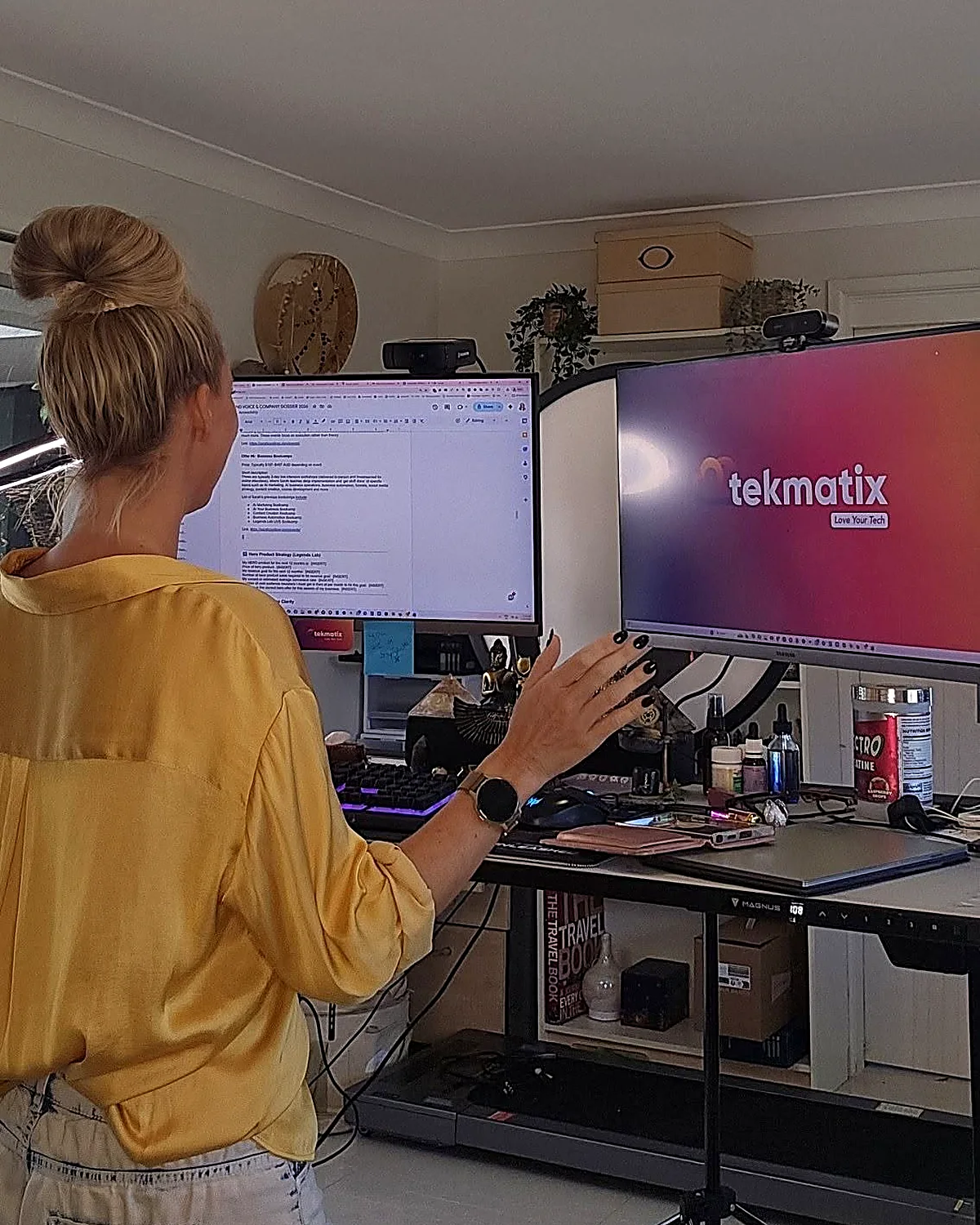
Sarah Cordiner at her desk showing the Tekmatix platform on screen
I built it.
I run my business on it.
1,000+Businesses in Australia and 30+ countries
  • 5.0 on Google from 100+ reviews
  • 98% recommended on Facebook
  • 1,000+ businesses in 30+ countries
  • Award-winning 24/7 support
  • 3 free live training calls every weekday
  • Replace $500 to $1,000+ a month in subscriptions
Sound familiar?

Eight logins. Eight bills. Zero of them talking.

Most business owners I meet are paying for a website here, an email tool there, a booking app, a course platform, a CRM they never open... and then paying someone to glue it all together with duct tape and Zapier.

  • 1Leads fall through the cracks because your forms, inbox and CRM live in different places.
  • 2Every new tool means another login, another bill and another thing to learn.
  • 3You can't see what's actually working because your data is scattered across ten dashboards.
What Tekmatix replaces
Website and hostingWix / Squarespace / GoDaddy
$30+/mo
Sales funnelsClickFunnels / Leadpages
$99+/mo
CRMHubSpot / Salesforce
$50+/mo
Email marketingMailchimp / ActiveCampaign
$40+/mo
Booking calendarCalendly / Acuity
$20+/mo
AI chat and voice agentsVarious
$99+/mo
Social media schedulerHootsuite / Buffer
$30+/mo
Courses and membershipsKajabi / Teachable / Thinkific
$150+/mo
All of it, in TekmatixPlans from $150 AUD / $97 USD a month
The full feature list

Everything your business runs on, under one roof.

Tekmatix is an all-in-one CRM, marketing, sales, course and AI platform. Here's what's inside, grouped by the job it does for you. Tap a category to filter, or scroll the lot.

The bit everyone asks about

AI that does the work

Hand the repetitive stuff to AI that already knows your contacts, calendar and offers.

  • AI Employees that answer chats, DMs and enquiries 24/7
  • Voice AI receptionist that answers your phone and books calls
  • AI booking bot on your website chat widget
  • AI Studio to build apps and tools by describing them (vibe coding)
  • Ask AI assistant built into your account
  • AI website and funnel builder plus content and image AI
  • Connects to Claude and ChatGPT via MCP, so your AI can work inside Tekmatix

Get found and grow your list

Everything you need to get seen, capture leads and build your audience.

  • Unlimited websites with free hosting and your own domains
  • Unlimited funnels, landing pages, sales pages and opt-ins
  • 100+ ready-made templates for sites and funnels
  • Blogging with unlimited posts
  • Social media planner with auto-posting
  • Forms and quizzes, unlimited
  • Surveys with conditional logicPro
  • Reviews and reputation management, incl. Google Business Profile
  • Link-in-bio pages and QR codes

Nurture and convert

Turn strangers into clients with automated follow-up that never forgets.

  • CRM with unlimited contacts and full client records
  • Unified inbox for email, SMS, Facebook and Instagram DMs
  • Email marketing with automated newsletters
  • SMS and phone, incl. missed-call text back
  • Unlimited workflows and automations
  • Sales pipelines so you see every deal
  • Booking calendars for individuals, teams and groups, with 2-way sync
  • Advanced reporting on ads, calls, courses and lead sourcesPro

Sell and get paid

Take money online, in person and on autopilot. Payments go straight to your Stripe or PayPal.

  • Checkouts with upsells and order bumps
  • Invoicing: one-off, recurring and payment plans
  • Tap to pay on your phone (EFTPOS)
  • Request payments by SMS
  • Products and e-commerce, digital and physical, plus coupons
  • Proposals, quotes and contracts with e-signaturesPro
  • Affiliate program with unlimited affiliatesPro
  • Event management with QR code ticketingPro

Courses, memberships and community

Built especially for course creators, educators and coaches. (It's where I teach my own students.)

  • Unlimited courses and memberships
  • Unlimited students and video hosting
  • Assessments and quizzes inside your courses
  • Student mobile app in your branding
  • Communities and groups, unlimitedPro
  • Course certificatesPro

Run the business

The behind-the-scenes admin, organised and in one place for your whole team.

  • Project management and Kanban boards
  • Task manager with deadlines and tracking
  • Unlimited staff users with permission controls
  • Admin mobile app for Apple and Android
  • Business card scanner
  • Integrations with Zapier, Make, WordPress, Google and more
  • Up to 5 sub-accounts for your other businessesMax
ProIncluded on Pro and Max plansMaxMax plan onlyEverything else is included from Starter up.

Want to see it with your own eyes?

Start a 7-day free trial and a Tekspert will jump on a free set-up call with you.

Who it's for

If you sell your expertise or your services, it's built for you.

Solo operators, growing teams and multi-business owners all run on Tekmatix. Here's where it shines brightest.

01

Coaches, course creators and educators

Your website, sales pages, checkout, courses, membership, community and email, all connected. Tekmatix was made especially for you.

02

Consultants, speakers and experts

Bookings, proposals, contracts, invoices and follow-up that makes you look like a big firm, even if it's just you.

03

Health, allied health and NDIS providers

Online bookings, reminders, reviews and client records for clinics, therapists and practitioners.

04

Tradies and local service businesses

Missed-call text back, quotes, tap to pay and review requests, so you win the job while you're still on the tools.

05

Studios, salons and personal trainers

Class bookings, memberships, payments and reminders that cut the no-shows and the admin.

06

Agencies, associations and multi-business owners

Pipelines, staff permissions, reporting and (on Max) up to 5 sub-accounts to run several brands from one login.

Business ownersCoachesCourse creatorsConsultantsTherapistsNDIS providersMedical and allied healthLegal and financial professionalsTradiesSalonsYoga studiosPersonal trainersPhotographersDesignersMarketing agenciesRecruitersOnline storesEvent organisersChurchesCharitiesBusiness associations

Honest moment: if you only need one simple tool and you're genuinely happy juggling logins, you probably don't need Tekmatix yet. But the minute you're copying leads from one app to another, or paying for five subscriptions that don't talk to each other, it's time.

You're never on your own

Most software gives you a login. We give you a team.

I'm an educator first, so Tekmatix was built education-first. Every plan comes with real humans, real training and real templates to get you up and running fast.

Day one

Free one-on-one set-up call

A Tekspert jumps on a call with you to set up your account and connect your integrations.

24/7

Award-winning live chat

Stuck at 11pm? Real support, any time of day or night.

Every weekday

3 free live training calls

Drop in, share your screen and get your questions answered live.

Included

Starter kit and training library

Ready-made templates and automations, a step-by-step help centre, video tutorials and a free Tekmatix training course.

Rather someone just did it for you?

Teksperts are available by the hour, plus fixed-price done-for-you set-up and migration from your old platforms.

See Tekmatix services →
Plans and pricing

Simple pricing that doesn't punish growth.

Unlimited contacts on Starter and Pro, so your bill doesn't jump every time your list grows. Pay in AUD or USD, monthly or yearly (pay yearly and get a month free).

Starter
$150 AUD / month
or $97 USD / month

Everything you need to market, sell and deliver, in one place.

  • Unlimited contacts, staff users and courses
  • Websites, funnels, CRM, email and bookings
  • Payments, invoicing and tap to pay
  • AI Agents, AI booking bot, AI Studio and Ask AI
  • 24/7 live chat and a free set-up call
Start 7-day free trial
Best for course creators Pro
$230 AUD / month
or $149 USD / month

Everything in Starter, plus the tools to build a community and scale.

  • Communities, groups and course certificates
  • Event management with QR ticketing
  • Your own affiliate program
  • Proposals, contracts and e-signatures
  • Unlimited surveys and advanced reporting
Start 7-day free trial
For multi-business owners Max
$497 AUD / month
or $349 USD / month

Everything in Pro, plus more AI, more accounts and a strategist in your corner.

  • Up to 5 sub-accounts
  • AI Employee Growth plan included: 1,000 AI conversation replies and 100 voice AI minutes a month
  • Monthly 60-minute strategy call with a senior Tekspert
  • Early access to Tekmatix Labs
Book a demo

Just starting out? The Launch plan is $75 AUD ($50 USD) a month for up to 1,000 contacts. No lock-in contracts.

Chat about the Launch plan

Emails, SMS, phone calls and AI usage are pay-as-you-go and billed in USD, so you only pay for what you use. See the full rates at tekmatix.com/rebilling. Prices current as at September 2026. Always check tekmatix.com/pricing for the latest.

Sarah Cordiner teaching a funnel diagram on a whiteboard
280,000+Students taught in 181 countries
A note from the founder

I didn't build software. I built the toolbox I needed.

Founder and CEO, Tekmatix20+ years in businessPostgraduate qualified educator

After 20+ years in business and more than 280,000 students, I kept seeing the same thing. Brilliant people with brilliant expertise, drowning in tech. Paying for ten tools, using two of them, and spending their evenings on YouTube trying to make them talk to each other.

So I put everything a business needs into one platform, then wrapped it in the thing I know best: education and support. Tekmatix runs my own websites, courses, funnels, emails and AI agents every single day. I wouldn't recommend it if I didn't use it.

Sarah x

Want me to teach you how to get the most out of it?

Inside the Legends Lab I show you step by step how to use tech, AI and automation to grow your business, with live calls, workshops and templates you can copy.

Join the Legends Lab
Don't just take my word for it

Non-techie people love their tech again.

Tech is hard for non-techie people, and they really get that and make it fun.
Forging Ahead CoachingFacebook review
Yesterday I felt overwhelmed. Now I feel excited and empowered.
Melanie GleesonGoogle review
I have used a number of top CRM systems. This is up there with the very best.
Peter J CroneyFacebook review
Solved problems I have had for weeks, in 50 minutes. Wonderful.
Nicole TurnbullGoogle review
5.0Google rating, 100+ reviews
98%Recommended on Facebook
1,000+Businesses
30+Countries
The rest of my toolkit

The other tools I use and actually recommend.

Tekmatix is the engine. These are the extras that plug in around it for AI, video, design, content and admin. Tap a category to filter.

Some of these are affiliate links, which means I may earn a small commission at no extra cost to you. Thanks for supporting the brand!

AITop pickClaude CoWorkAI agent for non-developers that works across your files, email and apps to automate tasks on your desktop.Check it out → AITop pickChatGPTAI assistant for content, research, brainstorming and custom GPTs for your team.Check it out → AIGoogle GeminiGoogle's multimodal AI assistant, built into Google Workspace.Check it out → AIGoogle AI StudioTest prompts and build with Google's AI models, free to start.Check it out → AIManusAutonomous AI agent that researches and completes multi-step tasks for you.Check it out → AIGensparkAI search and research engine that builds answers from multiple sources.Check it out → AILovableAI app builder. Describe the web app you want in plain English and it builds it.Check it out → Video and audioTop pickDescriptEdit video and podcasts by editing the transcript. Plus screen recording.Check it out → Video and audioCapCutMobile-friendly video editing for Reels, TikToks and short-form content.Check it out → Video and audioTop pickHeyGenAI avatar videos with your own custom scripts and voice.Check it out → Video and audioElevenLabsRealistic AI voiceovers and voice cloning.Check it out → Video and audioSubmagicAI short-form video editing: auto captions, effects and b-roll.Check it out → Video and audioTop pickStreamYardLivestream and multistream to your socials, webinars and virtual events.Check it out → Video and audioLoomQuick screen recordings for tutorials, SOPs and async updates.Check it out → Video and audioCamtasiaScreen recording and video editing for polished course videos.Check it out → Video and audioPodcast.coPodcast hosting and distribution to all the major platforms.Check it out → Design and contentTop pickCanvaDesign for non-designers: social graphics, slides, marketing material and more.Check it out → Design and contentTop pickGammaAI presentation builder for slides, documents and simple web pages.Check it out → Design and contentEnvato ElementsCommercial-use music, video, b-roll, photos and templates.Check it out → Design and contentCreative FabricaFonts, graphics and design assets for your content.Check it out → Design and contentGoogle WhiskGoogle's AI image tool for generating and remixing images.Check it out → Design and contentAdCreative.aiAI-generated ad creatives for your paid campaigns.Check it out → Design and content1of10Viral content research: find the top-performing ideas in your niche.Check it out → Design and contentSyllabyAI social media strategy with video scripts and content ideas for your niche.Check it out → Design and contentTubeBuddyYouTube channel growth, SEO and optimisation.Check it out → ProductivityTop pickMakeVisual automation to connect your apps and build advanced workflows.Check it out → ProductivityOtter.aiRecords, transcribes and summarises your meetings automatically.Check it out → ProductivityWispr FlowAI voice-to-text. Dictate into any text box on your computer.Check it out → ProductivityGoogle WorkspaceEmail, docs, sheets, calendar and team collaboration.Check it out → ProductivityHunter.ioFind business email addresses for B2B outreach.Check it out → ProductivityStunningRecovers failed Stripe payments automatically.Check it out → Money and adminStripePayment processing. Connects to Tekmatix for courses, products, memberships and payment plans.Check it out → Money and adminPayPalConnects to Tekmatix so customers can pay with PayPal.Check it out → Money and adminXeroAccounting for invoicing, payroll, BAS and tax reporting.Check it out → Money and adminAppSumoLifetime deals on software and business tools.Check it out → Money and adminFiverrFreelancers for one-off design, writing and tech jobs.Check it out → Books and publishingPublisher RocketAmazon KDP keyword and category research for authors.Check it out → Books and publishingBookBoltKDP and low-content book publishing research and design.Check it out → Books and publishingMy gear listThe cameras, mics and lighting I recommend, on Amazon.Check it out →

Wondering where the email, booking, course, funnel and CRM tools are? I don't need them any more. Tekmatix does all of that, so I'd rather you didn't pay for them twice.

See what Tekmatix covers ↑
Questions I get asked

Tech stack FAQs.

Still wondering if Tekmatix is right for you? Here are the straight answers.

What is Tekmatix?

Tekmatix is an all-in-one AI business platform. It brings your website, funnels, CRM, email marketing, bookings, payments, courses, memberships, communities, social media scheduling and AI agents together in one connected account, so everything talks to each other.

Do I need to be techy to use it?

No. Tekmatix was built for non-techie business owners. You get a free set-up call, 24/7 live chat, three free live training calls every weekday, a help centre, video tutorials and ready-made templates to get started.

Is there a free trial?

Yes. The Starter and Pro plans come with a 7-day free trial. The Max plan starts with a demo, so the team can make sure it's the right fit.

Can I pay in Australian dollars?

Yes. You can pay your subscription in AUD or USD. Usage charges for emails, SMS, calls and AI are pay-as-you-go and always billed in USD. See tekmatix.com/rebilling for rates.

Will my price go up as my list grows?

No. Starter and Pro include unlimited contacts, so your plan price doesn't increase as your business grows. You also get unlimited courses, students and staff users.

Can you move me off my current platforms?

Yes. Tekmatix Teksperts offer fixed-price migration and done-for-you set-up services, or can help you integrate the tools you want to keep. See tekmatix.com/services.

Can I run courses, memberships and communities in it?

Yes. Tekmatix was made especially for course creators, educators and coaches. Courses and memberships are included on every plan, and communities and certificates come with Pro and Max.

Which plan should I choose?

Starter suits most service businesses and solo experts. Pro is best if you run courses with a community, events, contracts or an affiliate program. Max is for people running more than one business or who want more AI and a monthly strategy call. Not sure? Book a demo.

Your move, legend

Stop juggling your tech. Start loving it.

One login. One bill. One platform that runs your marketing, sales, courses and AI, with a real team behind you. Try it free for 7 days and see how much simpler business gets.

7-day free trial on Starter and Pro / Free set-up call / Cancel anytime

See you inside. Sarah x
Latest Articles by Sarah Cordiner