12 Things Every Business Owner Must Know in 2026 (from Sarah Cordiner & Ryan Deiss)
In this video I share my own views on all 12 lessons, from more than 20 years in business, including the three places I disagree with Ryan: mentioning your offer (lesson 6), making your list opt in again (lesson 8) and picking just one platform (lesson 12). Look for the “Where I disagree with Ryan” boxes below.
I’ve been in business for more than 20 years, and I’ve been creating long, generous, educational content since around 2011. This week I sat in a room in Dallas and heard Ryan Deiss make the case for doing more of exactly that. Here’s everything he taught, and what to do about it in your business.
Quick answer: Ryan Deiss says we’re in a “trust recession”, and people won’t give you their money until they’ve first given you their time. His three trends for the next 12 months are content binging (get people to spend lots of time with your content, fast), selling in private (let the people who are ready put their hand up, instead of pitching everyone) and embedded influencers (the owner becomes the trusted face of the business). Inside those trends are 12 lessons, from ripping out long email drips to adding a “when you’re ready” P.S. to every email, which I have been teaching people to do for years, inside my Legends Lab and boot camps.
Ryan Deiss stood on stage this week and said something every business owner needs to hear: most of what used to work in marketing just doesn’t work all that well anymore. Even things that worked a year or two ago.
If you don’t know Ryan, he’s the founder and CEO of DigitalMarketer, and he says he was the first to introduce the idea of the marketing funnel, back in 2006. So when the man who says he gave us the funnel stands up and says “the funnel ain’t really a funnel no more”, it’s worth paying attention.
I’m in Dallas for LevelUp 2026, where I was also a speaker this year, talking about running a 7-figure SaaS company with AI operations. I sat in the audience and took notes for you, so I could share his talk with you properly. Not a quick summary. All of it.
And honestly? I was absolutely delighted by what I heard.
I’ve been in business for more than 20 years, and since I started creating educational content around 2011 (blogging, LinkedIn, then YouTube), it has become the number one marketing method behind my business: long-form videos, webinars, blogs and longer “how to” emails. I’ve always been told brevity isn’t my strong point. (You may have noticed. This post is long. Get a cuppa.) But as an educator, giving people deep, genuinely useful information has always been how I work, and it has worked for me for well over a decade.
So hearing Ryan say that long form is trending back up again, and that trust is now built with time, felt a lot like being told the thing I’ve been doing all along is the thing that works best right now.
Want the short version? My full 12-lesson video is at the top of this post. Here’s the quick one I filmed at the conference the day I heard him speak.
A quick note on how I’ve written this: I listened, I sat in the audience and I took notes for you. In this blog post, I’ve attempted to pass on Ryan’s teachings with some of my own interpretation. So not everything in here is my personal opinion. I’m sharing what his teaching was. However, where I have a differing opinion or additional perspective, I’ve added that in. Any figures are from Ryan, as he gave them on stage.
TL;DR: the 12 things
- We’re in a trust recession. Their time comes before their money.
- Speed beats the slow drip. Get people to binge you, fast.
- Put long-form content where it “isn’t supposed to go”. Long form gets stares, not glances.
- Turn one great idea into a native multi-part series.
- Build a YouTube binge factory around one “wingman” video.
- It really does hurt to ask. Marketing is a popcorn popper, not a funnel.
- Add a “when you’re ready” P.S. to everything.
- Make people register again. It’s date night.
- Make email social again with short hand-raiser emails.
- Faceless brands are fading. Become your company’s embedded influencer.
- Choose your character: a point of view, hooks and flaws.
- Pick one stage, master it, then bring people home to your email list.
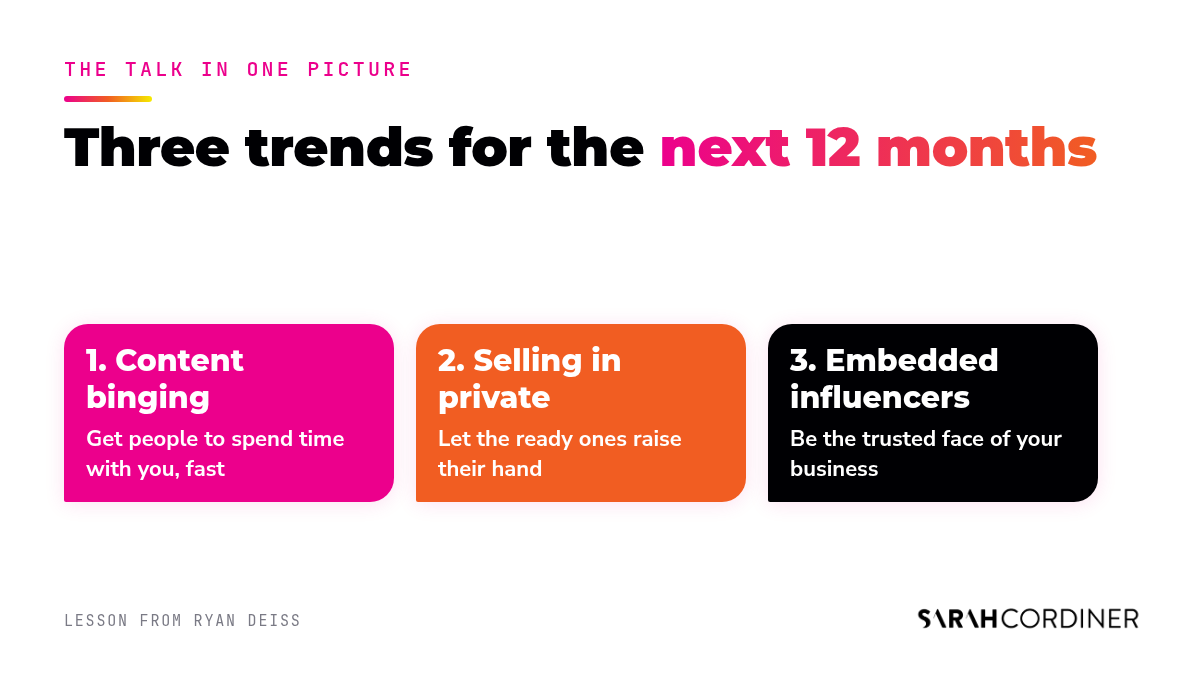
Ryan grouped everything into three trends that he thinks will shape the next 12 months and that he isn’t seeing enough people talk about: content binging, selling in private and embedded influencers. He also mentioned, almost in passing, that his companies have spent (and keep spending) over $8 million on marketing tests across 17 companies in different industries. He said he shared that not to impress anyone, but so we’d know what he was teaching is real.
For each lesson below you’ll get Ryan’s point in plain English, what it means for you, my own perspective (where I’ve been doing it for years, and where I see it differently), copy-and-paste AI prompts, and one practical thing to do. I agree with most of what Ryan taught. Where I don’t, you’ll see a “Where I disagree with Ryan” box, so you can tell straight away which views are his and which are mine.
Where I stand, in short
I agree with Ryan on: the trust recession, speed, long form in unexpected places, multi-part series, the wingman video, the “when you’re ready” P.S., making email social again and being the face of your business.
I disagree with Ryan on: keeping your offer out of your content (lesson 6), making your list opt in again (lesson 8) and mastering one platform before you try another (lesson 12).
1. We’re in a trust recession, so build trust before you chase traffic
Ryan’s point
Ryan said he’ll let the economists argue about whether we’re in a recession. What he’s sure of is that we’re in a trust recession.
He reminded the room of the days when you could buy ads, send people to a video sales letter with an order button underneath, and they’d watch it beginning to end and buy. He said a lot of people built careers in that high-trust cycle and aren’t around anymore, because selling in a high-trust cycle was all they knew how to do.
He’s been doing this long enough to remember the low-trust cycles too: the dot-com boom and the 2008 to 2009 financial crisis. His point: we have to shift from chasing virality, traffic and list size to building trust, because “if they don’t trust you, they won’t buy from you.”
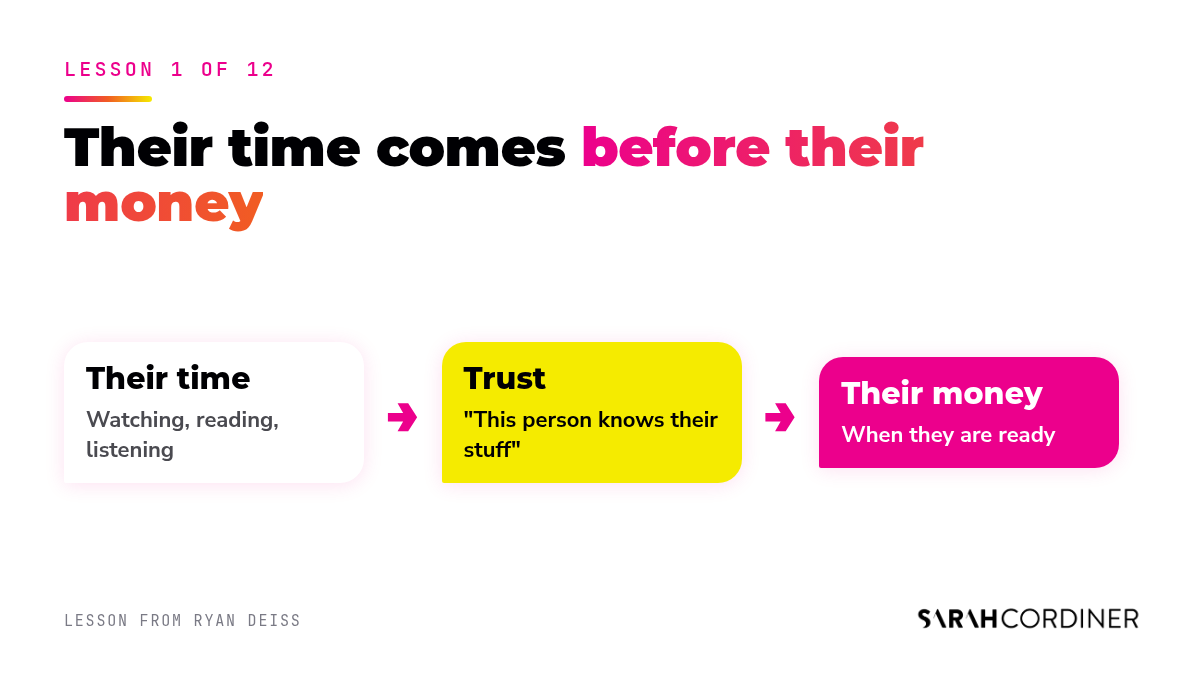
“People won’t give you their money until they have first given you some of their time.”
Ryan Deiss
He said we show commitment in two ways: with our wallets and with our calendars. Show him what you spend your time on, and he’ll show you what you’re probably going to spend your money on.
What it means for you
Your first job isn’t to get the sale. It’s to get people to spend time with you: watching, reading, listening and getting to know how you think. If you’re an expert, that’s good news. You already have the knowledge. You just need people to spend enough time with it.
I’ve been doing this for years too
I’ve lived through my own low-trust moments. In 2014, one phone call of about 11 minutes ended the government funding my training business in Western Australia relied on. I turned on my webcam and filmed every consultation, workshop and course I’d ever delivered, and went from a local market to a global one. In 2022, ChatGPT made my curriculum career obsolete overnight. In 2026, agentic AI started doing the tech setups I was being paid for. Each time, what carried me through wasn’t traffic. It was the trust I’d built by teaching. I tell the whole story in what to do if AI is threatening your work.
My take: let your content do the selling
I call this edu marketing, and I’ve been teaching it in these words for about 15 years. Your free content teaches something practical that people can use straight away. That’s your marketing, because the platforms show it to people interested in your topic. And it’s your sales pitch too, because it shows people you’re good at what you do instead of telling them.
I’ve never done sales calls. I’ve had corporate clients sign contracts well over six figures without one. When someone recently asked for a 15-minute call to see if my program was right for them, my honest answer was that my content is the call. If you do this well, you rarely need to pitch at all.
And with AI making volume easy, the thing that builds trust now is you: real, raw video from your home office, sharing your opinions, lessons and experiences, and tying them back to your business.
What to do
- Look at everything you put out last month. Count how much of it asked for money, and how much gave people a genuinely good reason to spend time with you.
- Pick one piece this week that earns time: a long video, a full how-to post, a workshop or a properly useful email.
2. Speed beats the slow drip: get people to binge your content
Ryan’s point
Ryan’s first trend is content binging, and specifically how it speeds up sales cycles.
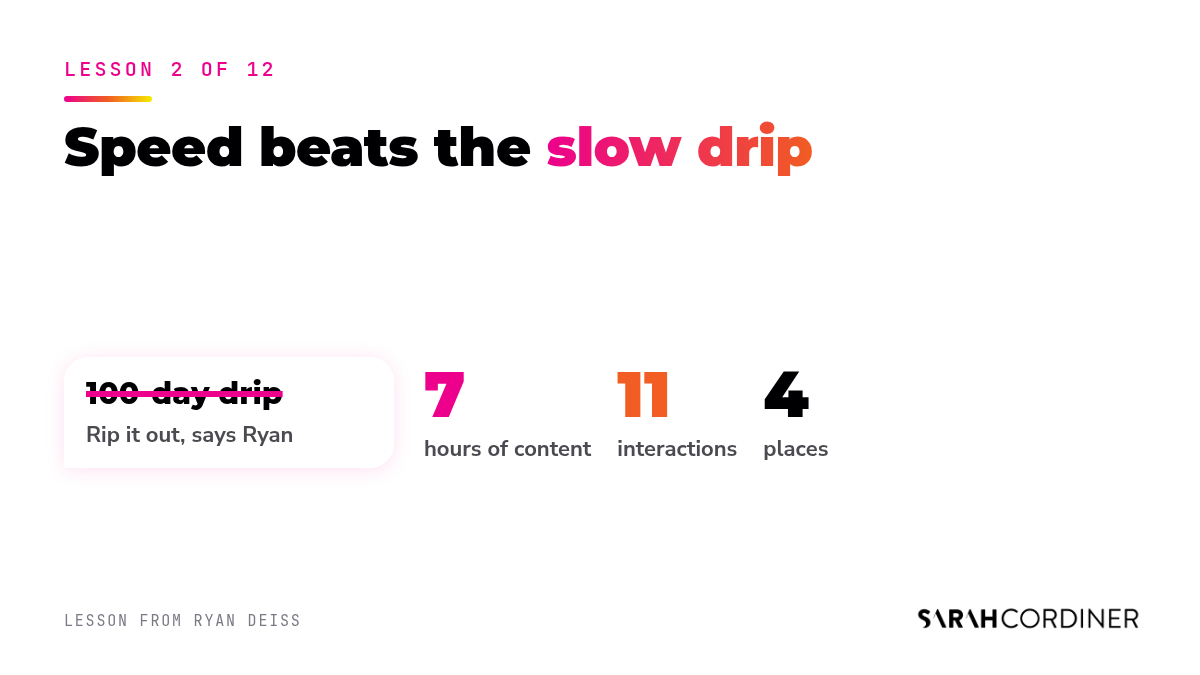
He credited Google and his friend Daniel Priestley with this idea: if you can get someone to consume seven hours of your content over 11 different interactions in four different places (reading you here, watching a YouTube video there, seeing you on Instagram or TikTok), you can get them to buy. And the key, he said, is doing it as quickly as possible.
Then he took aim at something a lot of us were taught. Remember the 30-day email drip series that people actually opened and read, one a day? His words: “If you’ve got 30, 50, 100 day drip cycles, rip them out. It doesn’t work anymore. The key is speed.” Later in the talk he said his own automated sequences now mostly run for just three to five days.
What it means for you
You can’t rely on a slow trickle of emails over months to build trust anymore. You need moments where people can consume a lot of you in one go, and you need to make that easy as soon as they find you.
I’ve been doing this for years too
My free online workshops are my binge content: 60 to 90 minutes of real teaching in one sitting. That’s a big chunk of someone’s time, all at once, which is exactly what Ryan is describing. I wrote up exactly how I run my free online workshops if you want to copy the process.
Now, the honest bit. My own guide to creating a welcome email sequence suggests sending the freebie straight away, a check-in two days later, then one helpful email a week. Ryan’s talk has me looking hard at the slow part of that. The delivery email still goes straight away. But I’m thinking about how to get more of my best teaching in front of new people in their first few days, not their first few months.
My take: you can get binge content from short form too
Binge content doesn’t only come from long form. You can get binge content from short-form content as well. This is where you might create a series of videos or carousels on your social media. Videos obviously work best, because there’s more human interaction and more face-to-face familiarity built. Trust builds quicker when it’s your face talking.
I know most of you would rather boil your own head in acid than speak to a camera, but trust me, it’s well worth getting over yourself to do it. That face-to-face contact builds trust a lot faster than plain text does, especially when today people assume that everything in text was written by AI. If it’s your own real voice talking in a real, raw, authentic, unedited video, in your plain human background, your engagement, conversions and trust increase much faster.
So here’s my suggestion: create a series of 10 little videos, where you open each one with “10 ways to [do X]. Part one.” You deliver the teaching, then say “Like, subscribe and follow for part two.” After 10 little mini videos, people will binge through all of them. It’s a great way to get your watch time and view time up, get your channel recommended more by the social platform and, of course, increase your chances of gaining not just followers and subscribers, but paying customers too.
Where I see it a little differently: keep your nurture sequence, and add live emails
I do still have a nurture sequence, and I’d keep yours. But I’d add live emails on top of it. I’ve recently gone from emailing once a week to emailing every three days. They aren’t sales emails. Each one teaches something and links to a full blog post with my video embedded and all of my prompts, so people can get results quickly.
And when someone is hot, let them buy. If they’ve just opted in or they’re watching right now, don’t make them sit through a ten-week sequence before they hear about your offer. You’re only delaying your own payday. Put the link in the caption or the comments, and never make people jump on a call to buy something they could have bought from a link.
Prompt to copy into your AI (GrokBot, Claude or ChatGPT): Plan my 10-part binge series
I want to film a series of 10 short, face-to-camera videos called “10 ways to [result] for [your ideal customers]”. For each part, write: the opening line (“10 ways to [result]. Part [number].”), the one teaching point for that part in under 45 seconds of talking, and the closing line (“Like, subscribe and follow for part [next number].”). Use my own expertise and examples only, and ask me questions where you need my real stories. Then give me a matching 10-slide carousel version of the same series.
Once they’re filmed, I schedule the whole series in one go on the Tekmatix Social Planner, so each part goes out the day after the last one without me having to think about it.
What to do
- List every automated email sequence you run and how long each one lasts.
- For anything longer than about five days, ask: would this work better as one binge-worthy piece (a workshop, a long video, a full guide) sent in the first few days?
- Don’t cut onboarding emails that help people actually use what they bought. Those do a different job.
- Plan and film a 10-part short video series (“10 ways to [do X]. Part one.”) and schedule it to go out on consecutive days.
3. Put your long-form content where it “isn’t supposed to go”
Ryan’s point
Ryan told us he got serious about social media about a year to 18 months ago. He posted good content consistently, did everything everyone tells you to do, and got flat results. No growth, no real engagement.
He also admitted he’s verbose (he said his wife says he monologues like a Bond villain), and chopping his ideas into tiny clips never worked for him. So he said “screw it” and did the opposite: he downloaded a 30-minute video people liked and posted the whole thing natively to X. He took his long newsletter articles and posted as much of them as he could straight onto LinkedIn and X.
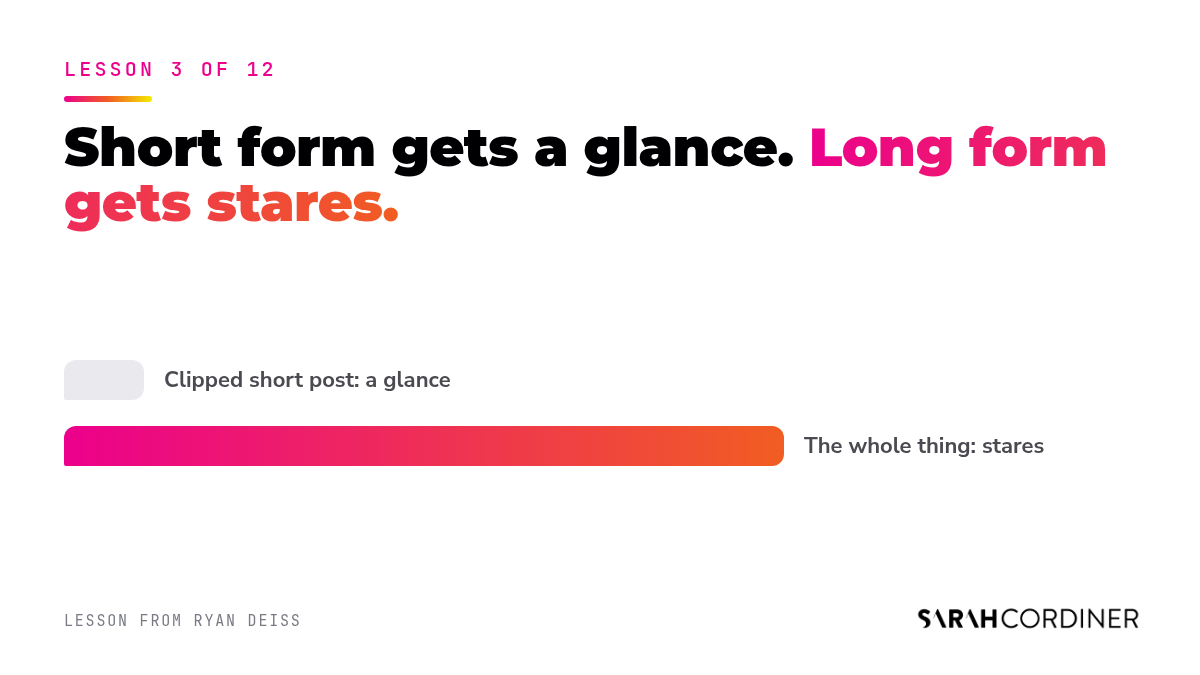
It worked. He said his long-form posts on short-form channels were getting five to seven times the engagement of his short-form posts.
Why? Partly because the content is good. But also because the algorithms notice time. When someone sees a long video and thinks “I’ll watch that later”, they open it in another tab and it just sits there. Do they come back to it? Mostly not, because, as he put it, “later equals never”. But it’s enough of a signal that the platform decides people must like spending time with you.
“Short form gets you a glance; long form gets you stares. We all need to be in the business of generating stares, not glances.”
Ryan Deiss
He also pointed to his friend Caleb Ralston, who posted a six and a half hour video to YouTube: essentially a whole course in one video. Everyone says nobody will watch that. Ryan’s point: even if they only watch a quarter of it, that’s a lot of time with you.
What it means for you
Stop assuming every channel needs bite-sized content. If you have a great long workshop, webinar or article, try putting it, uncut, somewhere people don’t expect it.
I’ve been doing this for years too
Brevity has never been my strong point, and most of my blog posts are long ones. My guide to coach vs mentor vs educator is around 6,500 words, because some things deserve the full explanation. I’m also putting more long-form video on YouTube. In my video above I asked whether you’d watch a 2-hour video these days. I’d genuinely love to know your answer.
I’ve found this works for me too
I’ve also found that this works really well for me. We all started shortening our content over the last few years, because we were told that attention spans were getting shorter and that shorter content gets more views. Well, whilst that’s still true, the people who are likely to pay you do stay longer if you’re teaching something useful.
As it happens, I recently put up a 30-minute video talking about the marketing tips Gary Vee had taught, with my own perspective and opinion on them (here’s what Gary Vee warned every business owner about). I put it on Facebook and TikTok, places that are notorious for short-form content watchers, and I had a number of comments telling me people had watched it the whole way through.
Prompt to copy into your AI (GrokBot, Claude or ChatGPT): Turn my long video into a native long-form post
Here are the words from a long video I’ve made on [topic]: [paste them]. Write me a Facebook caption and a TikTok caption that make people want to watch the whole thing: a strong first line, three bullet points on what they’ll learn, and a question to answer in the comments. Keep it in my voice, and don’t add anything I didn’t say.
What to do
- Take one long piece you already have: a workshop replay, a webinar or a long blog post.
- Post it in full, natively, on one short-form channel: LinkedIn, Facebook or X.
- Compare it with your usual short posts after a week.
4. Turn one great idea into a native multi-part series
Ryan’s point
Ryan said one of the most popular videos on his channel is about how to create a CEO scorecard and metrics dashboard. (“Really riveting stuff,” he joked. But people liked it.)
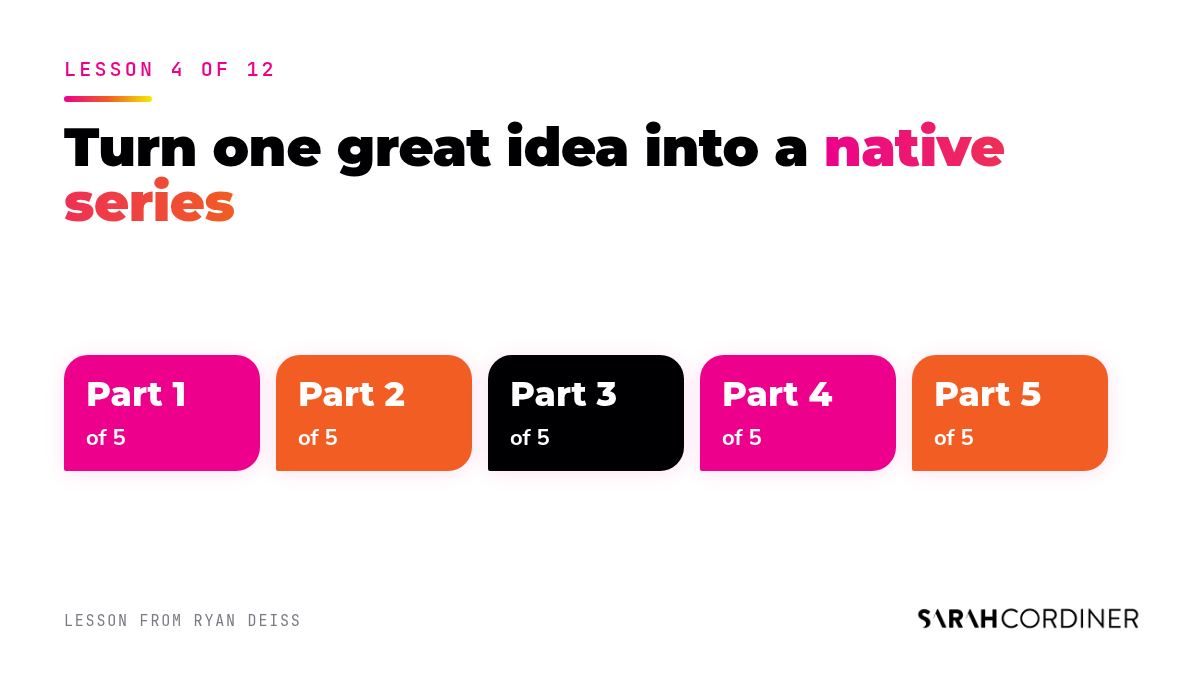
So he took that exact same content and broke it into five videos. Not clips cut out of the long video. Five videos filmed natively for the short-form platform. He said of everything he’s done, that series brought in the most traffic, the most engagement and the most leads.
The reason: when you label them “Part 1 of this series”, “Part 2 of this series” and so on, anyone who sees Part 2 or 3 goes to your profile to find the others. That’s another signal to the algorithm that you’re doing something right. He suggested testing multi-part value series on Reels and TikTok.
What it means for you
You don’t need a new idea for every post. You need your best idea, told well, in parts that make people want the next one.
I’ve been doing this for years too
I’ve been squeezing every drop out of my teaching for years. Whenever an event lets me, I film my own talks with a phone, a tripod and a decent microphone, and one hour on stage becomes months of social videos, posts, blogs, emails and training. I wrote about that in how speaking on real stages builds trust. Ryan’s twist is worth trying: film the series again natively instead of just chopping up the long version.
What to do
- Choose your most popular topic or most-asked question.
- Outline it as five short parts, each with one clear point.
- Film each part natively for Reels or TikTok, and say “Part 1 of 5” (and so on) at the start.
5. Build a YouTube binge factory around one “wingman” video
Ryan’s point
This was the part Ryan called “the biggie”. He said that right now, YouTube is the place.
He told a great story about calling his friend Dan Martell (he’s also friends with Alex Hormozi) and asking how to win on YouTube. The advice: “You gotta go pro.” A videographer, a producer, a crew following you around filming everything. Ryan’s reaction was that there was a 0% chance of him doing that. So he did nothing for six months.
Then he decided to do it on his own terms. His rule: post a video on a topic he finds interesting every single week. “Every single week, except when I don’t.”
Here’s his strategy, and it’s simple:
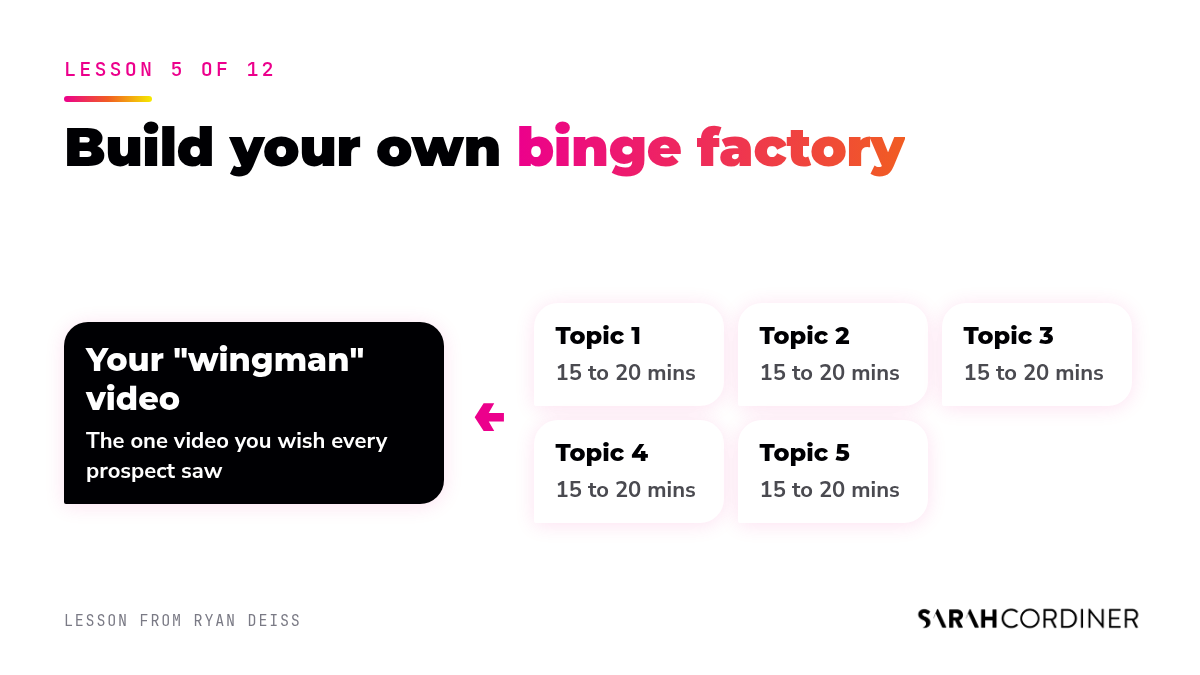
- Make one pillar video. Ask yourself: what is the one piece of content I wish every prospect saw before they talked to my sales team or bought from me? Ryan calls it your wingman, because it goes out first and tells people how great you are. It could be your webinar, your keynote, a demo, your origin story or you doing something impressive. His was a keynote he’d also run as a webinar, about 1 hour 20 minutes long. People said that was way too long for YouTube. He didn’t care. He also said it’s basically a Loom-style video, not a slick production.
- Make five shorter videos from it. Pull out the separate ideas inside the pillar and give each one its own 15 to 20 minute video.
- Put them in one playlist. When someone watches one, YouTube is very likely to serve up the others.
- Link everything back. In every description, link to the pillar video and to a relevant lead magnet, and mention it in the video: “check out the link in the description”.
One detail I loved: Ryan doesn’t want the pillar video to be the first thing someone watches. He doesn’t even need it to be the second. He wouldn’t mind it being the third. The smaller videos do the warming up.
What it means for you
You don’t need a film crew. You need one great video you’re proud of, and a handful of focused videos that lead people to it.
I’ve been doing this for years too
This one is close to my heart, because I built my global business from a webcam. In 2014 I filmed everything I’d ever taught and spent 38 hours uploading it over Australian internet. No crew, no studio. It’s also why turning a webinar or video you already have into a lead magnet is one of my favourite things to teach: most experts already have their wingman video sitting in a folder somewhere.
My take: pin your wingman video
This question really got me thinking, because I produce so much content. If there were one 60-minute tutorial you’d want every prospect to watch before working with you, what would it be? Once you’ve made it, pin it as the featured video on your YouTube channel so new visitors see it first, and point every smaller video back to it.
What to do
- Write down the answer to Ryan’s question: what is the one piece of content I wish every prospect saw before they bought?
- If it already exists (a webinar, keynote or workshop replay), upload it to YouTube as your pillar.
- Plan five 15 to 20 minute videos on single ideas from it, put them in one playlist, and link each description back to the pillar and your lead magnet.
6. It really does hurt to ask: marketing is a popcorn popper, not a funnel
Ryan’s point
Trend number two is selling in private. Ryan is a self-confessed direct response, ask-for-the-order guy. But he said what’s working right now is being much more intentional about when you ask for the sale.
He took apart the saying “it doesn’t hurt to ask”. Of course it hurts to ask, he said. When someone says no to an offer, the chance they’ll change their mind and say yes later is actually quite low, because changing a no to a yes means admitting “I was wrong”. And we humans really don’t love doing that.
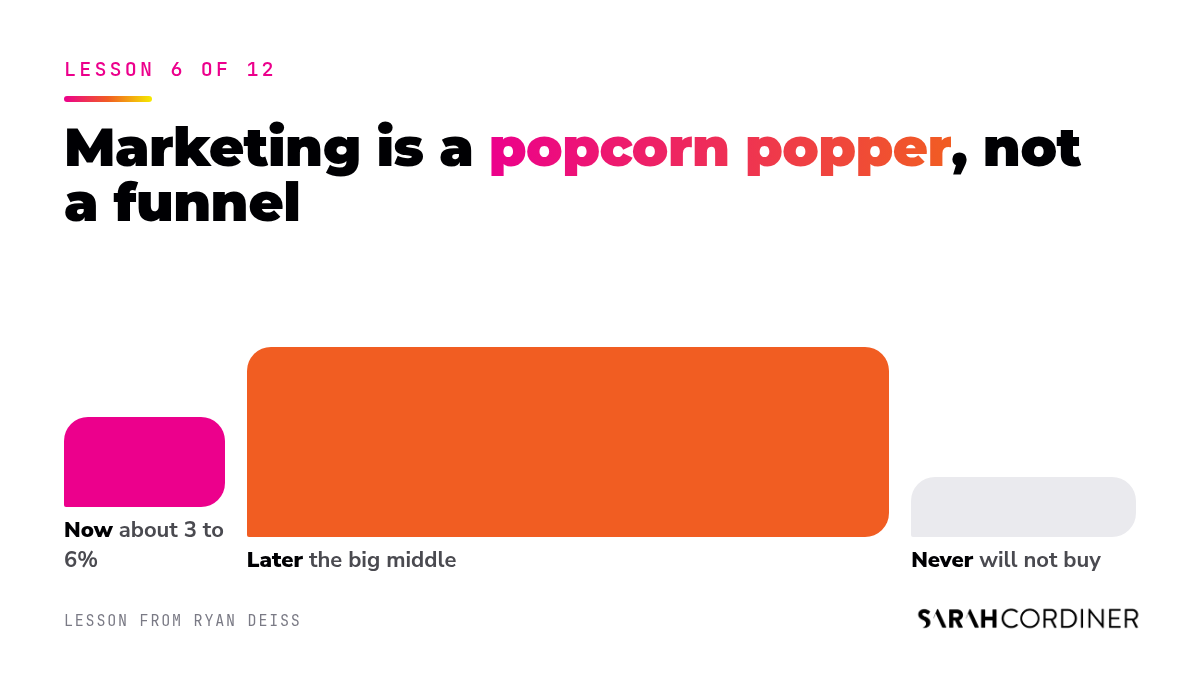
Then came the line that got the room buzzing. Ryan says the funnel isn’t how people buy anymore. Instead:
“Marketing today is not a funnel, friends. Marketing today is a popcorn popper.”
Ryan Deiss
Some kernels pop almost straight away. Most need time to heat up. A few never pop at all. And if you don’t put a lid on it, they pop all over the place.
He shared a model he learned from Dean Jackson: you have now leads, later leads and never leads. At any given time, he said, about 3 to 6% are ready to buy right now (from someone, if not from you). Some will never buy. Most are “later”. The problem is they don’t come with labels.
So most of us make one of two mistakes:
- Too much heat. We treat everyone like a “now” lead, pitch constantly and burn out our list. Ryan said that actually worked from about 2018 into 2022 or 2023, because we were in a high-trust cycle. It doesn’t now.
- Heat off. We’re so scared of unsubscribes that we stop emailing. Ryan called this the marketing equivalent of getting friend-zoned: first you get friend-zoned, then you get forgotten. Then one day you email out of the blue because you need sales, and people call you a spammer because they don’t remember you.
The lid, he said, is segmentation campaigns. They let you sell every day, because you’re not selling to everyone in the same way. For example: send helpful content on Monday, then on Tuesday send a segmentation email that says “if you’re interested in this, let us know”. The people who put their hand up go into a sales process. Everyone else? No harm, no foul. See you next week.
What it means for you
Stop pitching your whole list at once. Give people easy ways to tell you they’re interested, then sell privately to the ones who do.
I’ve been doing this for years too
I’ve had a hard rule for years: my free workshops teach, they’re not sales webinars dressed up as training. And when I’m a paid keynote speaker, I usually can’t pitch from the stage at all. So I teach, give people an easy way to stay connected, and in my experience around 25% of the people in rooms I’ve spoken to connect with me in some way afterwards. On the email side, every campaign I send goes to my mailing list, or a smaller segment of it, never to all contacts. Here’s how to segment your email list properly.
Where I disagree with Ryan
Always tell people how to buy from you. Just don’t make your content a sales pitch.
Ryan’s view, as I understood it, is that most of your content should simply give, and the selling happens privately once people are on your list. This is the lesson I disagree with most. I believe marketing content should be completely helpful, educational and practical in its own right. But the whole point of it being marketing is to promote what you do. This is a business. If you don’t tell people how they can work with you, you can’t make money and you can’t help them.
I’m a fast buyer. I’ve watched brilliant videos, wanted the thing, and couldn’t find a link anywhere. If you haven’t given me a link, you haven’t got the sale. Whether a piece of content took you 15 seconds or 15 hours, you exchanged part of your life to make it, and the point was to get business.
So I don’t pitch in my videos. I teach, help, share or entertain for the whole video, and at the very end I say one sentence: “If you want to learn more of this, that’s what my Legends Lab is for. I’ll put the info in the comments.” That’s it. If someone has watched all the way to the end, it’s completely fair to tell them what you do. Your employed friends wouldn’t go to work for free.
Some people will want to buy right there and then. If they have to go hunting, or wait until they’ve opted in to your email list, it’s a disservice to your bank account and to the people you could be helping right now. That’s my personal opinion, and it’s where Ryan and I don’t agree.
Prompt to copy into your AI (GrokBot, Claude or ChatGPT): Write my one-line offer mention
I teach [topic] in my videos, and my offer is [offer name] at [link]. Write me five versions of a single, relaxed sentence I can say at the very end of a teaching video, like “And I cover more of this in my [offer name]”. Then write a short first comment I can post with the link that sounds helpful, not salesy.
What to do
- Look at your last ten emails. How many were pitches to everyone?
- Replace your next full-list pitch with a segmentation email: one short paragraph that says “if you’re interested in X, click here or reply”.
- Send your sales emails only to the people who put their hand up.
- End your next teaching video with one sentence about your offer, and put the link in the post or the first comment.
7. Add a “when you’re ready” P.S. to everything
Ryan’s point
The first way Ryan sells in private is passive segmentation. He called it the simplest thing in the world: “If you’re not doing this, just do it. All you’ll do is make money, and it will cost you nothing.”
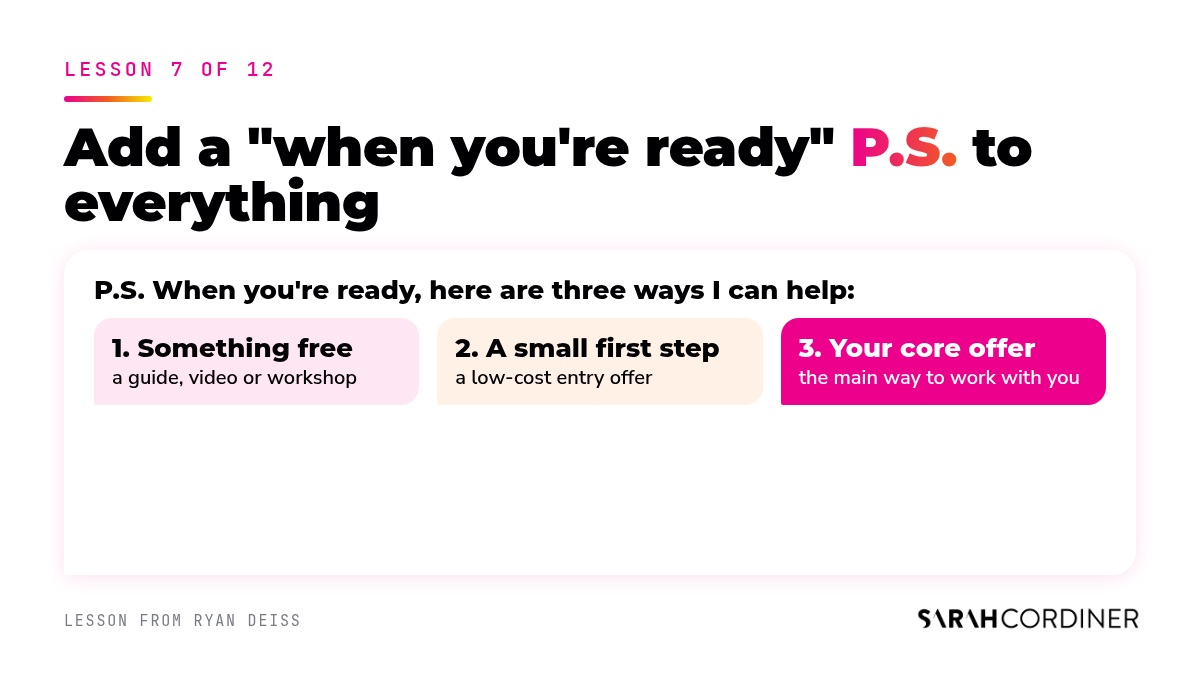
Every email you send should have a P.S. And his formula is simple:
“When you’re ready, here are three ways that we can work together.”
Ryan Deiss
- Something free, like a lead magnet, video or workshop.
- Something inexpensive, which he said we used to call a tripwire, or an entry-point offer.
- Your core offer.
He made a point that stung a little: many of the people on your list have absolutely no clue what you sell. They don’t know how to do business with you because you never tell them.
And it’s not just email. He does it at the bottom of relevant social posts, at the end of long posts on X, and in every YouTube description. He even said that if someone has watched his 1 hour 20 minute video, that’s like an entry-point purchase, because they’ve given him their time.
Here’s the freeing bit: the content above the P.S. doesn’t have to have anything to do with the offer below it. People don’t need to think “how do I implement this?” They just need to think “this person’s smart, I trust them”. When they’re ready, the options are right there.
What it means for you
You can stop trying to make every piece of content lead neatly into a sales pitch. Just be helpful, and make it obvious how to take the next step when they want to.
I’ve been doing this for years too
I’m a big fan of quiet, always-on selling. Even your email signature can be a passive lead generator, and my master email template promotes my main offers in every single email. Ryan’s three-step P.S. is a beautifully simple way to tie it all together. You’ll find one at the very bottom of this post, because of course I had to.
I’ve been teaching this for years
I’ve actually been teaching this for many years. I’m not even sure where I first came across it, but for me it was always about making sales easy and making buying easy. I’ve been email marketing for many years. I can’t remember exactly when I started, but it was back in the old-school Mailchimp days, probably around 2012. I had people replying to my emails asking how they could work with me, so I just started putting it in the footer of every single email I sent, and my sales increased dramatically.
It meant that every single email I sent made sales. Still to this day, email marketing is what makes me the most income, because I have that P.S. at the bottom. My analytics show that sales come from my emails every single time I send one, without fail, and they have done for many years.
The exact P.S. I use
Here’s the shape of mine: “P.S. [First name], are you still thinking about [the result you help people get]? Here are [number] ways I can help you do that.” Then simply list them: your program, a one-to-one session, a product, a done-for-you service, whatever you offer.
Save it in your master email template so it’s on every email. Then check which emails make money. In Tekmatix the email campaign analytics show what each email brought in, and Google Analytics and Google Search Console (both free) show where your traffic and leads come from. All my emails are helpful content, usually linking to a blog post, with that P.S. at the bottom. Two to three a week, scheduled, and sales come in on autopilot.
Prompt to copy into your AI (GrokBot, Claude or ChatGPT): Create my “when you’re ready” email footer
Please can you create an email footer that mentions all of the ways that people can work with me, and add it to my master email template so that every time I send an email, that footer is in place already. Here are my offers: [something free and its link], [a low-cost first step and its link] and [my core offer and its link]. Write it as a short “When you’re ready, here are three ways I can help you” P.S. in my voice.
I do this on Tekmatix. You save it as a master template, so every time an email is sent, whether you’re sending it manually yourself or your AI is sending your campaigns for you, your P.S. footer is already in place, and you make sales every single time, just like I do.
What to do
- Write your three: one free thing, one low-cost first step and your core offer, each with a link.
- Add the P.S. block to your master email template and your blog footer.
- Add a short version to your YouTube descriptions and the end of your long social posts.
8. Make people register again. It’s date night.
Ryan’s point
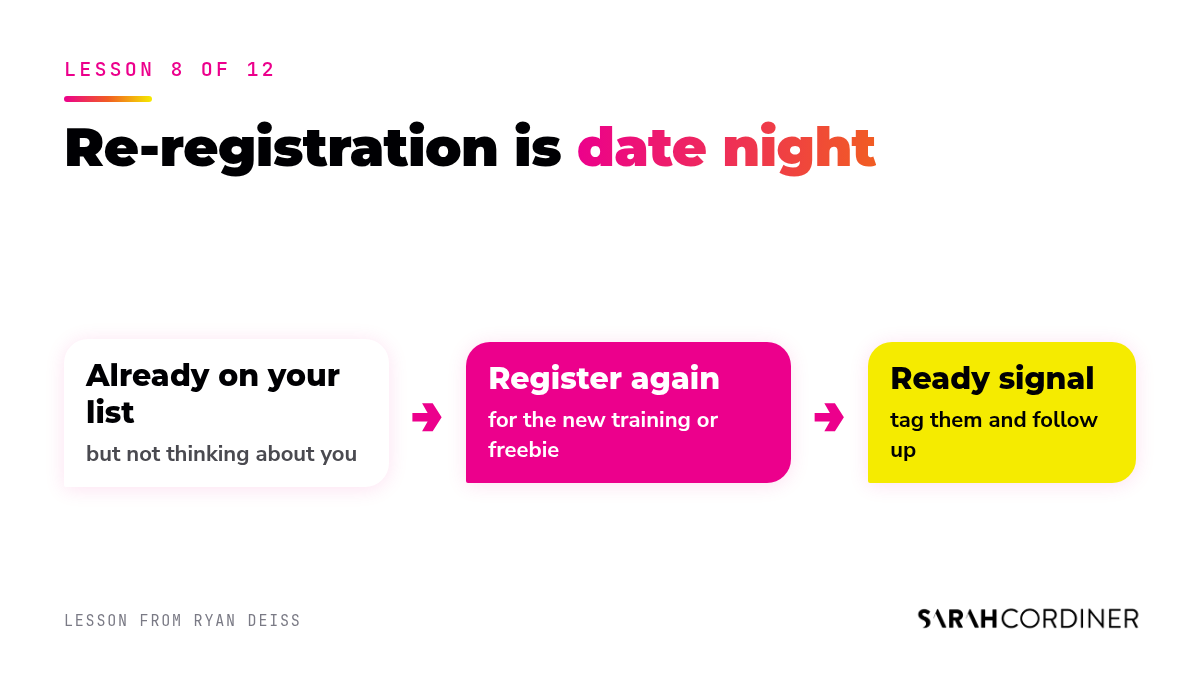
The second way to sell in private is re-registration. Ryan admitted it sounds weird: if people are already on your list, ask them to sign up again.
So if you create a new lead magnet, don’t just put it on a resources page and email everyone the download link. Have them opt in again. If you’re running a training, don’t automatically RSVP your list. Have them register.
When clients ask him why, he asks if they’re married. “Honey, why do you need me to take you out on a date? We’re already married.”
“Re-registration is date night.”
Ryan Deiss
Every time someone opts in again, you’re repeating the process that got them on your list in the first place. And if you think “but they already hear from me”? Ryan’s answer: they don’t think about you at all. Re-registering is one of the clearest signs of engagement, and one of the clearest signs that someone is ready.
What it means for you
Every new training, workshop or freebie is a chance to find out exactly who is interested right now. Don’t waste that by sending it to everyone automatically.
I’ve been doing this for years too
This is how I run my free workshops. Every one gets its own registration page, and everyone who registers is tagged with that workshop’s name. Every lead magnet has its own opt-in form and its own tag, too. So every registration tells me exactly who is interested in what, right now. It’s all in my free workshop guide.
Where I disagree with Ryan
Don’t put a form between your list and your content. Use trigger links instead.
The reasons for re-registration are good ones: it shows you who is engaged, and the opt-in can tag people by interest so you can run tightly targeted campaigns later. But for people already on my list, I believe a fresh opt-in form is an unnecessary barrier. It stops people getting the help, the results and the trust that lead them to buy. You created that content to be consumed, so why lock your own subscribers out of it?
Here’s what I do instead. I send a helpful email that’s useful on its own for people who just want the short version. Then I link to the full blog post, with all the steps and prompts, for people who want the detail. That link is a trigger link, so anyone who clicks it is tagged with that interest automatically. Same segmentation, no form.
And I win twice more. My website gets the traffic, which builds my retargeting audiences for ads. And because my YouTube video is embedded in the post, people spend longer on the page, which tells Google the page is worth recommending, while my YouTube watch time goes up at the same time.
In Tekmatix, I just ask the built-in AI to add a trigger link to every link in my email campaigns that goes outside the email, and it does it for me.
Prompt to copy into your AI (GrokBot, Claude or ChatGPT): Write my email that points to the full blog post
Here is my new blog post: [paste the post or its link]. Write me a short, helpful email for my list that gives one genuinely useful tip from the post in the email itself, then invites people to read the full post for all the prompts and steps. Use my voice, give it a “How to…” subject line, and keep it to one clear link to the post.
In Tekmatix, I make that link a trigger link, so everyone who clicks is tagged with the topic and I know exactly who to follow up.
What to do
- For your next training or freebie, send your list to a registration page instead of a download link or an automatic RSVP.
- Tag everyone who registers with the name of that training or freebie.
- Follow up the people who registered with a short, relevant offer.
- For people already on your list, try a helpful email that links to a full blog post, and make that link a trigger link that tags everyone who clicks.
9. Make email social again with short hand-raiser emails
Ryan’s point
The third way to sell in private is the hand-raiser: short, conversational emails designed to get a reply, not a click.
Ryan said email is the oldest social media channel on the internet. Remember when getting an email actually made you happy? “You’ve got mail!” Now it’s mostly “you’ve got spam”. So he’s started a campaign he calls make email social again.
His point: with AI reading and sorting more of our inboxes, the people who get opened will be the ones we open because of the from line, not the subject line. And the way to become one of those people is to send stuff people actually want, from a name they feel warmly about.
He shared three hand-raiser examples:
- “Hey, I’m looking for [number] [ideal clients] who want [result] in [time frame] without [the thing they don’t want]. Just reply to this email and I’ll send you the details.”
- “Hey, last time we talked you wanted [specific outcome]. Are you still working on that? Is it still a priority?”
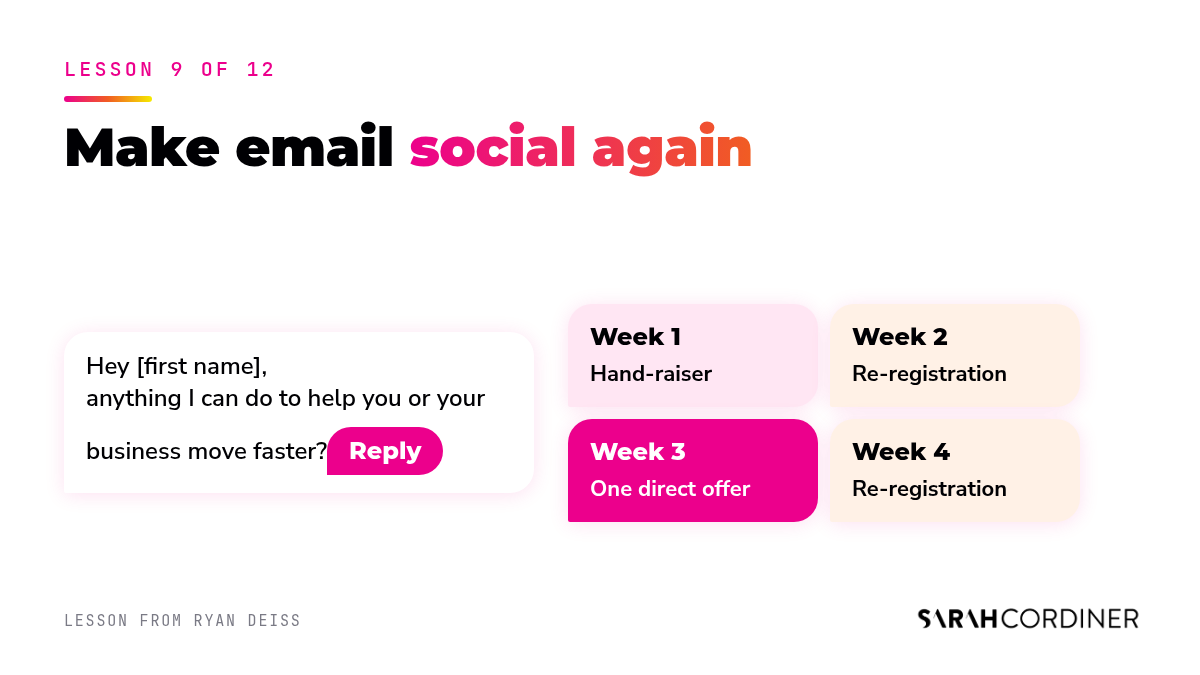
- “Hey [first name], anything I can do to help you or your company move faster?”
That last one, he said, came from his friend Neil Patel. Neil sent it to him out of the blue, and Ryan immediately pictured what “moving faster” would look like for him. Everyone wants to move faster, so it makes people imagine their own answer, and reply.
When clients worry about being flooded with replies, Ryan’s response is brilliant: “That’s adorable. You should be so lucky.” You won’t get that many. The ones who reply are ready. The ones who don’t won’t feel spammed, because it was so short. He added that life and business are really about improving the quality of your problems, and too many replies is a good problem.
He also shared the rough monthly rhythm his team runs (and mixes up depending on goals):
- Week 1: a hand-raiser email.
- Week 2: a re-registration.
- Week 3: one direct offer.
- Week 4: another re-registration.
What it means for you
Your emails don’t have to be newsletters. Some of your best-performing emails might be three lines long and sound like a message from a friend.
I’ve been doing this for years too
This is exactly where I’m heading. I’m going back to treating email like a social platform: conversational emails that start real conversations in your inbox, so you get to know me the way my social media audience does. When I warm up a quiet email list, I already use a stripped-back email with no banners, just my words, my sign-off and a tiny P.S. And yes, I still sign off “Sarah x”.
Why I loved this one
I really loved this one. Back in the old days of marketing, I used to email my list frequently, and I’d share a lot of my personal life, what I was doing and what I was working on. I still do to a degree, but nowhere near as much as I used to.
I reached a point where people told me they really looked forward to my emails. They got to know the characters I talked about in my emails every day. I had people email me months later asking what happened with a particular story or situation I’d been talking about, and so many more telling me they felt like they knew me and my life intimately. That created so much familiarity and trust that sales were so easy.
So this has definitely made me want to take my email marketing back to treating it a bit like my social media profile: sharing a bit more of the personal stuff, and tying that together with something helpful.
My take: talk it, don’t type it
Write your emails the way you speak. I start almost everything as a video, then turn what I said into the blog post and the email, so it sounds like me and not like the stiff version of me that comes out when I type. No scripts. The second you start reading a script, you turn into a zombie.
And stop worrying about unsubscribes. If someone doesn’t like me in an email, they won’t like working with me in real life. Look at your numbers instead. I ask my AI to review my last 50 emails, tell me which had the best open and click rates and why, and write more like them.
Prompt to copy into your AI (GrokBot, Claude or ChatGPT): Help me write a personal email that still helps
Here’s what’s happening in my life and business this week: [a few quick notes]. Turn one of these into a short, warm email to my list that tells the story in my voice, then links it to one helpful lesson for [your ideal customers]. End with a question that invites them to reply. Don’t invent any details I haven’t given you.
What to do
- Send one hand-raiser email this week. Use one of Ryan’s three, in your own words.
- Decide who will answer the replies, and how fast.
- Try Ryan’s four-week rhythm for one month and see what happens to your replies and sales.
10. Faceless brands are fading: become your company’s embedded influencer
Ryan’s point
Ryan’s third trend is the one he called “the meat”: embedded influencers. If you own a company, he said, it’s probably the most important line you can add to your job description.
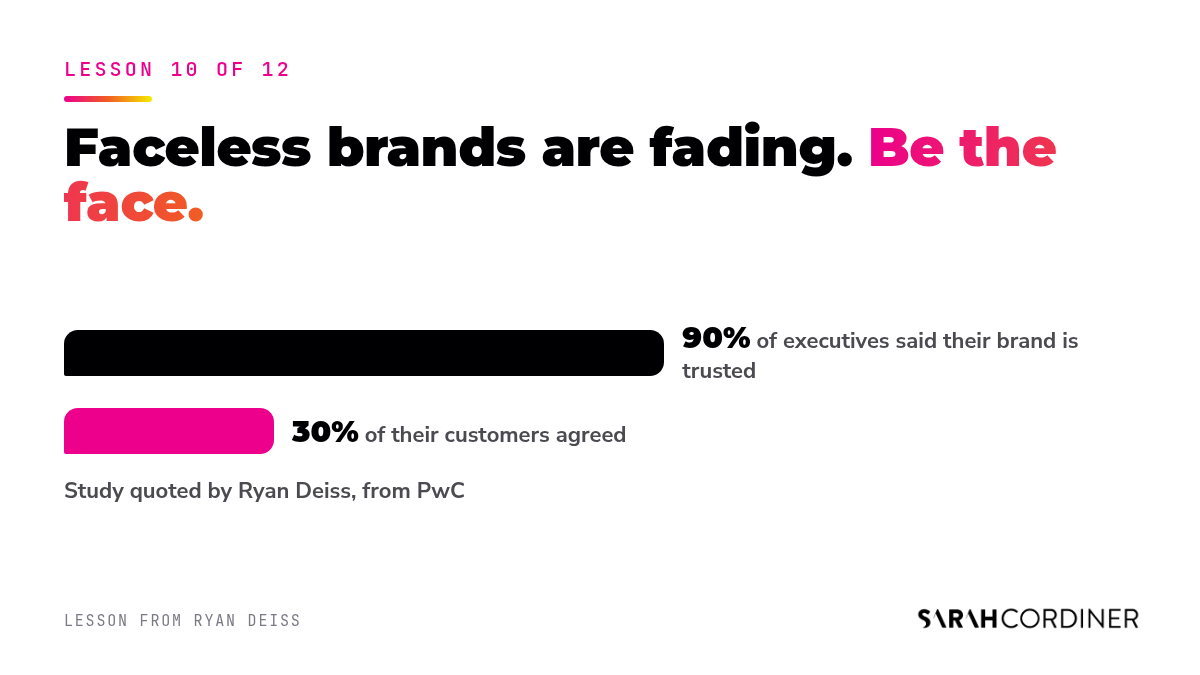
He believes faceless brands are dying, and that the ones still working will eventually be overtaken by brands with a trusted person at the front. He quoted a PwC study that asked executives at major brands whether their customers trust their brand. 90% said yes. When the same brands’ customers were asked, only 30% said they trusted them. A 60-point trust gap.
And no, you can’t fix that by borrowing a famous face. Ryan ran through some memorable celebrity endorsement deals and made the point that consumers can tell when someone is hawking a product they’re not really into. He even told the story of a brand that got an unpaid mention from one of the most famous celebrities in the world, rushed to build up stock, and saw no impact on sales at all. You can’t rent trust.
What does build trust? He quoted another study: 82% of consumers said they’re more likely to trust a company whose leaders are active on social media. Leaders, not celebrities.
An embedded influencer, in Ryan’s words, is a trusted internal voice, ideally the founder or CEO (though it can be a team member), who embodies the values of the brand. Not a paid endorser. He called Gary Vaynerchuk the original: Gary started out as the face of his family’s local wine shop. He spoke at LevelUp 2026 too, and I wrote up what Gary Vee warned every business owner about business after 2026.
And if you’re thinking “but my business is boring”, Ryan had examples for that too: a home inspector in Arizona who’s booked out for ages, a home cleaning company that grew a following filming dirty benchtops getting clean, a woman who hangs drywall, a man selling CNC machines, and one of his own clients whose company digs giant holes for fuel tanks and posts a walk-around video on LinkedIn about once a week. Boring to most people. Riveting to the people in that industry.
“If not you, then who?”
Ryan Deiss
He added that eventually you can go “from Iron Man to the Avengers”, with several embedded influencers in your team who share the same mission and point of view, so the business isn’t wholly dependent on you.
What it means for you
The most trusted marketing asset in your business might be you. Not a logo. Not a brand account. A real person people can get to know.
I’ve been doing this for years too
I’ve been the face of my own business for a long time, and I’ll be honest: it’s not always comfortable. I wrote about the people who tell me they’ll do anything to grow their business, walk on hot coals, jump out of a plane, but won’t post a 12-second video because they’d feel silly. Your ego doesn’t pay the bills. Your visibility does. Here’s why fear of looking silly is holding your business back.
What made the difference for me
Building a personal brand and being the face of my business has been the number one key to my success. It doesn’t happen overnight. It takes an excruciatingly long time and an enormous amount of commitment and dedication. It all comes down to consistency, and turning up online as your real self all of the time: getting that perfect combination of educational, how-to content and showing your real life and who you really are, so that when people meet you in real life, they feel like they’re meeting the exact same person they’ve got to know online.
If there’s an incongruence between who you are in real life and how you speak or show up online, work on that immediately. If I met you in a bar, in a cafe, in a hotel lobby or in an airport, would I meet the same person I see online? Would I even know who you were? Would I recognise you in the first place?
When I started Tekmatix back in 2022 and it became an “overnight success”, lots of people wanted to know how I did it. The answer was simply that I’d spent 16 years before that building a personal brand. I’d spent so many years helping people, giving them results and teaching them things that actually moved the needle, that when I said “I’ve built this thing and now I’m running my whole business on it”, people came flooding in. I didn’t do a big fancy launch. I didn’t run any massive campaign. I just carried on sharing what I was doing, and they simply came. That was all down to building a personal brand.
Why I buy from founders I can see
The high-ticket business programs I’ve joined myself, I joined because I’d watched the owner build their own results and share the journey openly online. I’d experienced their teaching and their personality before I ever handed over my credit card.
If you can’t stand up and say “this is who I am, this is why I built my business and this is what I can do for you”, how can you expect customers to trust you? Leading is lonely at first. Nobody crowns you the leader. You walk out alone, help people for a long time, and that’s when others start to follow. None of us started with followers. We just kept showing up.
Prompt to copy into your AI (GrokBot, Claude or ChatGPT): Check that the online me matches the real me
Here are my last 10 social posts: [paste them]. Describe the person who wrote them: their personality, values, tone and what they care about. Then ask me five questions to check whether that matches how I am in real life, and suggest three types of post that would show more of the real me alongside my how-to content.
What to do
- Decide who the face of your business is. If it’s not you, who?
- Commit to one piece of face-to-camera content a week for the next month.
- Make it about your work, your opinions and your customers, not just your products.
- Ask yourself: if someone met me in a bar, a cafe or an airport, would they meet the same person they see online?
11. Choose your character: a point of view, hooks and flaws
Ryan’s point
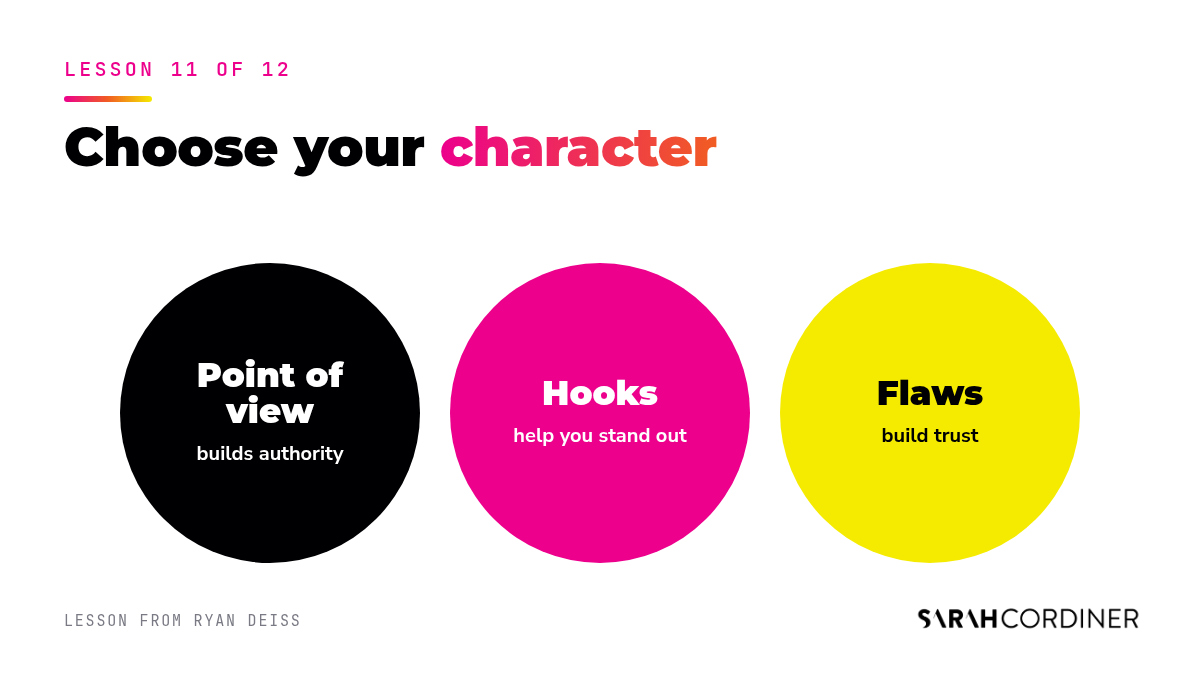
Ryan said choosing your character is the most important part of becoming an embedded influencer. He said remarkable characters have three things:
- A unique point of view. This creates authority and separates you from the noise.
- Brandable hooks. Visual and verbal signals that make you stand out and easy to recognise.
- Flaws and quirks. These are what make people trust you. As he put it, we don’t like people who are a little too perfect.
For point of view, he asked: what are your core contrarian beliefs? What hills are you prepared to die on? He shared some of his own, including “the more valuable you are to your business, the less valuable your business is”, “good people don’t fix broken systems, broken systems break good people”, “annual planning is dumb” and “most company mission and vision statements are entrepreneurial arts and crafts”.
His tactic: find the beliefs everyone in your industry repeats, and flip them. Not to say something you don’t believe, but because very often you’ll find you believe the flipped version more. And he gave us a prompt to do it with AI (my wording of it is below).
He said you’ll know it’s working when you get haters. If nobody disagrees with you, you’re not really saying anything interesting.
For hooks, he used Alex Hormozi’s famous handlebar moustache as an example, and pointed out that when Alex grew a beard, he kept a recognisable hook. Hooks can evolve.
For flaws, he was clear: don’t overshare. Start with your surface quirks and visible flaws, and keep your deepest shadows for the people you love most. His own quirk? Dad jokes. He said he used to play Forrest Gump as a character online, and now he’s Ted Lasso: a walking dad joke who also nearly ruined his marriage by being a workaholic, which he said is his story too.
He finished with a lovely story about a building where everyone complained the lifts were too slow. Nothing fixed it, until someone put in mirrors. Because we love looking at ourselves. We love characters who remind us of ourselves.
Prompt to copy into your AI (GrokBot, Claude or ChatGPT): Find my point of view
List the 12 most common beliefs and best practices in my industry, which is [your industry], for [your ideal customers]. For each belief, write the opposite: a respectful, contrarian inversion of it. Then help me choose the three inversions that I actually believe are more true than the original, by asking me one question about each. Use only my real experience and opinions, and don’t invent stories or results.
What it means for you
People don’t remember information. They remember people with opinions, signatures and a bit of honest mess. Decide what yours are, and repeat them.
I’ve been doing this for years too
A few of my hills to die on, which you’ll hear from me again and again: I’m a business and AI educator, not a coach, and this industry is completely confused about the difference (I wrote a whole guide on coach vs mentor vs educator about it). Free workshops should teach, not pitch. And my newest one: if you don’t spy on your staff, you’re running a daycare, not a business, and the toddlers are in charge. I’m open about my flaws too: brevity isn’t my thing, I once ended up vomiting into my office bin after the worst day of my business life, and I launched Tekmatix in my fluffy socks. Your stories are the one thing nobody else can copy, which is why your personal stories make your content memorable.
My take: stand for something, and choose carefully
This one is super important. If you’re going to stand for something, make sure you are willing to die on that hill. If you change your mind every five minutes on what your position or opinion is, you’ll create a brand that’s considered flaky, indecisive and unreliable. Yes, it’s completely okay to have your mind changed and to be honest about that. But if you’re constantly changing opinions and viewpoints from one day to the next, you create a feeling of insecurity in the people who look up to you and want to be held safely by you. When you’re a leader, you need very strong foundations, and you need to be very grounded in your position.
You also need to decide whether you’re someone who creates a following through controversy, contradiction and very strong opinions that create segmentation in audiences, or someone who wants to be able to serve and support people from all different kinds of beliefs and backgrounds. As soon as you start being contrarian, divisive and very opinionated, or take a takedown or cancel culture position on the thing you stand against, you create a wall between you and the people who might sit on the other side of that opinion or viewpoint. And there’s not very much chance of ever coming back from that, if you go there.
I personally like to help people from all walks of life. I’ve come from a colourful background myself, as a woman of Gypsy heritage, but I was also fortunate enough to get a scholarship into private education by passing an exam. I’m the first female in my family to ever get a formal education and go on to build a business. So I can’t ever stand on the side of dissing people who have low incomes, because I came from little to nothing myself. And I also don’t want to stand on the side of saying rich people suck and rich people are bad. That’s just one simple example.
You’ve got to make sure that what you do and what you say is congruent with who you are and how you want to be seen for the rest of time. Everything you say can, and absolutely will, make someone either feel attracted to you or completely and utterly repelled by you, to the point where they’d never work with you again because of one thing you said.
Prompt to copy into your AI (GrokBot, Claude or ChatGPT): Pressure-test my hill to die on
Here’s a position I want to be known for: [your belief]. Tell me how it might land with people from different backgrounds, beliefs and income levels. Flag anything that could come across as divisive or as a takedown of a group of people, and help me word it so I stand firmly for something without standing against the people I want to serve.
What to do
- Run the prompt above in your AI.
- Choose your three hills to die on.
- Post one of them this week, with a real story from your business behind it.
12. Pick one stage, master it, then bring people home to your list
Ryan’s point
Ryan’s next step is to choose your stage: the channel where you’ll show up. His advice was to start where your audience hangs out, not where you’d most like to be. “I’m most passionate about the channels that my customers are most passionate about.”
He said that if you run a local home services business, you should really be doubling down on Facebook. People hate on it because that’s “where the old people are”. His answer: “You know what old people have? Money.” He also said Facebook is becoming more locally minded.
Then the important bit: just pick one. He started on YouTube. His client with the giant holes only does LinkedIn. Master one, then go to two, then three.
“There are two models in content marketing: being everywhere all at once, and being missed when you’re gone.”
Ryan Deiss
Start with being missed when you’re gone, he said. Work on being everywhere later.
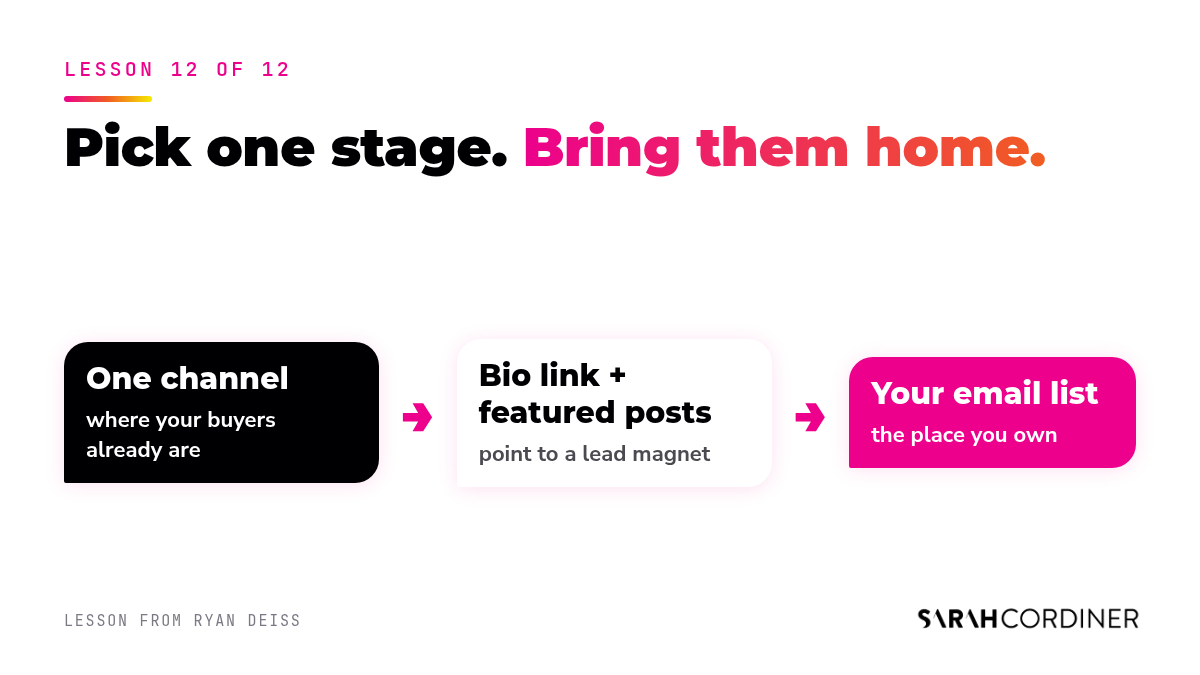
Finally, integrate the business, which he called deplatforming: getting people off social channels and onto your email list. At a minimum, put links in your bio. Don’t make your featured or pinned posts just posts; make them point to lead magnets. And add calls to action where they’re relevant.
“You don’t need a million followers. You need to be a voice that people trust, and that voice should be inside your company.”
Ryan Deiss
What it means for you
Spreading yourself thin across every platform is a fast way to be forgettable everywhere. Go deep in one place, and make sure that place leads to something you own.
I’ve been doing this for years too
For me, real rooms have always been one of my best stages. I once walked out of a single conference with 302 business cards, and it was the follow-up, not the cards, that turned them into real work. These days I’m putting more of my energy into long-form video, and every social post I write keeps the link out of the caption and in the first comment. And I keep one hub, sarahcordiner.com/links, so people can find my free resources and programs in one place. If you need a lead magnet to point your featured posts to, here’s how to turn a webinar or video into a lead magnet in minutes.
Where I disagree with Ryan
Don’t pick one platform. Publish everywhere, then let your data choose.
This is the third place I see it differently. When you’re starting out, you don’t know which channel or medium will work for you, and humans are everywhere. People say corporate executives are only on LinkedIn. They’re scrolling Facebook on their lunch break too.
So I create one piece of content in whatever form I feel like that day, then publish it everywhere. With a social planner like the one in Tekmatix, that takes no extra work. It matters, because you can’t predict what will take off. One of my videos had 79 views on Instagram and 3.2 million on Facebook. If I’d only posted it on Instagram, I’d have decided that content didn’t work.
And republish. I once put out something I’d worked really hard on, on a Friday, and it went nowhere. I posted the exact same video again the following Tuesday and it got thousands of views. People only see a tiny fraction of what’s posted, so volume matters. Publish everywhere, republish, and within a few months you’ll have real data on what works, and which channel you actually enjoy.
How I’ve done this
When I started many years ago, writing was my favourite medium. I love to write, and I still do to this day. So it was easy for me to create a free blog account, and I simply started blogging and sharing all of my content through blogs. Then, as I got some income coming in, I could afford to buy myself a camera and some simple, cheap lighting from Amazon, and I started filming videos. The videos sucked. I wasn’t a professional presenter, and it took an enormous amount of presenting over the years to get better on camera.
But combining the two together, which I do now with blog posts that have my videos embedded in them, made a real difference. People spent more time on my blog posts when the YouTube video was embedded. Not only did that increase my watch time on YouTube, it also increased the time people spent on my pages from Google, which improved the ranking of both at the same time.
For most of my life, my method was to write it all down first to get it out of my head, then film the video based on everything I’d written. Now that I’ve honed my camera skills, I tend to do it the opposite way round. I just turn the camera on and start talking, then I give the video to my AI and get it to turn everything that literally came out of my own mouth into a blog post, made entirely from my own words.
Prompt to copy into your AI (GrokBot, Claude or ChatGPT): Turn my video into a blog post in my own words
Here are the words from my video on [topic]: [paste them]. Turn them into a blog post using only what I said, in my own voice. Give it a “How to…” title, a short quick-answer summary at the top, clear subheadings, any steps or prompts I mentioned laid out so people can copy them, and a few FAQs at the end. Leave a spot at the top to embed the YouTube video, and don’t add any claims or stories I didn’t say.
I run my websites and blogs on Tekmatix. You get unlimited blogs and unlimited domains, and you can connect your own AI, or just use the built-in AI, to write your blog posts, publish them or schedule them for you. Then the Tekmatix Social Planner schedules all of your social media content to share them.
What to do
- Ryan’s version: choose your one stage for the next 90 days. My version: publish each piece everywhere for 90 days, then double down where your data says it’s working.
- Update your bio link and your pinned or featured posts so they point to a lead magnet.
- Add a short call to action to your most relevant posts.
- Embed your YouTube video in a blog post on the same topic, so both get more watch time and page time.
The big idea: AI makes content endless, so your humanity is the scarce thing
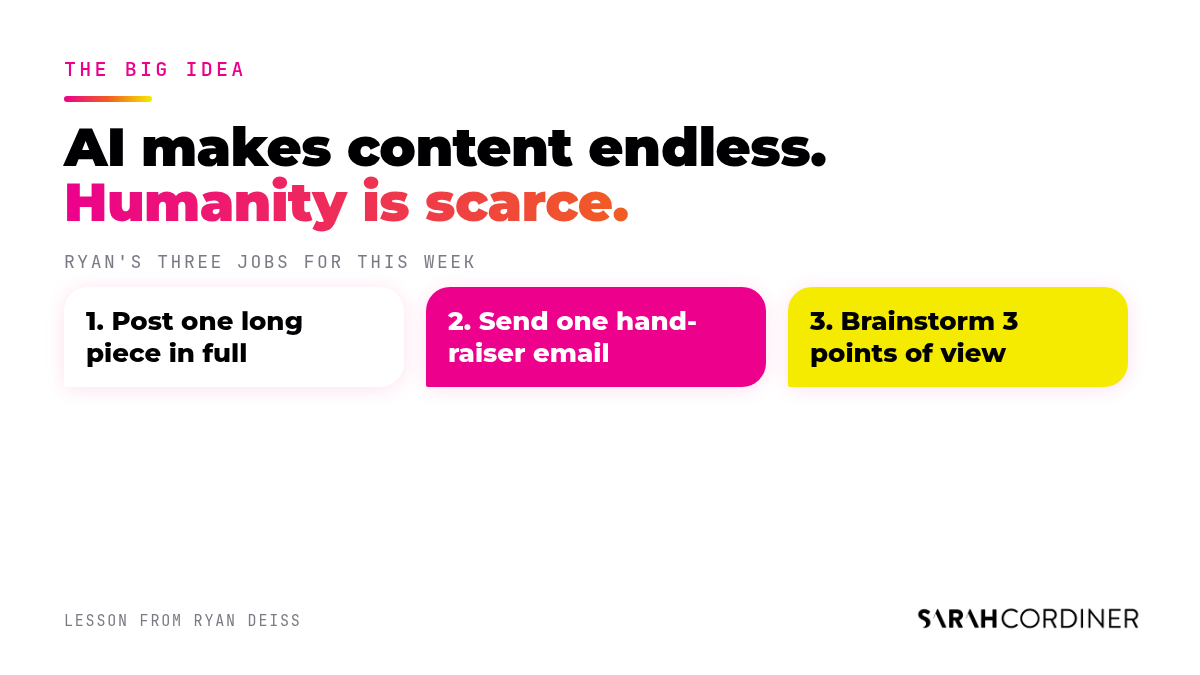
Ryan wrapped up by tying all three trends together. He said AI is flooding the world with infinite great content. The scarce resource is going to be humanity: your humanity, and your brand’s humanity. Content binging, selling in private and embedded influencers are all ways to sell that.
He said that if you focus on these for the rest of this year and into next year, you’ll win, while your competitors are still chasing tactics that, even if they work, will be gone tomorrow.
And he gave us three things to do this week:
- Cross-post one long-form piece somewhere it “isn’t supposed to go”.
- Send one hand-raiser message.
- Brainstorm your three unique points of view, and start putting them out into the world.
I’ve been doing this for years too
This is the same thing I keep saying about AI. It isn’t slop when it works from your own material: your own videos, your teaching, your stories and your lived experience. Use AI to multiply you, not replace you. The more AI writes, the more your real voice, your real opinions and your real stories are worth.
Your 7-day action plan
| Day | Do this | From lesson |
|---|---|---|
| 1 | Write your three-option “when you’re ready” P.S. and add it to your email template | 7 |
| 2 | Post one long-form piece in full on a short-form channel | 3 |
| 3 | Send one short hand-raiser email and answer every reply | 9 |
| 4 | Run the point-of-view prompt and pick your three hills to die on | 11 |
| 5 | Choose your wingman video and plan five supporting videos | 5 |
| 6 | List your automated sequences and flag anything longer than five days | 2 |
| 7 | Pick your one stage for 90 days and point your bio link to a lead magnet | 12 |
Build your brand and business
Want help putting all 12 into action?
Join the Legends Lab by Sarah Cordiner. It’s my business education program and community for experts who teach, train, advise and create. Inside, I show you how to build trust with long-form content, run workshops that teach, write emails people actually reply to, and use AI that works from your own material, while you stay the trusted face of your business.
Join the Legends LabFAQs
What are the biggest marketing trends for 2026, according to Ryan Deiss?
Ryan Deiss named three trends for the next 12 months: content binging (getting people to consume a lot of your content quickly, to build trust faster), selling in private (using segmentation, re-registration and hand-raiser emails so only interested people get sales messages), and embedded influencers (the founder or a trusted team member becomes the visible face of the business).
What is a trust recession?
It’s Ryan Deiss’s term for the current low-trust environment, where people are much more careful about who they buy from. His rule is that people won’t give you their money until they’ve first given you some of their time, so marketing has to focus on building trust, not just traffic or list size.
Do long email drip sequences still work?
Ryan Deiss says long 30, 50 or 100 day drip sequences don’t work anymore and should be ripped out, because speed matters now. He said his own automated sequences mostly run for three to five days. Onboarding emails that help customers use what they bought do a different job, so review those separately.
What is a hand-raiser email?
A short, conversational email designed to get a reply rather than a click, for example: “Hey [first name], anything I can do to help you or your business move faster?” The people who reply are telling you they’re ready, and the people who don’t aren’t put off because the email was so short.
What should go in the P.S. of a marketing email?
Ryan Deiss recommends a “when you’re ready” P.S. in every email, with three options: something free, a low-cost entry-point offer and your core offer. He calls it passive segmentation, because people who are ready to buy can take the next step without every email needing to pitch.
What is an embedded influencer?
A trusted internal voice, ideally the founder or CEO, who becomes the visible face of a business and embodies its values, rather than a paid celebrity endorser. Ryan Deiss quoted a study saying 82% of consumers are more likely to trust a company whose leaders are active on social media.
Should you mention your offer in educational content?
Sarah Cordiner’s view is yes, briefly. Teach in the content, then mention your offer in one sentence at the end, such as “And I cover more of this in my Legends Lab”, with the link in the post or the first comment. If people can’t find your offer easily, they can’t buy from you easily.
Should you make people already on your email list opt in again?
Ryan Deiss recommends re-registration as a clear sign that someone is ready. Sarah Cordiner disagrees: she puts no email walls in front of people already on her list. She sends a helpful email that links to the full blog post, and makes that link a trigger link that tags everyone who clicks, so she can run segmented campaigns later without asking them to opt in again.
Where does Sarah Cordiner disagree with Ryan Deiss?
On three points. She believes you should always briefly tell people how to buy from you at the end of your content (lesson 6), that people already on your list shouldn’t be asked to opt in again when a trigger link can segment them (lesson 8), and that you should publish each piece of content everywhere and let the data show which channel works, rather than mastering one platform first (lesson 12).
Who is Sarah Cordiner?
Sarah Cordiner is a business and AI educator with more than 20 years in business, and the founder of the Legends Lab business education program and of Tekmatix. She teaches business owners how to turn their expertise into courses, content and AI-powered systems.
One last thing
If you take one thing from Ryan’s talk, make it this: people buy from people they trust, and trust is built with time. Give people more of you, more generously, and make it easy for the ready ones to put their hand up.
I’ve been creating content this way for well over a decade, and I’m more convinced than ever that it works.
Sarah x
P.S. When you’re ready, here are three ways I can help you:
- Something free: all my free videos, posts and resources live at sarahcordiner.com/links.
- A first step: if your expertise could become a course, join me for my live Concept to Course with AI workshop.
- The full program: come and join us inside the Legends Lab, where the workshop comes included.
How Sarah Cordiner Can Help You Scale Your Business with Tech, AI, and Automation
Tech doesn't have to be hard or scary. I help you make it easy to learn, fun to implement, and even better to see the amazing results that you can get with some simple tech tools and strategy.
Here are all of the different ways that I can help you scale your business, streamline your operations, and make your bottom line full of joy using tech, AI, and automation (as well as traditional methods) as your secret weapon.
One platform. Your whole business. Finally talking to each other.
"What tech do you use, Sarah?" I get asked this every single week. The honest answer? Almost all of it lives in one place: Tekmatix. It's the all-in-one AI business platform I founded, and it runs my websites, funnels, courses, emails, bookings, payments and AI agents. Here's everything it does, who it's for, and the handful of other tools I love.
No lock-in contracts / Cancel anytime / Australian owned and female owned
I run my business on it.
- 5.0 on Google from 100+ reviews
- 98% recommended on Facebook
- 1,000+ businesses in 30+ countries
- Award-winning 24/7 support
- 3 free live training calls every weekday
- Replace $500 to $1,000+ a month in subscriptions
Eight logins. Eight bills. Zero of them talking.
Most business owners I meet are paying for a website here, an email tool there, a booking app, a course platform, a CRM they never open... and then paying someone to glue it all together with duct tape and Zapier.
- 1Leads fall through the cracks because your forms, inbox and CRM live in different places.
- 2Every new tool means another login, another bill and another thing to learn.
- 3You can't see what's actually working because your data is scattered across ten dashboards.
Everything your business runs on, under one roof.
Tekmatix is an all-in-one CRM, marketing, sales, course and AI platform. Here's what's inside, grouped by the job it does for you. Tap a category to filter, or scroll the lot.
AI that does the work
Hand the repetitive stuff to AI that already knows your contacts, calendar and offers.
- AI Employees that answer chats, DMs and enquiries 24/7
- Voice AI receptionist that answers your phone and books calls
- AI booking bot on your website chat widget
- AI Studio to build apps and tools by describing them (vibe coding)
- Ask AI assistant built into your account
- AI website and funnel builder plus content and image AI
- Connects to Claude and ChatGPT via MCP, so your AI can work inside Tekmatix
Get found and grow your list
Everything you need to get seen, capture leads and build your audience.
- Unlimited websites with free hosting and your own domains
- Unlimited funnels, landing pages, sales pages and opt-ins
- 100+ ready-made templates for sites and funnels
- Blogging with unlimited posts
- Social media planner with auto-posting
- Forms and quizzes, unlimited
- Surveys with conditional logicPro
- Reviews and reputation management, incl. Google Business Profile
- Link-in-bio pages and QR codes
Nurture and convert
Turn strangers into clients with automated follow-up that never forgets.
- CRM with unlimited contacts and full client records
- Unified inbox for email, SMS, Facebook and Instagram DMs
- Email marketing with automated newsletters
- SMS and phone, incl. missed-call text back
- Unlimited workflows and automations
- Sales pipelines so you see every deal
- Booking calendars for individuals, teams and groups, with 2-way sync
- Advanced reporting on ads, calls, courses and lead sourcesPro
Sell and get paid
Take money online, in person and on autopilot. Payments go straight to your Stripe or PayPal.
- Checkouts with upsells and order bumps
- Invoicing: one-off, recurring and payment plans
- Tap to pay on your phone (EFTPOS)
- Request payments by SMS
- Products and e-commerce, digital and physical, plus coupons
- Proposals, quotes and contracts with e-signaturesPro
- Affiliate program with unlimited affiliatesPro
- Event management with QR code ticketingPro
Courses, memberships and community
Built especially for course creators, educators and coaches. (It's where I teach my own students.)
- Unlimited courses and memberships
- Unlimited students and video hosting
- Assessments and quizzes inside your courses
- Student mobile app in your branding
- Communities and groups, unlimitedPro
- Course certificatesPro
Run the business
The behind-the-scenes admin, organised and in one place for your whole team.
- Project management and Kanban boards
- Task manager with deadlines and tracking
- Unlimited staff users with permission controls
- Admin mobile app for Apple and Android
- Business card scanner
- Integrations with Zapier, Make, WordPress, Google and more
- Up to 5 sub-accounts for your other businessesMax
Want to see it with your own eyes?
Start a 7-day free trial and a Tekspert will jump on a free set-up call with you.
If you sell your expertise or your services, it's built for you.
Solo operators, growing teams and multi-business owners all run on Tekmatix. Here's where it shines brightest.
Coaches, course creators and educators
Your website, sales pages, checkout, courses, membership, community and email, all connected. Tekmatix was made especially for you.
Consultants, speakers and experts
Bookings, proposals, contracts, invoices and follow-up that makes you look like a big firm, even if it's just you.
Health, allied health and NDIS providers
Online bookings, reminders, reviews and client records for clinics, therapists and practitioners.
Tradies and local service businesses
Missed-call text back, quotes, tap to pay and review requests, so you win the job while you're still on the tools.
Studios, salons and personal trainers
Class bookings, memberships, payments and reminders that cut the no-shows and the admin.
Agencies, associations and multi-business owners
Pipelines, staff permissions, reporting and (on Max) up to 5 sub-accounts to run several brands from one login.
Honest moment: if you only need one simple tool and you're genuinely happy juggling logins, you probably don't need Tekmatix yet. But the minute you're copying leads from one app to another, or paying for five subscriptions that don't talk to each other, it's time.
Most software gives you a login. We give you a team.
I'm an educator first, so Tekmatix was built education-first. Every plan comes with real humans, real training and real templates to get you up and running fast.
Free one-on-one set-up call
A Tekspert jumps on a call with you to set up your account and connect your integrations.
Award-winning live chat
Stuck at 11pm? Real support, any time of day or night.
3 free live training calls
Drop in, share your screen and get your questions answered live.
Starter kit and training library
Ready-made templates and automations, a step-by-step help centre, video tutorials and a free Tekmatix training course.
Rather someone just did it for you?
Teksperts are available by the hour, plus fixed-price done-for-you set-up and migration from your old platforms.
Simple pricing that doesn't punish growth.
Unlimited contacts on Starter and Pro, so your bill doesn't jump every time your list grows. Pay in AUD or USD, monthly or yearly (pay yearly and get a month free).
Everything you need to market, sell and deliver, in one place.
- Unlimited contacts, staff users and courses
- Websites, funnels, CRM, email and bookings
- Payments, invoicing and tap to pay
- AI Agents, AI booking bot, AI Studio and Ask AI
- 24/7 live chat and a free set-up call
Everything in Starter, plus the tools to build a community and scale.
- Communities, groups and course certificates
- Event management with QR ticketing
- Your own affiliate program
- Proposals, contracts and e-signatures
- Unlimited surveys and advanced reporting
Everything in Pro, plus more AI, more accounts and a strategist in your corner.
- Up to 5 sub-accounts
- AI Employee Growth plan included: 1,000 AI conversation replies and 100 voice AI minutes a month
- Monthly 60-minute strategy call with a senior Tekspert
- Early access to Tekmatix Labs
Just starting out? The Launch plan is $75 AUD ($50 USD) a month for up to 1,000 contacts. No lock-in contracts.
Explore the Launch planEmails, SMS, phone calls and AI usage are pay-as-you-go and billed in USD, so you only pay for what you use. See the full rates at tekmatix.com/rebilling. Prices current as at September 2026. Always check tekmatix.com/pricing for the latest.

I didn't set out to start a software company. I started the toolbox I needed.
After 20+ years in business and more than 280,000 students, I kept seeing the same thing. Brilliant people with brilliant expertise, drowning in tech. Paying for ten tools, using two of them, and spending their evenings on YouTube trying to make them talk to each other.
So I put everything a business needs into one platform, then wrapped it in the thing I know best: education and support. Tekmatix runs my own websites, courses, funnels, emails and AI agents every single day. I wouldn't recommend it if I didn't use it.
Sarah x
Want me to teach you how to get the most out of it?
Inside the Legends Lab I show you step by step how to use tech, AI and automation to grow your business, with live calls, workshops and templates you can copy.
Non-techie people love their tech again.
Tech is hard for non-techie people, and they really get that and make it fun.
Yesterday I felt overwhelmed. Now I feel excited and empowered.
I have used a number of top CRM systems. This is up there with the very best.
Solved problems I have had for weeks, in 50 minutes. Wonderful.
The other tools I use and actually recommend.
Tekmatix is the engine. These are the extras that plug in around it for AI, video, design, content and admin. Tap a category to filter.
Some of these are affiliate links, which means I may earn a small commission at no extra cost to you. Thanks for supporting the brand!
Wondering where the email, booking, course, funnel and CRM tools are? I don't need them any more. Tekmatix does all of that, so I'd rather you didn't pay for them twice.
See what Tekmatix covers ↑Tech stack FAQs.
Still wondering if Tekmatix is right for you? Here are the straight answers.
What is Tekmatix?
Tekmatix is an all-in-one AI business platform. It brings your website, funnels, CRM, email marketing, bookings, payments, courses, memberships, communities, social media scheduling and AI agents together in one connected account, so everything talks to each other.
Do I need to be techy to use it?
No. Tekmatix was built for non-techie business owners. You get a free set-up call, 24/7 live chat, three free live training calls every weekday, a help centre, video tutorials and ready-made templates to get started.
Is there a free trial?
Yes. The Starter and Pro plans come with a 7-day free trial. The Max plan starts with a demo, so the team can make sure it's the right fit.
Can I pay in Australian dollars?
Yes. You can pay your subscription in AUD or USD. Usage charges for emails, SMS, calls and AI are pay-as-you-go and always billed in USD. See tekmatix.com/rebilling for rates.
Will my price go up as my list grows?
No. Starter and Pro include unlimited contacts, so your plan price doesn't increase as your business grows. You also get unlimited courses, students and staff users.
Can you move me off my current platforms?
Yes. Tekmatix Teksperts offer fixed-price migration and done-for-you set-up services, or can help you integrate the tools you want to keep. See tekmatix.com/services.
Can I run courses, memberships and communities in it?
Yes. Tekmatix was made especially for course creators, educators and coaches. Courses and memberships are included on every plan, and communities and certificates come with Pro and Max.
Which plan should I choose?
Starter suits most service businesses and solo experts. Pro is best if you run courses with a community, events, contracts or an affiliate program. Max is for people running more than one business or who want more AI and a monthly strategy call. Not sure? See all the Tekmatix features.
Stop juggling your tech. Start loving it.
One login. One bill. One platform that runs your marketing, sales, courses and AI, with a real team behind you. Try it free for 7 days and see how much simpler business gets.
7-day free trial on Starter and Pro / Free set-up call / Cancel anytime
See you inside. Sarah x