[REPORT]: The Future of Education and Training – Beyond 2020
![[REPORT]](https://sarahcordiner.com/wp-content/uploads/2020/02/REPORT-1.jpg "[REPORT]")
What Is The Future of Adult Education & Training From 2020?
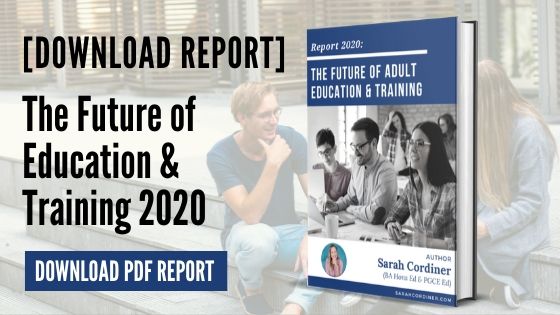
Author: Sarah Cordiner
It is impossible for us to accurately predict the future of the post-compulsory education & training sector with any certainty.
However, we can be certain that it will be different.
The current landscape and trends over the past 5-10 years can give us plenty of signals as to what training and education providers in the post-compulsory sector may be facing in the near future.
We can be reactive to the constant changes in our sector as education and training providers, or plan ahead as best we can for strategic and sustainable growth for a strong and fit-for-purpose future of education and training.
Having recently completed a tenure as the ‘Executive Director and Head of Campus’ of an Australian University, and with over 13 years of experience as a leader in the post-compulsory/adult education sector; in this article I will share my thoughts on what we might expect for our sector in this new decade.
What is Post-Compulsory Education?
This report was originally titled “The Future of Post-Compulsory Education and Training”, however I am aware that this term is not one that is widely used in the sector and as such I used the term ‘adult education and training’ for the purposes of accessibility & searchability.
The term post-compulsory education varies in definition from country to country, however, it is commonly agreed that:
“it is a generic term for the educational sectors covering students aged 16 years and upwards”.
This can include but is not limited to:
- Further education: Education below degree level, but engaged in by students above school age/level
- Higher education: (universities or other providers/institutions providing undergraduate degrees and above),
- Vocational Education and Training [VET]: These are programs classified as Certificate I to Advanced Diploma level; mostly involving TAFEs (technical and further education) and RTOs (registered training organisations)
- Adult and community learning: This includes short courses, licenced programs, non-accredited courses etc)
- Work-based learning: Such as on the job training and assessment, work experience, job-specific training etc)
A Call for Change
Our society is changing at a rapid rate, as is the nature of students, their needs, expectations and the careers, lifestyles and interests that motivate them to learn.
The future of post-compulsory education and training providers will need to adapt in order to survive.
Any organisation that does not adapt, iterate and evolve with the ever-transient nature of our modern day world, will categorically be left behind and ultimately not survive.
Change is non-negotiable for the modern day education provider if we wish to survive as providers to the next generation of learners.
Change Builds on Success
Often change is forced upon us because existing systems and practices are ‘bad’.
A good example of this is when the Australian VET (vocational education and training) sector was reformed by the regulator ASQA in 2015 in an attempt to eliminate ‘shonky’ practice.
However, as much as nothing can ever be perfect, change usually happens simply as a result of the world forever changing around us – it’s natural evolution; and there’s plenty of that happening in the post-compulsory education sector.
- The post compulsory education sector continues to grow with record numbers of enrolments and sector revenue generation.
- The international student export revenue generated in Australia alone is currently worth $33.9 billion and has grown by 13% in the past 2 years.
- The diversity of students is increasing in terms of their broader socio-economic backgrounds, age, gender, ethnicity and culture.
- Rural, regional and remote communities that have the benefit of colleges and universities in their regions are acting as anchor institutions for regional development advancement, where stagnation may otherwise be seen. These regional education hubs are providing opportunities and access to education and training that wouldn’t otherwise exist for thousands of people, as well as facilitating economic regeneration through edu-tourism.
- Student satisfaction remains high at around 85% satisfaction rates across all higher education institutions across Australia – even those in rural, regional and remote [RRR] Australia (beating the myth that RRR provisions are lower quality). In fact our RRR education providers not only perform more with considerably less resources than metropolitan providers, but universities such as The University of Notre Dame Broome (one of the remote university campuses in the world) is rated the number 1 university in Australia in student ratings.
These developing trends alone are seeing increasing opportunity for innovation and change in our post-compulsory education sector.
So, what might the future of education look like?
Increase in Student Demand & Enrolment Numbers
The sector has grown in recent years and is showing no signs of stopping in the immediate future.
We can be confident that demand and enrolment numbers will continue to rise, in an already dubbed ‘recession-proof’ industry.
Despite the fact that the steepest rise in demand and enrolments is in online-based programs, there is much truth to be found in the timeless preference and effectiveness of face to face delivery for many people and subjects.
Online learning enrolment numbers are likely to surpass the number of face to face program enrolments as this becomes an ever-preferential way of learning for the future learner. However, because the overall number of post-compulsory learners is going up, online learning is unlikely to take away from face to face training enrolments.
New ways of learning and teaching will continue to present themselves as technology embeds itself further into our classrooms, but face- to-face education and training will never be entirely replaced.
The trick for the future will be for training and education providers to become masters a multi-functional, multi-platform training.
This will mean having specialist staff who are adept at transforming and contextualising learning programs for face to face, online (self-study), online (facilitated), virtual reality and artificial intelligence.
Those that don’t have every option available, will be missing a portion of the market – unless they can dominate in one niche mode of delivery.
Flexible Entry Requirements
Another continuing trend is that more flexible entry requirements will be expected by our future learners.
Of course, this will come with much debate as entry requirements and/or program prerequisites are there for a reason:
- to ensure that students are set up for success
- to ensure they have been assessed as having the appropriate level of existing skills and experience to meet the demands of the program they are enrolling in
- to ensure that the program is both right for the student and the organisation is able to provide the support or reasonable adjustments to accommodate any special needs
- To ensure the calibre of the program remains competitive and therefore credible
However, with so many post-compulsory enrolments coming from such an increasingly broad spectrum of socio-economic backgrounds and life stages, students are increasingly expecting to be offered ‘bridging programs’ or additional learning support services to enable them to get in and get through.
Without these options, future learners are likely to take their business to learning providers who are offering the most flexible and lenient entry restrictions.
A Focus on Individual Learning Experience
Open Access For A Modern Day Consumer
In addition to having access to the choice of face to face, blended or wholly online programs, our future learners will continue to want a more personalised, convenient and responsive service.
Students are increasingly expecting to receive a memorable and ‘brag-worthy’ experience when they buy a learning program and not just the certification at the end.
They are expecting educational organisations to behave more and more like ‘customer-centred’ businesses with customer service at the forefront. And yes, the future student see’s the institution as the ‘service provider’ and themselves as the VIP customer.
Going are the days where the educational institution ‘has the power’.
The traditional authoritarian proponent of ‘the institution has the power and control, and the student is the subordinate child’ will not survive into the modern-day world of educational consumerism.
The modern-day learner will publicly call-out what they consider to be ‘poor service’, exercise consumer rights and take their business elsewhere if they are dissatisfied.
To Be Entertained
Our modern-day and future students want to be engaged, entertained, personally and professionally pampered with convenience; and provided with personalised experiences that make them feel like they made a valuable investment.
Instead of just learning about hazards on an underground mine site, for example, mining trainees will expect to enter the virtual mine via VR (virtual reality) technology and train to work safely on it via an experience – rather than a multiple-choice questionnaire.
In a National Commission Audit, Bond University stated that students of the future will demand “a learning environment where the personal attributes, aptitudes, and goals of each individual are cultivated.”
Blurred Lines Of Teacher And Tech
As mentioned earlier, the demand for online will increase but not replace face to face learning demand altogether.
It is expected that the line between the two will continue to blur; where live, real-time teaching will be expected to be delivered via the platform of technology and thus the sector seeing a demand for more live-streaming and remote-access class attendance.
With today’s technology, there is no reason why I shouldn’t be able to virtually attend a live class in metropolitan Sydney, from my remote Australian town in the North-West of Australia via a video link.
The current and future learner will expect to have this live access to the traditional classroom from anywhere in the world; and what’s good for the provider, is that this opens up a bigger market.
Multi-Disciplinary and Tailored Courses
A multi-disciplinary approach is being increasingly expected by today’s students.
This is where units of competency or other courses, sectors or specialisations are merged together to create more personalised and tailored learning experience for the ever-changing career niches of our world today.
This could mean that in the future, an educational organisation may have students completing hundreds of different versions of the same course – simply because they have been compliantly enabled to design their own experience by selecting from a much more diverse choice of electives that specifically suit their own unique interests a career aspirations.
Think ‘pick and mix’ of units and modules to ‘build their own’ tailored course.
This is becoming increasingly popular in non-accredited training and a similar demand is highly likely to spill into the accredited sector by both student and employers alike.
More Person-Centered
Despite a large school-of-thought that technology will obliterate the personal experience of education, current trends are showing us that with more use of technological automation in the classroom, including delivery, assessment and progress monitoring; the future educator will be able to go back to a more student-centered (rather than admin-centered) modus operandi.
As our technology and automation take care of the time-consuming tasks of attendance management, progress monitoring, assessing/marking, delivery of content and even group discussions; the educator will have more time to focus on the humanistic, personal side of individualistic teaching.
The person-centered (or humanistic) side of education encourages development of essential traits and qualities such as empathy, self-esteem, self-efficacy, confidence, social competence, self-evaluation and emotional intelligence.
These can only come from an educator who knows that student emotional development is as important as cognitive and intellectual development and that being supportive, understanding and an authentic human being is more important to the learning process than being critical, judgemental and ‘just a teacher’ (role-focussed).
Immediate Feedback, 24 Hour Service & Tech Supported Services
Automation and artificial intelligence systems informed by more thorough marking rubrics will create a far more systematic and immediate experience of grading and assessment for both the educator and the learner.
Technology is increasingly able to conduct thorough plagiarism checking, benchmarking against assessment rubrics, cohort averaging and providing feedback.
As such, feedback will be expected faster by the student – if not immediately upon their work submission.
The same is true for general communication between the institution and the student.
As our programs become increasingly accessible online, our ‘opening hours’ become 24/7, and as such students will expect a 24-hour service, instant messaging and immediate responses.
Therefore message bots and embedded support apps will be essential for the future education provider, loaded with the responses to FAQs related to general study, topic-specific and technical questions, assessment submission guidelines and even academic writing assistance.
Education institutions will come to rely more heavily on technology to assure the authenticity and integrity of student work, especially since new legislation has been passed to prosecute contract cheating.
Affordability And Value
One of the biggest trends we’ve seen in the past 5-10 years is the arrival of MOOCs – massive open online courses.
Online courses used to be highly expensive – not straying far from the thousands of dollars, even tens of thousands of dollars you would pay for traditional face to face programs with private education providers, celebrity influencers and universities.
However, from around 2009 onwards, the world of possibilities for the everyday person to create and sell online education programs began to become common knowledge in the general public realm.
With hundreds of free platforms available to quickly and easily create a high functioning learning management system (online school), build an education-based business and publish online courses, the volume of online courses has dramatically increased with millions of online courses now available out there in the world.
This increase in supply has increased competition and therefore driven down the prices of online courses in the past 3-5 years especially.
Up until 2015, I was personally still selling some of my own online courses for over $5,000, when all of a sudden the complete saturation of the market forced me to change my pricing to subscription models instead – and I wasn’t the only one.
It isn’t doom and gloom though, as the number of people enrolling in online courses has increased and so education and training providers are still making more money than ever, despite the drop in price because volume of numbers is making up for it.
Secondly, those moving to subscription models are benefitting from repeated income over much longer periods of time, creating a much more stable and sustainable bottom line.
With increasingly more free-to-access learning content and online courses being offered for free, education and training providers who want to survive will have to rapidly adapt to high-experience offerings or multi-package benefits – that is, bundling multiple learning products together to increase the competitive value.
A Career In The Global Market
Aside from gaining employment, higher education qualifications serve another highly valued and critical function in our increasingly globalised community – a degree is a ‘passport’.
I myself can attest to the power of personal and professional liberty that is granted with the ownership of a university degree.
It was my Postgraduate Degree in Education that awarded me entry as a permanent resident in Australia due to it being on the ‘Australian Skilled Occupation List’.
Had I not held that qualification at the time I migrated to the ‘Golden Country’, my entry would have been denied – along with the successful and bountiful life that I’ve since enjoyed.
I literally owe the life I have today to my degree, as do many millions of others who increasingly see formal education not only as their ticket to a rewarding career, but also as their passport to live, work and be enriched in countries that they otherwise would not be granted visa access to without.
Credibility Will Still Hold In A Name
Many consider the mass introduction of free and cheap education options flooding the market (such as ‘free’ MBAs) as an obliteration of the credibility of a university degree.
University used to be a highly competitive and therefore exclusive opportunity for the elite and highly intellectual percentages of society – and with it brought even more notoriety to holding a university degree.
Now that there are accredited qualifications, degrees and even postgraduate programs literally available for free, the question is now being asked: “has higher education been devalued?”
The answer to this is absolutely not.
Higher education is under increasing pressure to change in the ways such as those outlined in this article, along with increasingly stringent quality assurance demands.
Additionally, the demand for qualified, university credentialed professionals is only increasing.
Whether students put their accredited education to it’s maximum use is another matter of course, but for those who do, employers are still more likely to pick the candidates with the personality, characteristics and enthusiasm they seek, backed up with the undeniable assurance of adequate training promised by a completed university degree.
As a consultant in an increasingly saturated world of business, I can also attest that those who hold a degree in their area of expertise are automatically competitively advantaged and are much more likely to dominate their niche as an industry leader due to the trust, credibility and authority that holding a degree has in the commercial market.
So, whether it is employers, immigration offices or just plain old perception, the credibility of the traditional, accredited institution will remain strong into the future, whether it cost the student a fortune to obtain or was an online freebie.
Micro Learning
Access to information and global experts is easier than ever and this is certainly impacting the way we learn and consume information formally and informally.
We are bombarded with more than 5 times as much information per day today than we were in 1986.
But with so many distractions, the attention spans of our students are rapidly decreasing and as such, the average tutorial video is only captivating the full attention of most online learners for an average of 9-12 minutes before it is stolen to something else.
The modern day student expects to be able to ‘jump in and out’ of their learning in micro sessions, get straight to the point and not have their time wasted by any unnecessary content – and anything other than they key point is considered unnecessary by the typical millennial learner.
As such, training and education institutions need to adapt accordingly, transforming their content from long lecture recordings, into mini videos of less than 10mins containing one concentrated lesson or take-home point per video.
This can be built upon with links to further reading or the full recording of a long lecture and their assessments etc; but ultimately the tutorials themselves need to be rapid, to the point and organised in order in an easily accessible cloud-based learning portal.
IN a similar essence, short courses, mini degrees and skill sets instead of long-form traditional degrees will become much more sought after by students and employers; enabling tailored learning experiences and professional development education.
Learning Is A Hobby
With online learning now making quality education available to anyone, anywhere for highly affordable prices; we are seeing significantly more people who are ‘learning for the sake of learning’ and non-outcome driven learning for simple self-improvement.
By turning accredited training programs into non-accredited online versions and even introducing more ‘lifestyle’ and ‘personal development’ offerings, the future education and training provider will be opening up a larger market (and income) for itself.
However, more people are also engaging in accredited training due to the ease of access and affordability that online study options are enabling.
In the past you would only engage in formal educational qualifications if you genuinely desired to pursue a career in that field due to the high costs, long study times and downtime from employment or caregiving.
However, in today’s world we have much greater career flexibility and career migration due to the ease in which we can upskill with online learning.
As such, more people are taking up ‘learning’ as a hobby and taking (even ‘collecting’) short, cheap accredited and non-accredited courses, simply ‘because they can’, and, because being ‘multi-skilled’ offers a much greater sense of professional confidence.
Family Friendly
With the diversity of students enrolled in our post-compulsory education institutions growing, it is no longer just those immediately completing compulsory education that can be found engaging post-compulsory learning.
People of all ages and all stages of their lives are now choosing to study – whether they are working or running a family home, and very often both.
This means that educational institutions in the post-compulsory sector are being increasingly expected to provide ancillary services in addition to their learning program provision – including flexible hours, parent rooms, on-site creches and social facilitation to meet the service demands of a more diverse student base.
Changes in Regulation
Will Regulators Consider Streamlining Dual-sector Compliance?
We can all count on regulation updating, but how it changes will be interesting to see.
At present, the vocational education and training [VET] system in particular is criticised as being over-regulated in some parts and grossly unregulated in others.
If we are to facilitate better pathways between compulsory and post-compulsory education, then we must better be able to blend VET and higher education.
With two very different regulatory systems (ASQA which regulate VET and TEQSA who regulate Higher Education), significant challenges are faced by dual-sector education institutions who have double the workload and compliance overheads – not to mention the internal conflicts that come with staff who essentially have to speak completely different languages and be held accountable to entirely different standards, despite operating in the same classroom, for the same purposes, with the same people.
Students (rightly) expect to be able to seamlessly progress from VET to higher education both without any interruption to their learning experience, but also with automated RPL (recognition of prior learning) and credit transfer being applied to their records without administrative hassle.
With increasing student demand pushing for this seamless marriage between VET and Higher Ed, education and training providers will need to ensure highly systemised administration processes and continue to inform regulators of the need for better dual-sector streamlining of compliance, regulation, reporting and monitoring.
This is critical for both the sake of a quality learning experience and the sustainability of the organisations and institutions struggling to juggle multiple sets of regulations in the sector.
If changes are not made towards better dual-sector streamlining, we could see more education and training providers closing their doors this decade due to the inability to resource the increasing regulatory demands, which already exceed the income made from their programs in many smaller provider businesses.
Compliance Requirements Should Not Cause Barriers
If VET will continue to be a pathway for students into further or higher education in the future, it is suggested by some part of the sector that ASQA may need to review some of it’s regulatory approaches.
De-regulation is definitely not going to improve anything, but it is suggested that the measures of a ‘compliant’ organisation should be less focussed on administration and instead more on the quality of the students’ learning experience and their professional advancement.
I believe that the VET regulator will be challenged by the sector to adapt how it recognises and authorises the ‘requirements of Trainer-Assessors’.
One argument is that the overly specific requirements often disregard perfectly ‘qualified’ trainer-assessors, and in many cases over-qualified professionals that the sector desperately needs as ‘not meeting requirements to train and assess in VET’ according to what are quite frankly ridiculous measures of ‘a qualified Trainer’.
The TAE (VET Training and Assessment qualification) is often criticised as being an exercise in paperwork to satisfy ASQA, rather than an assured process for preparing educators to provide high quality, transformational learning experiences; and that it excludes quality, experienced, specialist, graduate educators in favour of those who have ticked the 10-day ‘TAE’ box.
When you compare a postgraduate qualified teacher with 20 years of teaching experience and ASQA considers them as inadequately compliant to teach Cert I level VET students, but considers a comparative novice to the industry who has completed a 5 day TAE as ‘compliant’, I think Housten, we have a problem.
If the standards don’t adjust to be more flexible and experience-focussed, the costs, staffing and other challenges that they already bring will surely see single-sector and dual-sector education providers drop VET and VETiS entirely, removing pathways into education altogether in many parts of Australia.
If It Gets Too Hard, They’ll Find Another Way
With the ever-tightening compliance grip caused by Australian-based training regulators like ASQA, I predict that in an attempt to by-pass the Australian restrictions, we will see offshore private agreements form around learning and teaching standards, compliance and international, inter-institutional credit recognition.
Of course, CRICOS standards will control this to a degree but there are ever more creative ways that education and training providers are (compliantly) going through private partnerships around credit transfer, non-award to award RPL (recognition of prior learning) and more so that they can be innovative with their delivery of quality training without being choked by some of the inflexible clauses enforced by the regulator.
The internationalisation and fluid migratory behaviour of today’s workforce means that international institutions will benefit from agreeing to recognise each other’s credits, allowing for credit transfer and recognition of prior learning between countries, institutions and industries that would never have otherwise cooperated.
Those that do not join in this cooperative approach to an internationalised approach of prior learning will fall behind as our students increasingly demand inter-institutional and international learning experiences.
Professional Development of Our Future Educators
The role of the educator will also need to change if we are going to ensure a sustainable future in education and training.
In today’s world, educators are expected to play an increasingly administrative and people management role, taking precious time away from their ability to design, develop, update and deliver exceptional education.
Many educators today are becoming more and more disenfranchised by managing admin tasks, completing reports and performing technical serving to LMS systems and we risk losing exceptional staff in our sector if we do not address and respond to their changing roles.
The future education and training provider requires a readdressing of the workforce, a complete review, re-writing and re-training of every job description in the organisation, organisational restructures and more flexible working arrangements.
What has worked for the past 20 years, will not work for the next decade onward.
How we train our education and training workforce also needs to be evaluated as we determine what our future educator’s roles look like.
- Do the current qualification provisions adequately prepare our educators for one of the most important jobs in the world?
- Is there a good enough balance between theory and practice?
- Should we shorten the ‘in institution’ training component so that we can get educators out into the workplace learning environment faster, but make the experiential element longer and more thorough – and continue monitoring and supporting of the development of their professional practise throughout their career?
The education and training providers that consider these questions and take proactive action around the roles of their educators that enable them to teach more than they do admin, will have a stronger workforce and a better business.
Longer-Term Strategic Planning
Most education institutions only plan a year or two ahead.
Annual budgets, especially in universities, are only calculated a year ahead. This often comes down to the way they are funded.
For example, contracts are often only issued on an annual basis from the Government; student payment plans and staff contracts are usually all annual and in many universities and colleges even senior leaders are still on short term tenured contracts – leaving their sense of job security under constant question and subsequently impacting performance.
From my own experience as a leader in the education and training sector for many years, I have also seen that when staff are giving shorter term or temporary contracts as a result of shorter-term planning, that less ownership is taken over cohort management, progression and academic excellence.
I have heard staff attribute this to the reasoning of ‘why bother when we may not even be here to see them complete?’. As much as this is a professional attitude travesty carried by only a few in the sector, it is notable that shorter-term commitments to our staff will result in shortfalls in performance to some degree.
But it’s not just about staff performance.
As with any type of business, we cannot secure a strong and sustainable future if we are too busy reactive to the problems and demands of today.
Proactivity is critical in this sector and our entire future economy depends on our ability to develop and offer the training and education that matches the needs of the future economy.
When the average Certificate IV program can take 18 months to complete, and the average Degree 3 years; training and education providers should be working at MINIMUM 5 years in advance to ensure that the training required by the National Workforce Development Plans to fill future skills gaps, has time to be developed, approved and presented to students in time to complete that training before the anticipated skills gaps hurt the economy.
Those that want to attract the best staff and have the strongest sustainability, will need to adopt a more distant future orientation.
It is easier for the smaller educational institution to plan further ahead as they have more flexibility in contract negotiation, tendering opportunities sought and multiple streams of income.
Business Diversification
Wages and overheads continue to go up, as funding remains unpredictable and what students are prepared to pay for a qualification is dramatically decreasing as access to affordable online equivalents become increasingly more available.
Additionally, any business that depends solely on one product, service or stream of income is operating on a high-risk strategy.
Training and education providers who get all of their income from one type of funding, grant, client or system could face
Therefore, universities, colleges and training providers will need to innovate, diversify and find alternative streams of income or offer more in order to both meet the changing demands of the world, but also to financially survive.
What is possible for each provider will depend on their size, location, scope and resources among other things, however, here are some suggestions of ways in which business diversification for training and education providers can be achieved:
- Diversification of subjects, types of programs (units of competency, modules, skillsets) as well as cross-sector offerings (Vocational training, HE and non-accredited personal and professional development programs).
- Venue hire, conference hosting, events management services
- Accommodation hire
- Brokering of services for fees and commissions
- Partnering with other providers to broaden scope
- Job sharing staff and opening up secondment agreements for better serviceability, staffing flexibility and costs sharing
- Development of hybrid programs that combine accredited and non-accredited training for highly tailored programs
- Localised training pathways to major local employment opportunities that includes local employers and industry involvement
- Creating and selling training and assessment resources
- Publishing and selling content in the form of books, eBooks, industry papers etc
- Creating an online course for all accredited traditional programs (where compliantly possible)
- Creating open online (self-enrol) fee for services courses for the public (non-accredited)
- Public (non-enrolled student) education and training workshops and short courses
- Local tendering
- Local grants
Conclusion
Change can bring great challenge, but those leading education and training organisations must remember that it also brings much opportunity.
The education and training providers who embrace change, new technologies and proactively plan for the long term future have the highest chances of surviving and thriving in the future market.
Author: Sarah Cordiner
Qualified Education and Training Consultant: sarah@sarahcordiner.com
How Sarah Cordiner Can Help You Scale Your Business with Tech, AI, and Automation
Tech doesn't have to be hard or scary. I help you make it easy to learn, fun to implement, and even better to see the amazing results that you can get with some simple tech tools and strategy.
Here are all of the different ways that I can help you scale your business, streamline your operations, and make your bottom line full of joy using tech, AI, and automation (as well as traditional methods) as your secret weapon.
One platform. Your whole business. Finally talking to each other.
"What tech do you use, Sarah?" I get asked this every single week. The honest answer? Almost all of it lives in one place: Tekmatix. It's the all-in-one AI business platform I founded, and it runs my websites, funnels, courses, emails, bookings, payments and AI agents. Here's everything it does, who it's for, and the handful of other tools I love.
No lock-in contracts / Cancel anytime / Australian owned and female owned
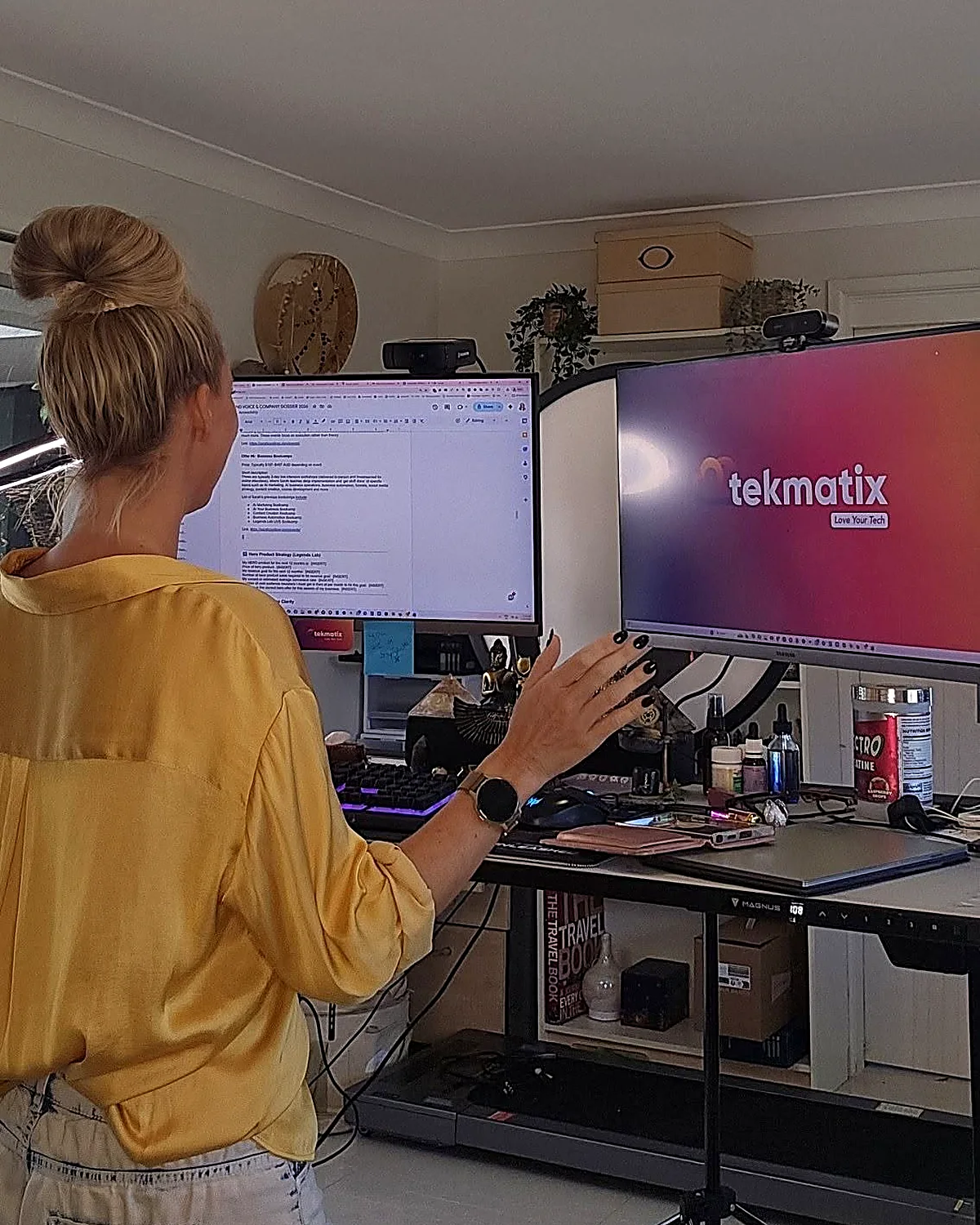
I run my business on it.
- 5.0 on Google from 100+ reviews
- 98% recommended on Facebook
- 1,000+ businesses in 30+ countries
- Award-winning 24/7 support
- 3 free live training calls every weekday
- Replace $500 to $1,000+ a month in subscriptions
Eight logins. Eight bills. Zero of them talking.
Most business owners I meet are paying for a website here, an email tool there, a booking app, a course platform, a CRM they never open... and then paying someone to glue it all together with duct tape and Zapier.
- 1Leads fall through the cracks because your forms, inbox and CRM live in different places.
- 2Every new tool means another login, another bill and another thing to learn.
- 3You can't see what's actually working because your data is scattered across ten dashboards.
Everything your business runs on, under one roof.
Tekmatix is an all-in-one CRM, marketing, sales, course and AI platform. Here's what's inside, grouped by the job it does for you. Tap a category to filter, or scroll the lot.
AI that does the work
Hand the repetitive stuff to AI that already knows your contacts, calendar and offers.
- AI Employees that answer chats, DMs and enquiries 24/7
- Voice AI receptionist that answers your phone and books calls
- AI booking bot on your website chat widget
- AI Studio to build apps and tools by describing them (vibe coding)
- Ask AI assistant built into your account
- AI website and funnel builder plus content and image AI
- Connects to Claude and ChatGPT via MCP, so your AI can work inside Tekmatix
Get found and grow your list
Everything you need to get seen, capture leads and build your audience.
- Unlimited websites with free hosting and your own domains
- Unlimited funnels, landing pages, sales pages and opt-ins
- 100+ ready-made templates for sites and funnels
- Blogging with unlimited posts
- Social media planner with auto-posting
- Forms and quizzes, unlimited
- Surveys with conditional logicPro
- Reviews and reputation management, incl. Google Business Profile
- Link-in-bio pages and QR codes
Nurture and convert
Turn strangers into clients with automated follow-up that never forgets.
- CRM with unlimited contacts and full client records
- Unified inbox for email, SMS, Facebook and Instagram DMs
- Email marketing with automated newsletters
- SMS and phone, incl. missed-call text back
- Unlimited workflows and automations
- Sales pipelines so you see every deal
- Booking calendars for individuals, teams and groups, with 2-way sync
- Advanced reporting on ads, calls, courses and lead sourcesPro
Sell and get paid
Take money online, in person and on autopilot. Payments go straight to your Stripe or PayPal.
- Checkouts with upsells and order bumps
- Invoicing: one-off, recurring and payment plans
- Tap to pay on your phone (EFTPOS)
- Request payments by SMS
- Products and e-commerce, digital and physical, plus coupons
- Proposals, quotes and contracts with e-signaturesPro
- Affiliate program with unlimited affiliatesPro
- Event management with QR code ticketingPro
Courses, memberships and community
Built especially for course creators, educators and coaches. (It's where I teach my own students.)
- Unlimited courses and memberships
- Unlimited students and video hosting
- Assessments and quizzes inside your courses
- Student mobile app in your branding
- Communities and groups, unlimitedPro
- Course certificatesPro
Run the business
The behind-the-scenes admin, organised and in one place for your whole team.
- Project management and Kanban boards
- Task manager with deadlines and tracking
- Unlimited staff users with permission controls
- Admin mobile app for Apple and Android
- Business card scanner
- Integrations with Zapier, Make, WordPress, Google and more
- Up to 5 sub-accounts for your other businessesMax
Want to see it with your own eyes?
Start a 7-day free trial and a Tekspert will jump on a free set-up call with you.
If you sell your expertise or your services, it's built for you.
Solo operators, growing teams and multi-business owners all run on Tekmatix. Here's where it shines brightest.
Coaches, course creators and educators
Your website, sales pages, checkout, courses, membership, community and email, all connected. Tekmatix was made especially for you.
Consultants, speakers and experts
Bookings, proposals, contracts, invoices and follow-up that makes you look like a big firm, even if it's just you.
Health, allied health and NDIS providers
Online bookings, reminders, reviews and client records for clinics, therapists and practitioners.
Tradies and local service businesses
Missed-call text back, quotes, tap to pay and review requests, so you win the job while you're still on the tools.
Studios, salons and personal trainers
Class bookings, memberships, payments and reminders that cut the no-shows and the admin.
Agencies, associations and multi-business owners
Pipelines, staff permissions, reporting and (on Max) up to 5 sub-accounts to run several brands from one login.
Honest moment: if you only need one simple tool and you're genuinely happy juggling logins, you probably don't need Tekmatix yet. But the minute you're copying leads from one app to another, or paying for five subscriptions that don't talk to each other, it's time.
Most software gives you a login. We give you a team.
I'm an educator first, so Tekmatix was built education-first. Every plan comes with real humans, real training and real templates to get you up and running fast.
Free one-on-one set-up call
A Tekspert jumps on a call with you to set up your account and connect your integrations.
Award-winning live chat
Stuck at 11pm? Real support, any time of day or night.
3 free live training calls
Drop in, share your screen and get your questions answered live.
Starter kit and training library
Ready-made templates and automations, a step-by-step help centre, video tutorials and a free Tekmatix training course.
Rather someone just did it for you?
Teksperts are available by the hour, plus fixed-price done-for-you set-up and migration from your old platforms.
Simple pricing that doesn't punish growth.
Unlimited contacts on Starter and Pro, so your bill doesn't jump every time your list grows. Pay in AUD or USD, monthly or yearly (pay yearly and get a month free).
Everything you need to market, sell and deliver, in one place.
- Unlimited contacts, staff users and courses
- Websites, funnels, CRM, email and bookings
- Payments, invoicing and tap to pay
- AI Agents, AI booking bot, AI Studio and Ask AI
- 24/7 live chat and a free set-up call
Everything in Starter, plus the tools to build a community and scale.
- Communities, groups and course certificates
- Event management with QR ticketing
- Your own affiliate program
- Proposals, contracts and e-signatures
- Unlimited surveys and advanced reporting
Everything in Pro, plus more AI, more accounts and a strategist in your corner.
- Up to 5 sub-accounts
- AI Employee Growth plan included: 1,000 AI conversation replies and 100 voice AI minutes a month
- Monthly 60-minute strategy call with a senior Tekspert
- Early access to Tekmatix Labs
Just starting out? The Launch plan is $75 AUD ($50 USD) a month for up to 1,000 contacts. No lock-in contracts.
Chat about the Launch planEmails, SMS, phone calls and AI usage are pay-as-you-go and billed in USD, so you only pay for what you use. See the full rates at tekmatix.com/rebilling. Prices current as at September 2026. Always check tekmatix.com/pricing for the latest.

I didn't build software. I built the toolbox I needed.
After 20+ years in business and more than 280,000 students, I kept seeing the same thing. Brilliant people with brilliant expertise, drowning in tech. Paying for ten tools, using two of them, and spending their evenings on YouTube trying to make them talk to each other.
So I put everything a business needs into one platform, then wrapped it in the thing I know best: education and support. Tekmatix runs my own websites, courses, funnels, emails and AI agents every single day. I wouldn't recommend it if I didn't use it.
Sarah x
Want me to teach you how to get the most out of it?
Inside the Legends Lab I show you step by step how to use tech, AI and automation to grow your business, with live calls, workshops and templates you can copy.
Non-techie people love their tech again.
Tech is hard for non-techie people, and they really get that and make it fun.
Yesterday I felt overwhelmed. Now I feel excited and empowered.
I have used a number of top CRM systems. This is up there with the very best.
Solved problems I have had for weeks, in 50 minutes. Wonderful.
The other tools I use and actually recommend.
Tekmatix is the engine. These are the extras that plug in around it for AI, video, design, content and admin. Tap a category to filter.
Some of these are affiliate links, which means I may earn a small commission at no extra cost to you. Thanks for supporting the brand!
Wondering where the email, booking, course, funnel and CRM tools are? I don't need them any more. Tekmatix does all of that, so I'd rather you didn't pay for them twice.
See what Tekmatix covers ↑Tech stack FAQs.
Still wondering if Tekmatix is right for you? Here are the straight answers.
What is Tekmatix?
Tekmatix is an all-in-one AI business platform. It brings your website, funnels, CRM, email marketing, bookings, payments, courses, memberships, communities, social media scheduling and AI agents together in one connected account, so everything talks to each other.
Do I need to be techy to use it?
No. Tekmatix was built for non-techie business owners. You get a free set-up call, 24/7 live chat, three free live training calls every weekday, a help centre, video tutorials and ready-made templates to get started.
Is there a free trial?
Yes. The Starter and Pro plans come with a 7-day free trial. The Max plan starts with a demo, so the team can make sure it's the right fit.
Can I pay in Australian dollars?
Yes. You can pay your subscription in AUD or USD. Usage charges for emails, SMS, calls and AI are pay-as-you-go and always billed in USD. See tekmatix.com/rebilling for rates.
Will my price go up as my list grows?
No. Starter and Pro include unlimited contacts, so your plan price doesn't increase as your business grows. You also get unlimited courses, students and staff users.
Can you move me off my current platforms?
Yes. Tekmatix Teksperts offer fixed-price migration and done-for-you set-up services, or can help you integrate the tools you want to keep. See tekmatix.com/services.
Can I run courses, memberships and communities in it?
Yes. Tekmatix was made especially for course creators, educators and coaches. Courses and memberships are included on every plan, and communities and certificates come with Pro and Max.
Which plan should I choose?
Starter suits most service businesses and solo experts. Pro is best if you run courses with a community, events, contracts or an affiliate program. Max is for people running more than one business or who want more AI and a monthly strategy call. Not sure? Book a demo.
Stop juggling your tech. Start loving it.
One login. One bill. One platform that runs your marketing, sales, courses and AI, with a real team behind you. Try it free for 7 days and see how much simpler business gets.
7-day free trial on Starter and Pro / Free set-up call / Cancel anytime
See you inside. Sarah x