How to Handle Negative Feedback About Your Business Online Without Losing Your Mind

How to Handle Negative Feedback About Your Business Online Without Losing Your Mind
How to Handle Negative Feedback About Your Business Online Without Losing Your Mind

There comes a point in business where visibility becomes a double-edged sword.

You work for years to be known. You build your brand. You show up online. You serve clients. You put your face, ideas, offers, values and intellectual property into the world.

Then one day, the public starts talking about your business without you.

Not in your comments section.

Not in your inbox.

Not in a tidy little testimonial form where everything is controlled and beautifully formatted.

They talk about you in Facebook groups you are not in, private chats you will never see, comment threads you did not consent to, and conversations based on half a screenshot, someone’s interpretation, or the good old classic, “Well, I heard…”

Welcome to the next level.

It can feel confronting, especially if you are a founder-led brand, coach, consultant, course creator, speaker, educator or service provider. When your business is personal, public criticism can feel like an attack on your character.

But here is the leadership lesson that nobody really tells you when you are growing:

The more visible your business becomes, the less control you have over the public narrative.

That does not mean you become careless.

It does not mean you ignore legitimate feedback.

It does not mean you tolerate abuse, defamation, harassment, bullying or bad behaviour.

It means you learn how to handle negative feedback in business with maturity, processes, boundaries and emotional regulation.

Because scaling a business is not just about more sales, more followers, more clients and more visibility.

It is also about becoming the kind of leader who can stay calm when people misunderstand you, criticise you, complain about you, or talk about your business without the full story.

In this article, you will learn how to deal with public criticism, how to respond to negative comments online, how to build a customer complaint process, how to protect your energy, and how to stop letting one loud comment mentally outweigh hundreds of quiet success stories.

The Bigger Your Business Gets, The More People Will Talk

In the early days of business, feedback is usually manageable.

You know most of your customers by name. You personally respond to emails. You jump into DMs. You fix issues one by one. You can usually resolve a concern before it ever becomes a public complaint.

Then your business grows.

You get more customers, more visibility, more reach, more content, more offers, more opinions, more interpretations, and more people watching from the sidelines.

At that point, your brand starts becoming part of public conversation.

People discuss your prices.

They discuss your marketing.

They discuss your personality.

They discuss your client experiences, even when they have never been a client.

They discuss what they think you meant, what they think happened, what they think someone else told them, and what they think your business should do differently.

It can feel deeply unfair.

Sometimes it is unfair.

But it is also part of growth.

The goal was never to build a business where every single person on the internet likes you.

The goal was to build a business that is visible, valuable, trusted and known by the right people.

And when more people know you exist, more people will have an opinion.

That is not always a crisis.

Sometimes it is simply evidence that your business is no longer invisible.

Why Negative Feedback Feels So Personal

Negative feedback can hit hard because business ownership is not just a job.

For many entrepreneurs, especially experts, educators, coaches and creators, the business is built from your knowledge, story, values, lived experience, personal brand and reputation.

So when someone criticises the business, it can feel like they are criticising you.

This is especially true when the comment is public, inaccurate, emotionally charged or missing important context.

Your nervous system does not calmly say, “Ah yes, here is a useful data point for operational improvement.”

It says, “Danger. Attack. Fix it immediately.”

That is why the urge to defend yourself can be so strong.

You want to explain.

You want to correct the misunderstanding.

You want to tell the full story.

You want to post the screenshots.

You want people to know the truth.

But leadership requires discernment.

There is a time to respond.

There is a time to investigate.

There is a time to apologise.

There is a time to repair.

There is a time to seek legal advice.

And there is also a time to let people be wrong about you without turning your entire business into a public courtroom.

That moment is not weakness.

It is a leadership threshold.

How to Reframe Public Criticism as a Sign of Visibility

One of the most useful mindset shifts is this:

Public conversation is often a sign that your business has become visible enough to be discussed.

That does not mean negative comments are enjoyable.

It does not mean you ignore them.

It means you stop interpreting every comment as proof that your business is falling apart.

Bigger brands are talked about every day.

People complain about airlines, banks, software companies, restaurants, supermarkets, fast food chains, universities, online platforms and public figures constantly.

Do their CEOs jump into every comment thread to correct every opinion?

No.

They have teams, policies, brand guidelines, complaint pathways, legal processes, public relations strategies and customer support systems.

Now, your business might not be Nike, McDonald’s or a global tech company.

But the mindset still helps.

When your brand grows, you cannot operate as though every public comment requires your personal emotional involvement.

That is how founders burn out.

Instead, you move from personal reactivity to professional response.

The Balance Check: One Loud Complaint Is Not the Whole Story

Negative feedback feels louder than positive feedback.

A happy client might quietly complete your course, enjoy your programme, get the result they came for, and never say a word publicly.

An unhappy person might write three posts, two emails, five comments and a dramatic group thread before breakfast.

That does not make them the majority.

It makes them loud.

Use the balance check.

Ask yourself:

  • For every negative comment, how many satisfied clients do we have?
  • How many people have completed the programme without issue?
  • How many customers are quietly using the product successfully?
  • How many testimonials, referrals, renewals or repeat purchases do we have?
  • Is this feedback revealing a real pattern, or is it one isolated case?

This is not about dismissing complaints.

It is about perspective.

One negative comment should not be allowed to emotionally outweigh hundreds or thousands of quiet success stories.

Think about your own behaviour as a customer.

You probably do not leave a five-star review every time the supermarket has eggs, the bank app opens correctly, or the online checkout works.

You got what you expected, so you moved on with your day.

Many satisfied customers are the same.

No feedback often means everything worked exactly as expected.

When to Respond and When to Let It Go

One of the hardest parts of handling online criticism is knowing whether to respond.

Not every comment deserves your energy.

Not every rumour needs your correction.

Not every person is looking for resolution.

Some people are genuinely seeking help.

Some people are venting.

Some people are misinformed.

Some people want attention.

Some people want a public fight.

Your job is to know the difference.

Respond When There Is a Genuine Customer Service Issue

A response is appropriate when:

  • The person is an actual customer or client
  • They have raised a specific issue
  • There is a clear opportunity to resolve the matter
  • The complaint relates to service delivery, access, billing, communication, results, support or expectations
  • Your team needs to acknowledge, investigate or provide next steps

In these cases, respond calmly and professionally.

Do not debate in public.

A simple response might be:

“Thanks for raising this. We are sorry to hear this has been frustrating. Please contact our support team directly so we can review your account and help resolve this properly.”

Then take the conversation into the correct private support channel.

Do Not Respond to Every Opinion From Non-Customers

When someone has never purchased from you, never worked with you, never experienced your service and is only repeating hearsay, you do not automatically owe them a detailed response.

This is where founders often waste enormous emotional energy.

They try to convince strangers.

They try to correct every misunderstanding.

They try to win the approval of people who were never going to buy anyway.

That is not reputation management.

That is emotional leakage.

A stranger’s opinion is not always a business emergency.

Avoid Public Arguments

Public arguments rarely create clarity.

They often create screenshots.

When emotions are high, the best response is usually calm, brief and procedural.

Your aim is not to win the thread.

Your aim is to protect the integrity of your brand.

Write Every Message Like It Could Be Screenshotted

One of the most important rules for modern business communication is this:

Write every email, DM, support reply and comment as if it could be screenshotted and shared publicly.

Because it can be.

This does not mean you become robotic.

It means you become clear, calm and professional.

Train yourself and your team to communicate in a way that would still look reasonable if taken out of context.

That means:

  • Do not write emotionally reactive replies
  • Do not insult, shame or blame the customer
  • Do not over-explain in a panic
  • Do not make promises your policies do not support
  • Do not admit fault without understanding the situation
  • Do not share confidential information publicly
  • Do not respond when you are angry

A good complaint response should be boring in the best possible way.

Clear.

Professional.

Kind.

Procedural.

Documented.

That is what protects your business.

Build a Customer Complaint Process Before You Need It

The worst time to create a complaint process is when someone is already upset.

That is when emotions are high, your team is nervous, the founder is triggered, and nobody knows who is meant to do what.

Instead, create a simple customer complaint SOP before the next issue arises.

This does not need to be complicated.

It just needs to be clear.

Step 1: Define What Counts as a Complaint

Not every question is a complaint.

Not every cancellation is a crisis.

Not every refund request is an attack.

Create categories so your team knows how to respond.

For example:

  • General support request
  • Billing query
  • Access issue
  • Service delivery concern
  • Misunderstanding of inclusions
  • Refund request
  • Public complaint
  • Legal or high-risk complaint
  • Abusive or threatening communication

When your team can categorise the issue, they can respond with confidence.

Step 2: Set Response Timeframes

Customers get more frustrated when they feel ignored.

Set clear internal standards for response times.

For example:

  • General support requests receive a reply within one business day
  • Billing issues are reviewed within two business days
  • Formal complaints are acknowledged within one business day
  • Legal threats are escalated immediately

You do not need to solve everything instantly.

You do need to acknowledge people properly.

Step 3: Create Response Templates

Templates help your team stay consistent.

They also reduce emotional writing.

Create templates for common situations such as:

  • Refund requests
  • Access issues
  • Complaints about programme fit
  • Requests outside scope
  • Public comments
  • Cancellation requests
  • Boundary-setting replies
  • Escalations to management

Templates should never feel cold or dismissive.

They should provide structure while still allowing a human tone.

Step 4: Document Everything

Keep records of:

  • What the customer purchased
  • What was promised
  • What was delivered
  • What support was offered
  • What options were provided
  • What communication was sent
  • What the customer chose
  • Any abusive or concerning behaviour

Documentation protects everyone.

It protects the customer from being misunderstood.

It protects your team from confusion.

It protects your business if the matter escalates.

Step 5: Review and Improve

Every complaint can teach you something.

After the issue is resolved, ask:

  • Was our communication clear?
  • Did the customer misunderstand the offer?
  • Did our sales page need more detail?
  • Did onboarding need improvement?
  • Did our team have the right template?
  • Did our policy support the situation?
  • Do we need a new SOP?

This is how negative feedback becomes operational improvement instead of emotional damage.

Use a Calm Complaint Response Framework

When a customer is upset, your response needs to be grounded.

A useful structure is:

  1. Acknowledge the concern
  2. Summarise what has been provided or offered
  3. Reconfirm the relevant policy or process
  4. Offer clear resolution options
  5. Set the next step

For example:

“Thank you for sharing your concerns. We understand this has not felt aligned for you, and we appreciate the opportunity to review it properly.

Here is what has been provided so far.

Here are the support options we have offered.

Based on our policy, these are the available pathways from here.

Option one is…

Option two is…

Option three is…

Please let us know which option you would like to proceed with by [date], and we will assist from there.”

Notice the tone.

It is not defensive.

It is not begging.

It is not dramatic.

It is not emotional.

It is leadership.

Give Options Without Becoming a Doormat

There is a big difference between being helpful and having no boundaries.

You can be compassionate without handing over the keys to the business.

You can offer solutions without creating endless exceptions.

You can care about the customer without becoming responsible for their emotional state.

A strong approach is to provide three pathways for resolution where appropriate.

For example:

  • Option one: Continue with additional support
  • Option two: Adjust the service pathway within policy
  • Option three: Part ways respectfully

That third option matters.

Not every client relationship is meant to continue.

Sometimes the best resolution is a clean, respectful separation.

This is especially important for coaches, consultants, educators, membership owners and course creators, because your work often involves transformation, accountability and personal responsibility.

You can provide the tools, support, structure and guidance.

You cannot do the emotional, strategic or implementation work for the client.

When you have offered reasonable pathways and the client refuses all of them, that is not your failure.

That is their choice.

Stop Carrying Other People’s Emotional Reactions

Upset people are often responding from more than the immediate issue.

They may be overwhelmed.

They may be scared.

They may feel embarrassed.

They may be under financial pressure.

They may have misunderstood what they bought.

They may be angry at themselves and directing it at you.

That does not make their behaviour acceptable.

It does help you stop absorbing it as proof that you are a terrible business owner.

You can hold compassion without carrying responsibility for every reaction.

A client’s disappointment does not always mean you did something wrong.

A refund request does not always mean your offer is bad.

A public complaint does not always mean your brand is damaged.

A negative comment does not always mean you need to change your entire business model.

Regulated empathy is the goal.

You care, but you stay steady.

You listen, but you do not collapse.

You respond, but you do not bleed out emotionally every time someone is unhappy.

Protect Your Founder Energy as You Scale

In the early stages, being highly accessible can help you grow.

You reply to comments.

You answer DMs.

You jump on calls.

You personally solve everything.

That level of access can build trust.

But it can also become unsustainable.

As your business grows, founder access needs to become more intentional.

This is not becoming cold.

This is adapting to scale.

You may need to:

  • Direct support requests to your team
  • Stop replying to every DM
  • Avoid reading every public thread
  • Remove yourself from emotionally draining spaces
  • Create office hours instead of constant access
  • Use templates, portals and help desks
  • Empower your team to resolve issues
  • Set clear boundaries around communication

The bigger your business becomes, the more your energy must be protected for leadership, vision, strategy, delivery and decision-making.

You cannot build a sustainable business if your nervous system is being run by Facebook group commentary.

When Legal Advice Is Appropriate

Most complaints can be handled through clear communication, customer support and good processes.

Some situations need professional advice.

Consider seeking legal guidance when there are:

  • Defamation concerns
  • Threats or harassment
  • Contract disputes
  • Repeated public claims that may damage your business
  • Privacy or confidentiality issues
  • Regulatory or compliance concerns
  • Large financial claims
  • Staff safety concerns
  • Complex refund or service disputes

This is not about becoming aggressive.

It is about being responsible.

You may never need to use legal documentation publicly.

But your business should operate in a way that, if it ever had to be reviewed, your conduct would be professional, consistent and fair.

Good leadership is not just what you say online.

It is what your records, policies and communication show behind the scenes.

Turn Negative Feedback Into Better Systems

The healthiest way to use negative feedback is to separate the emotion from the information.

Ask yourself:

“What is useful here?”

Maybe the person delivered the feedback badly, but there is still something to improve.

Maybe the complaint revealed that your onboarding was unclear.

Maybe your sales page needs stronger expectation-setting.

Maybe your cancellation policy needs to be easier to find.

Maybe your team needs a better escalation process.

Maybe your offer is attracting the wrong-fit clients.

Maybe you need clearer boundaries around what is included and what is not.

Do not let bad feedback become a verdict on your worth.

Let it become a prompt for better systems.

That is how mature businesses grow.

Common Mistakes Business Owners Make With Public Criticism

Mistake 1: Trying to Correct Everyone

You will exhaust yourself trying to make every stranger understand the full story.

Clarity matters, but constant correction is not the same as leadership.

Mistake 2: Responding While Triggered

A heated reply can create more damage than the original complaint.

Pause before responding.

Draft it.

Review it.

Get a trusted person to read it.

Then send the calm version.

Mistake 3: Over-Apologising

Apologise when it is appropriate.

But do not apologise so much that you accidentally accept responsibility for things that are not yours to own.

Mistake 4: Making Exceptions That Break Your Business

One emotional case can tempt you to throw out your policies.

Be fair, but be careful.

Policies exist to protect consistency.

Mistake 5: Ignoring Patterns

One complaint may be isolated.

Ten complaints about the same issue may be a pattern.

Do not dismiss repeated feedback just because it is uncomfortable.

Mistake 6: Letting One Comment Define Your Brand

Your brand is not one comment.

Your business is not one complaint.

Your reputation is built through repeated delivery, clear communication, strong values and consistent service over time.

Best Practices for Managing Online Criticism Professionally

Here are the practical standards I recommend every growing business builds into its operations:

  • Create a complaint SOP before you need it
  • Train your team to respond calmly and consistently
  • Keep communication factual, kind and procedural
  • Move public complaints into private support channels
  • Document all offers, solutions and responses
  • Use templates, but keep them human
  • Offer clear resolution options
  • Protect founder energy with boundaries
  • Review complaints for genuine options
  • Protect founder energy with boundaries
  • Review complaints for genuine improvement opportunities
  • Seek legal advice when the risk is high
  • Do not publicly share private customer details
  • Do not let strangers with opinions control your business decisions

This is how you move from reactive founder to steady leader.

Key Takeaways

Handling negative feedback in business is not about becoming emotionless.

It is about becoming equipped.

The more visible your business becomes, the more people will talk.

Some feedback will be valid.

Some will be misinformed.

Some will be painful.

Some will be useful.

Some will be absolute nonsense from people who have never even paid you a cent.

Your job is to know which is which.

Respond where appropriate.

Improve where needed.

Protect your energy.

Build the process.

Train the team.

Then go and make a cup of tea instead of doom-scrolling Facebook groups like it is an Olympic sport.

FAQ

How do I respond to negative comments about my business online?

Respond calmly, briefly and professionally. Acknowledge the concern, invite the person into the correct support channel, and avoid debating in public. Keep your response clear enough that it would still look professional if screenshotted and shared.

Should I reply to people talking about my business in Facebook groups?

Not always. If the person is a genuine customer with a real support issue, invite them to contact your team directly. If the discussion is based on hearsay, speculation or non-customer opinions, it may be wiser to stay out of it and focus on serving your actual clients.

How do I stop taking business criticism personally?

Remind yourself that criticism of the business is not automatically a criticism of your character. Look for the useful information, check whether there is a genuine pattern, and avoid letting one loud comment outweigh the many customers who are quietly satisfied.

What should be included in a customer complaint process?

A good customer complaint process should include complaint categories, response timeframes, escalation steps, response templates, documentation standards, resolution options and a review process for improving your systems afterwards.

How do I protect my business reputation online?

Protect your reputation by operating with integrity behind the scenes, communicating professionally, documenting decisions, responding consistently, training your team, and creating clear policies. Reputation is not built from one perfect response. It is built through repeated professionalism over time.

When should I get legal advice about online criticism?

Consider legal advice when there are threats, harassment, possible defamation, contract disputes, privacy issues, regulatory concerns, large financial claims or repeated public statements that may seriously affect your business. Legal advice can help you respond appropriately rather than emotionally.

How do I give an unhappy client options without being walked over?

Offer clear pathways within your policies. For example, provide additional support, an adjusted pathway, or a respectful parting of ways. The key is to offer reasonable solutions without creating endless exceptions that damage your business.

Conclusion

Being talked about is one of the uncomfortable side effects of being visible.

You cannot grow a public business and also control every public opinion.

At some point, people will misunderstand you, repeat things they heard from someone else, complain about you, criticise your decisions, or discuss your business in places you cannot access.

That is not fun.

But it is also not the end of the world.

The next level of business requires a different level of emotional steadiness, operational structure and leadership maturity.

You need clear policies.

You need calm responses.

You need trained team members.

You need proper complaint pathways.

You need records.

You need boundaries.

And you need the ability to say, “We handled that professionally, we offered reasonable options, we learned what we needed to learn, and now we are moving on.”

You are not here to be everything to everyone.

You are here to serve the right people, in the right way, with the right standards.

Ready to build a business that can handle more visibility, more clients and more growth without burning you out behind the scenes?

Inside Legends Lab, I help entrepreneurs, experts, coaches, consultants, speakers and course creators build stronger offers, clearer messaging, better systems, scalable content and the leadership foundations required to grow with confidence.

Build Your Brand & Business

Want Help Building Your Brand Properly?

If you want to learn how to build your personal brand, business systems, audience, and scalable online business properly, check out the Legends Lab program by Sarah Cordiner.

Join Legends Lab

How Sarah Cordiner Can Help You Scale Your Business with Tech, AI, and Automation

Tech doesn't have to be hard or scary. I help you make it easy to learn, fun to implement, and even better to see the amazing results that you can get with some simple tech tools and strategy.

Here are all of the different ways that I can help you scale your business, streamline your operations, and make your bottom line full of joy using tech, AI, and automation (as well as traditional methods) as your secret weapon.

Sarah's tech stack
The tech I run my businesses on / Updated 2026

One platform. Your whole business. Finally talking to each other.

"What tech do you use, Sarah?" I get asked this every single week. The honest answer? Almost all of it lives in one place: Tekmatix. It's the all-in-one AI business platform I founded, and it runs my websites, funnels, courses, emails, bookings, payments and AI agents. Here's everything it does, who it's for, and the handful of other tools I love.

7-day free trialFree set-up call24/7 live chatAUD or USD

No lock-in contracts / Cancel anytime / Australian owned and female owned
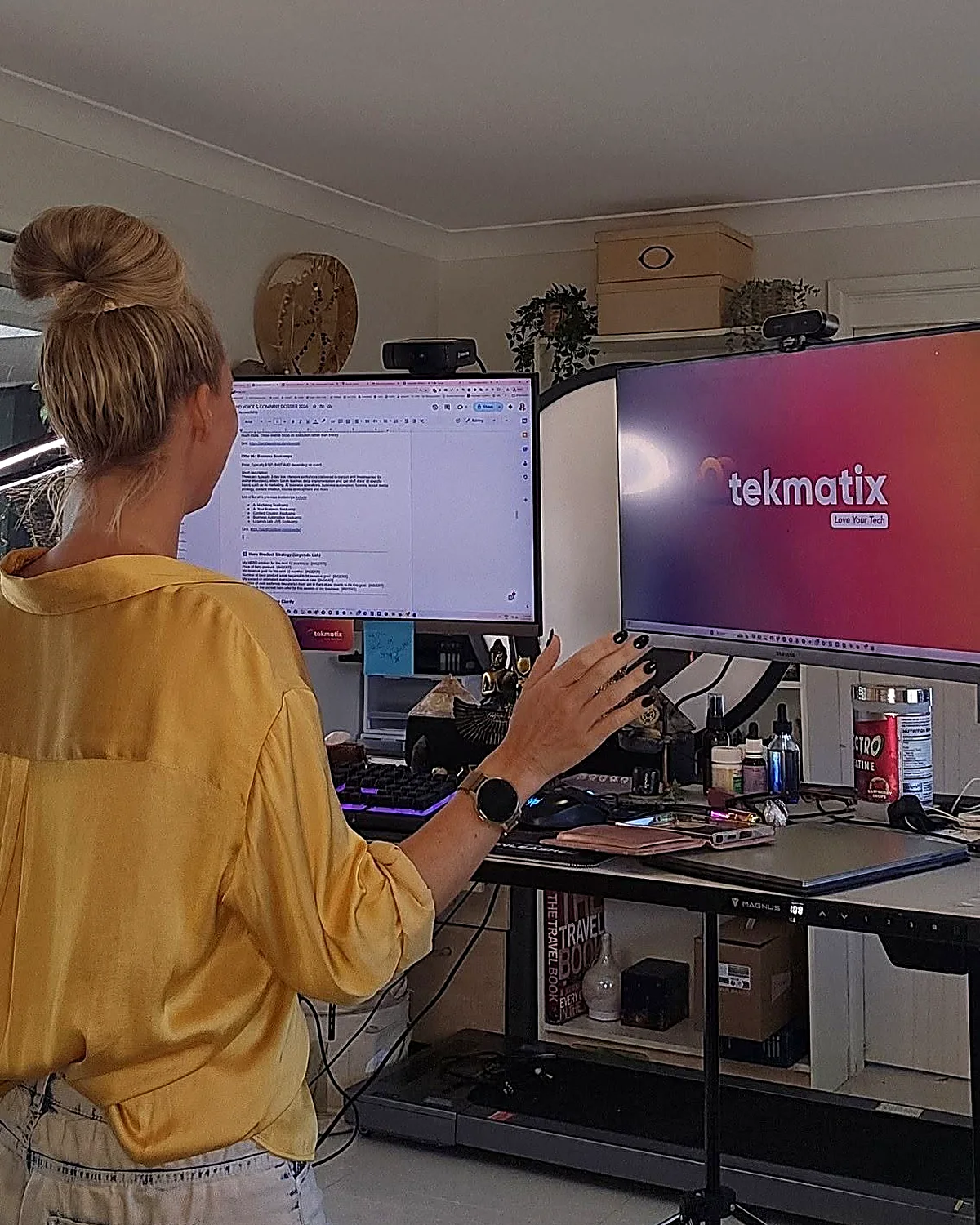
Sarah Cordiner at her desk showing the Tekmatix platform on screen
I built it.
I run my business on it.
1,000+Businesses in Australia and 30+ countries
  • 5.0 on Google from 100+ reviews
  • 98% recommended on Facebook
  • 1,000+ businesses in 30+ countries
  • Award-winning 24/7 support
  • 3 free live training calls every weekday
  • Replace $500 to $1,000+ a month in subscriptions
Sound familiar?

Eight logins. Eight bills. Zero of them talking.

Most business owners I meet are paying for a website here, an email tool there, a booking app, a course platform, a CRM they never open... and then paying someone to glue it all together with duct tape and Zapier.

  • 1Leads fall through the cracks because your forms, inbox and CRM live in different places.
  • 2Every new tool means another login, another bill and another thing to learn.
  • 3You can't see what's actually working because your data is scattered across ten dashboards.
What Tekmatix replaces
Website and hostingWix / Squarespace / GoDaddy
$30+/mo
Sales funnelsClickFunnels / Leadpages
$99+/mo
CRMHubSpot / Salesforce
$50+/mo
Email marketingMailchimp / ActiveCampaign
$40+/mo
Booking calendarCalendly / Acuity
$20+/mo
AI chat and voice agentsVarious
$99+/mo
Social media schedulerHootsuite / Buffer
$30+/mo
Courses and membershipsKajabi / Teachable / Thinkific
$150+/mo
All of it, in TekmatixPlans from $150 AUD / $97 USD a month
The full feature list

Everything your business runs on, under one roof.

Tekmatix is an all-in-one CRM, marketing, sales, course and AI platform. Here's what's inside, grouped by the job it does for you. Tap a category to filter, or scroll the lot.

The bit everyone asks about

AI that does the work

Hand the repetitive stuff to AI that already knows your contacts, calendar and offers.

  • AI Employees that answer chats, DMs and enquiries 24/7
  • Voice AI receptionist that answers your phone and books calls
  • AI booking bot on your website chat widget
  • AI Studio to build apps and tools by describing them (vibe coding)
  • Ask AI assistant built into your account
  • AI website and funnel builder plus content and image AI
  • Connects to Claude and ChatGPT via MCP, so your AI can work inside Tekmatix

Get found and grow your list

Everything you need to get seen, capture leads and build your audience.

  • Unlimited websites with free hosting and your own domains
  • Unlimited funnels, landing pages, sales pages and opt-ins
  • 100+ ready-made templates for sites and funnels
  • Blogging with unlimited posts
  • Social media planner with auto-posting
  • Forms and quizzes, unlimited
  • Surveys with conditional logicPro
  • Reviews and reputation management, incl. Google Business Profile
  • Link-in-bio pages and QR codes

Nurture and convert

Turn strangers into clients with automated follow-up that never forgets.

  • CRM with unlimited contacts and full client records
  • Unified inbox for email, SMS, Facebook and Instagram DMs
  • Email marketing with automated newsletters
  • SMS and phone, incl. missed-call text back
  • Unlimited workflows and automations
  • Sales pipelines so you see every deal
  • Booking calendars for individuals, teams and groups, with 2-way sync
  • Advanced reporting on ads, calls, courses and lead sourcesPro

Sell and get paid

Take money online, in person and on autopilot. Payments go straight to your Stripe or PayPal.

  • Checkouts with upsells and order bumps
  • Invoicing: one-off, recurring and payment plans
  • Tap to pay on your phone (EFTPOS)
  • Request payments by SMS
  • Products and e-commerce, digital and physical, plus coupons
  • Proposals, quotes and contracts with e-signaturesPro
  • Affiliate program with unlimited affiliatesPro
  • Event management with QR code ticketingPro

Courses, memberships and community

Built especially for course creators, educators and coaches. (It's where I teach my own students.)

  • Unlimited courses and memberships
  • Unlimited students and video hosting
  • Assessments and quizzes inside your courses
  • Student mobile app in your branding
  • Communities and groups, unlimitedPro
  • Course certificatesPro

Run the business

The behind-the-scenes admin, organised and in one place for your whole team.

  • Project management and Kanban boards
  • Task manager with deadlines and tracking
  • Unlimited staff users with permission controls
  • Admin mobile app for Apple and Android
  • Business card scanner
  • Integrations with Zapier, Make, WordPress, Google and more
  • Up to 5 sub-accounts for your other businessesMax
ProIncluded on Pro and Max plansMaxMax plan onlyEverything else is included from Starter up.

Want to see it with your own eyes?

Start a 7-day free trial and a Tekspert will jump on a free set-up call with you.

Who it's for

If you sell your expertise or your services, it's built for you.

Solo operators, growing teams and multi-business owners all run on Tekmatix. Here's where it shines brightest.

01

Coaches, course creators and educators

Your website, sales pages, checkout, courses, membership, community and email, all connected. Tekmatix was made especially for you.

02

Consultants, speakers and experts

Bookings, proposals, contracts, invoices and follow-up that makes you look like a big firm, even if it's just you.

03

Health, allied health and NDIS providers

Online bookings, reminders, reviews and client records for clinics, therapists and practitioners.

04

Tradies and local service businesses

Missed-call text back, quotes, tap to pay and review requests, so you win the job while you're still on the tools.

05

Studios, salons and personal trainers

Class bookings, memberships, payments and reminders that cut the no-shows and the admin.

06

Agencies, associations and multi-business owners

Pipelines, staff permissions, reporting and (on Max) up to 5 sub-accounts to run several brands from one login.

Business ownersCoachesCourse creatorsConsultantsTherapistsNDIS providersMedical and allied healthLegal and financial professionalsTradiesSalonsYoga studiosPersonal trainersPhotographersDesignersMarketing agenciesRecruitersOnline storesEvent organisersChurchesCharitiesBusiness associations

Honest moment: if you only need one simple tool and you're genuinely happy juggling logins, you probably don't need Tekmatix yet. But the minute you're copying leads from one app to another, or paying for five subscriptions that don't talk to each other, it's time.

You're never on your own

Most software gives you a login. We give you a team.

I'm an educator first, so Tekmatix was built education-first. Every plan comes with real humans, real training and real templates to get you up and running fast.

Day one

Free one-on-one set-up call

A Tekspert jumps on a call with you to set up your account and connect your integrations.

24/7

Award-winning live chat

Stuck at 11pm? Real support, any time of day or night.

Every weekday

3 free live training calls

Drop in, share your screen and get your questions answered live.

Included

Starter kit and training library

Ready-made templates and automations, a step-by-step help centre, video tutorials and a free Tekmatix training course.

Rather someone just did it for you?

Teksperts are available by the hour, plus fixed-price done-for-you set-up and migration from your old platforms.

See Tekmatix services →
Plans and pricing

Simple pricing that doesn't punish growth.

Unlimited contacts on Starter and Pro, so your bill doesn't jump every time your list grows. Pay in AUD or USD, monthly or yearly (pay yearly and get a month free).

Starter
$150 AUD / month
or $97 USD / month

Everything you need to market, sell and deliver, in one place.

  • Unlimited contacts, staff users and courses
  • Websites, funnels, CRM, email and bookings
  • Payments, invoicing and tap to pay
  • AI Agents, AI booking bot, AI Studio and Ask AI
  • 24/7 live chat and a free set-up call
Start 7-day free trial
Best for course creators Pro
$230 AUD / month
or $149 USD / month

Everything in Starter, plus the tools to build a community and scale.

  • Communities, groups and course certificates
  • Event management with QR ticketing
  • Your own affiliate program
  • Proposals, contracts and e-signatures
  • Unlimited surveys and advanced reporting
Start 7-day free trial
For multi-business owners Max
$497 AUD / month
or $349 USD / month

Everything in Pro, plus more AI, more accounts and a strategist in your corner.

  • Up to 5 sub-accounts
  • AI Employee Growth plan included: 1,000 AI conversation replies and 100 voice AI minutes a month
  • Monthly 60-minute strategy call with a senior Tekspert
  • Early access to Tekmatix Labs
Book a demo

Just starting out? The Launch plan is $75 AUD ($50 USD) a month for up to 1,000 contacts. No lock-in contracts.

Chat about the Launch plan

Emails, SMS, phone calls and AI usage are pay-as-you-go and billed in USD, so you only pay for what you use. See the full rates at tekmatix.com/rebilling. Prices current as at September 2026. Always check tekmatix.com/pricing for the latest.

Sarah Cordiner teaching a funnel diagram on a whiteboard
280,000+Students taught in 181 countries
A note from the founder

I didn't build software. I built the toolbox I needed.

Founder and CEO, Tekmatix20+ years in businessPostgraduate qualified educator

After 20+ years in business and more than 280,000 students, I kept seeing the same thing. Brilliant people with brilliant expertise, drowning in tech. Paying for ten tools, using two of them, and spending their evenings on YouTube trying to make them talk to each other.

So I put everything a business needs into one platform, then wrapped it in the thing I know best: education and support. Tekmatix runs my own websites, courses, funnels, emails and AI agents every single day. I wouldn't recommend it if I didn't use it.

Sarah x

Want me to teach you how to get the most out of it?

Inside the Legends Lab I show you step by step how to use tech, AI and automation to grow your business, with live calls, workshops and templates you can copy.

Join the Legends Lab
Don't just take my word for it

Non-techie people love their tech again.

Tech is hard for non-techie people, and they really get that and make it fun.
Forging Ahead CoachingFacebook review
Yesterday I felt overwhelmed. Now I feel excited and empowered.
Melanie GleesonGoogle review
I have used a number of top CRM systems. This is up there with the very best.
Peter J CroneyFacebook review
Solved problems I have had for weeks, in 50 minutes. Wonderful.
Nicole TurnbullGoogle review
5.0Google rating, 100+ reviews
98%Recommended on Facebook
1,000+Businesses
30+Countries
The rest of my toolkit

The other tools I use and actually recommend.

Tekmatix is the engine. These are the extras that plug in around it for AI, video, design, content and admin. Tap a category to filter.

Some of these are affiliate links, which means I may earn a small commission at no extra cost to you. Thanks for supporting the brand!

AITop pickClaude CoWorkAI agent for non-developers that works across your files, email and apps to automate tasks on your desktop.Check it out → AITop pickChatGPTAI assistant for content, research, brainstorming and custom GPTs for your team.Check it out → AIGoogle GeminiGoogle's multimodal AI assistant, built into Google Workspace.Check it out → AIGoogle AI StudioTest prompts and build with Google's AI models, free to start.Check it out → AIManusAutonomous AI agent that researches and completes multi-step tasks for you.Check it out → AIGensparkAI search and research engine that builds answers from multiple sources.Check it out → AILovableAI app builder. Describe the web app you want in plain English and it builds it.Check it out → Video and audioTop pickDescriptEdit video and podcasts by editing the transcript. Plus screen recording.Check it out → Video and audioCapCutMobile-friendly video editing for Reels, TikToks and short-form content.Check it out → Video and audioTop pickHeyGenAI avatar videos with your own custom scripts and voice.Check it out → Video and audioElevenLabsRealistic AI voiceovers and voice cloning.Check it out → Video and audioSubmagicAI short-form video editing: auto captions, effects and b-roll.Check it out → Video and audioTop pickStreamYardLivestream and multistream to your socials, webinars and virtual events.Check it out → Video and audioLoomQuick screen recordings for tutorials, SOPs and async updates.Check it out → Video and audioCamtasiaScreen recording and video editing for polished course videos.Check it out → Video and audioPodcast.coPodcast hosting and distribution to all the major platforms.Check it out → Design and contentTop pickCanvaDesign for non-designers: social graphics, slides, marketing material and more.Check it out → Design and contentTop pickGammaAI presentation builder for slides, documents and simple web pages.Check it out → Design and contentEnvato ElementsCommercial-use music, video, b-roll, photos and templates.Check it out → Design and contentCreative FabricaFonts, graphics and design assets for your content.Check it out → Design and contentGoogle WhiskGoogle's AI image tool for generating and remixing images.Check it out → Design and contentAdCreative.aiAI-generated ad creatives for your paid campaigns.Check it out → Design and content1of10Viral content research: find the top-performing ideas in your niche.Check it out → Design and contentSyllabyAI social media strategy with video scripts and content ideas for your niche.Check it out → Design and contentTubeBuddyYouTube channel growth, SEO and optimisation.Check it out → ProductivityTop pickMakeVisual automation to connect your apps and build advanced workflows.Check it out → ProductivityOtter.aiRecords, transcribes and summarises your meetings automatically.Check it out → ProductivityWispr FlowAI voice-to-text. Dictate into any text box on your computer.Check it out → ProductivityGoogle WorkspaceEmail, docs, sheets, calendar and team collaboration.Check it out → ProductivityHunter.ioFind business email addresses for B2B outreach.Check it out → ProductivityStunningRecovers failed Stripe payments automatically.Check it out → Money and adminStripePayment processing. Connects to Tekmatix for courses, products, memberships and payment plans.Check it out → Money and adminPayPalConnects to Tekmatix so customers can pay with PayPal.Check it out → Money and adminXeroAccounting for invoicing, payroll, BAS and tax reporting.Check it out → Money and adminAppSumoLifetime deals on software and business tools.Check it out → Money and adminFiverrFreelancers for one-off design, writing and tech jobs.Check it out → Books and publishingPublisher RocketAmazon KDP keyword and category research for authors.Check it out → Books and publishingBookBoltKDP and low-content book publishing research and design.Check it out → Books and publishingMy gear listThe cameras, mics and lighting I recommend, on Amazon.Check it out →

Wondering where the email, booking, course, funnel and CRM tools are? I don't need them any more. Tekmatix does all of that, so I'd rather you didn't pay for them twice.

See what Tekmatix covers ↑
Questions I get asked

Tech stack FAQs.

Still wondering if Tekmatix is right for you? Here are the straight answers.

What is Tekmatix?

Tekmatix is an all-in-one AI business platform. It brings your website, funnels, CRM, email marketing, bookings, payments, courses, memberships, communities, social media scheduling and AI agents together in one connected account, so everything talks to each other.

Do I need to be techy to use it?

No. Tekmatix was built for non-techie business owners. You get a free set-up call, 24/7 live chat, three free live training calls every weekday, a help centre, video tutorials and ready-made templates to get started.

Is there a free trial?

Yes. The Starter and Pro plans come with a 7-day free trial. The Max plan starts with a demo, so the team can make sure it's the right fit.

Can I pay in Australian dollars?

Yes. You can pay your subscription in AUD or USD. Usage charges for emails, SMS, calls and AI are pay-as-you-go and always billed in USD. See tekmatix.com/rebilling for rates.

Will my price go up as my list grows?

No. Starter and Pro include unlimited contacts, so your plan price doesn't increase as your business grows. You also get unlimited courses, students and staff users.

Can you move me off my current platforms?

Yes. Tekmatix Teksperts offer fixed-price migration and done-for-you set-up services, or can help you integrate the tools you want to keep. See tekmatix.com/services.

Can I run courses, memberships and communities in it?

Yes. Tekmatix was made especially for course creators, educators and coaches. Courses and memberships are included on every plan, and communities and certificates come with Pro and Max.

Which plan should I choose?

Starter suits most service businesses and solo experts. Pro is best if you run courses with a community, events, contracts or an affiliate program. Max is for people running more than one business or who want more AI and a monthly strategy call. Not sure? Book a demo.

Your move, legend

Stop juggling your tech. Start loving it.

One login. One bill. One platform that runs your marketing, sales, courses and AI, with a real team behind you. Try it free for 7 days and see how much simpler business gets.

7-day free trial on Starter and Pro / Free set-up call / Cancel anytime

See you inside. Sarah x

Latest Articles by Sarah Cordiner