Business Crisis Survival: How to Stabilise, Pivot and Rebuild Stronger

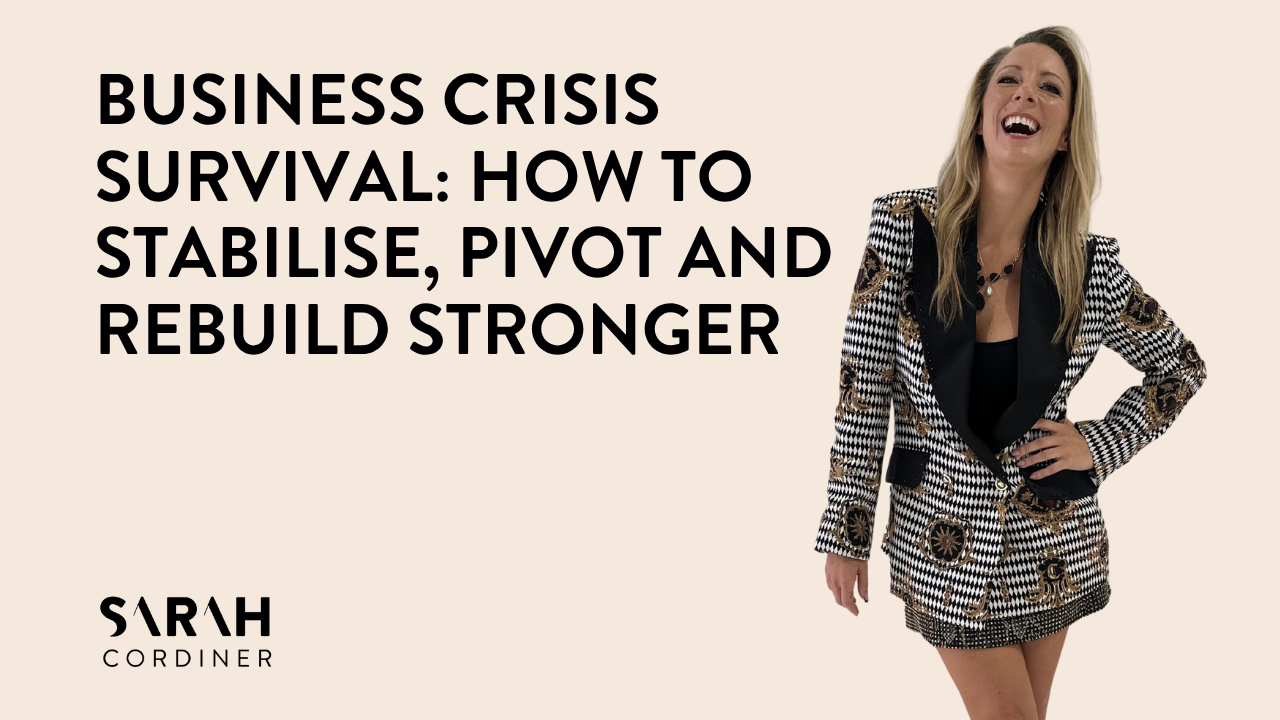
Business Crisis Survival: How to Stabilise, Pivot and Rebuild Stronger
Business Crisis Survival: How to Stabilise, Pivot and Rebuild Stronger

Your whole business can collapse in a day.

One phone call. One cancelled contract. One funding source disappearing. One lease issue. One team member leaving. One platform shutting you down. One unexpected bill. One ceiling literally coming down, which is definitely not the kind of “overhead” any of us meant in our profit and loss statement.

And yet, as brutal as those moments feel, they can also become the exact point where you finally stop building a business held together by duct tape, stress, hope and one fragile dependency.

When you are in a business crisis, you do not need fluffy inspirational quotes. You do not need someone telling you to “stay positive” while your bank account, nervous system and inbox are all on fire.

You need a way through.

You need practical steps. You need clear thinking. You need to know what to do first, what to stop doing immediately, and how to make decisions when your brain wants to spiral in 47 directions at once.

I know this because I have been there.

Years ago, I had a seven-year government contract disappear, and overnight, the business model I had built around it collapsed. I had staff, leases, offices, tax debt, obligations, people depending on me, and a very loud chorus of people telling me I would never recover.

Lovely, isn’t it?

But that crisis became the moment I rebuilt. It forced me to look at what was no longer working, where I had created too much dependency, and how I could keep doing the work I loved in a completely different way.

That is the heart of business crisis survival.

Not pretending everything is fine.

Not bypassing the panic.

Not waiting for ideal conditions.

But asking better questions, making cleaner decisions, and taking the next step before the whole thing collapses under the weight of old assumptions.

In this article, I am going to walk you through a practical business crisis survival framework for entrepreneurs, business owners, educators, consultants, coaches, speakers and course creators who need to stabilise, pivot and rebuild stronger.

You will learn how to focus in a crisis, protect cash flow, reduce business risk, pivot your delivery model, use your existing assets, lead through change, and create a more scalable business that is not dependent on one fragile point of failure.

What Business Crisis Survival Really Means

Business crisis survival is not just about staying open.

It is about making intelligent decisions under pressure so that you can stabilise the business now and rebuild it into something stronger later.

A crisis might look like:

  • Losing a major client
  • A contract being cancelled
  • A funding source disappearing
  • A platform account being shut down
  • A team member suddenly leaving
  • A lease, venue or physical location becoming unavailable
  • A health issue forcing you to change how you work
  • A cash flow gap
  • A reputation issue
  • A legal or compliance problem
  • A market shift that makes your current offer harder to sell

Whatever the trigger, the real danger is not always the event itself.

The real danger is panic-based decision-making.

When you are overwhelmed, your brain wants to do everything at once. You start checking every app, rewriting every offer, emailing random people, discounting things you should not discount, changing your branding at midnight, and convincing yourself that if you just work 19 hours a day, you can outrun reality.

You cannot.

Crisis requires focus.

Not frantic movement.

Step 1: Ask “What’s Important Now?”

The first question to ask in a business crisis is simple:

What’s important now?

This is the WIN method.

When everything feels urgent, this question cuts through the noise. It forces you to identify the actions that actually matter in the next few days, not the things that merely feel busy, familiar or emotionally soothing.

In a true business crisis, your priorities are usually:

  • Stabilising revenue
  • Protecting cash flow
  • Reducing immediate risk
  • Communicating with key people
  • Preserving essential operations
  • Making decisions that keep the business alive

This is not the time to redesign your logo.

This is not the time to spend three days choosing a new font.

This is not the time to disappear into a “research phase” and call it strategy.

Your brain may want to do low-risk, low-impact tasks because they feel controllable. But business crisis survival requires you to prioritise survival-based actions first.

Create Your WIN List

Write down three actions only.

Not 19.

Not a colour-coded life transformation plan.

Three.

Ask yourself:

  1. What action could bring money in within the next 7 days?
  2. What action could reduce financial, legal or operational risk?
  3. What communication needs to happen so people are not left confused?

Examples of WIN actions include:

  • Sending a proposal to a warm lead
  • Following up unpaid invoices
  • Creating a fast, relevant offer for your current audience
  • Speaking to your accountant or legal advisor
  • Contacting key clients before they hear rumours
  • Moving delivery online if a physical venue is unavailable
  • Reviewing your cash flow and cutting non-essential costs
  • Asking for payment plans, extensions or revised terms where appropriate

The key is to stop asking, “How do I fix my whole life?”

Ask, “What’s important now?”

Then do that.

Step 2: Clarify the Outcome You Actually Want

Once you have stabilised your immediate focus, the next question is:

What do I want now?

Not what did you want five years ago.

Not what looked good on your vision board.

Not what your ego thinks you should still want because you announced it publicly.

What do you want now, based on the reality in front of you?

A crisis often reveals that you have been chasing a version of success that no longer fits your life, capacity, business model or values.

Maybe you thought you wanted a big team, but now you realise you want a leaner, more profitable business.

Maybe you thought you wanted physical offices, but now you realise you want location freedom.

Maybe you thought you wanted corporate contracts, but now you realise you need diversified income streams.

Maybe you thought you wanted to do everything live, but now your body, family or schedule is telling you that scalable delivery is no longer optional.

Write One Clear Sentence

Complete this sentence:

Right now, I want __________.

Keep it specific.

For example:

  • Right now, I want to stabilise cash flow without taking on more one-to-one clients.
  • Right now, I want to move my training online so I can keep serving clients without relying on a venue.
  • Right now, I want to replace one major client with three smaller revenue streams.
  • Right now, I want to simplify my offers so I can sell quickly and deliver well.
  • Right now, I want to stop depending on one platform for all of my leads.

If you cannot answer this clearly, you will keep trying random things and calling it strategy.

Clarity does not remove the difficulty.

But it gives your decisions a destination.

Step 3: Identify What Is No Longer True

Business disruption has a way of ripping the truth into daylight.

Painful? Yes.

Useful? Also yes.

When a crisis hits, one of the most powerful questions you can ask is:

Where is the misalignment?

In other words:

What am I doing, tolerating or relying on that no longer matches reality?

This might include:

  • A business model that depends too heavily on one client
  • A delivery method that requires you to be physically present all the time
  • A team structure that no longer suits your revenue
  • A pricing model that does not leave enough margin
  • A lease or venue that creates too much financial pressure
  • A marketing strategy that only works when you have high energy
  • A sales process that depends entirely on referrals
  • A platform dependency that leaves you exposed
  • A client base that has changed how they buy

This is not about blaming yourself.

It is about telling the truth.

Create a Truth Inventory

Draw two columns.

In the first column, write:

What is no longer working?

In the second column, write:

What does this now require?

For example:

  • One major client creates too much risk. This now requires diversified lead generation.
  • Live delivery drains too much time. This now requires recorded or hybrid delivery.
  • My income depends on me being available. This now requires assets, systems and scalable offers.
  • I have no emergency runway. This now requires better cash flow planning.
  • I rely on social media only. This now requires an email list and owned audience.

Your truth inventory becomes the foundation for your next strategic decision.

Step 4: Keep the Destination, Change the Path

One of the biggest mistakes business owners make in a crisis is believing that if the current path breaks, the whole mission is over.

It usually is not.

You may be able to keep the same destination while changing the vehicle.

This distinction matters.

The destination is your deeper purpose, impact, audience and commercial outcome.

The vehicle is how you currently deliver it.

For example, your destination might be:

  • Helping people learn a skill
  • Supporting business owners to grow
  • Training teams
  • Teaching experts how to create courses
  • Building a community
  • Creating financial stability for your family
  • Commercialising your intellectual property

Your vehicle might be:

  • In-person workshops
  • Corporate contracts
  • One-to-one consulting
  • Physical venues
  • Live events
  • A particular platform
  • A specific team model

When the vehicle breaks, you do not necessarily need to abandon the destination.

You need a new vehicle.

Ask a Better Pivot Question

Instead of asking, “What am I going to do now?” ask:

How can I keep doing what I do, but in a different way?

That question changed everything for me.

When my old model collapsed, I had to stop relying on rooms, leases and repeated live delivery. I had to look at my knowledge and ask, “How could this be delivered differently?”

The answer was to record once and deliver many times.

That shift eventually became the foundation of a more scalable business model.

Not because I planned it perfectly.

Because crisis forced me to stop clinging to the old vehicle.

Step 5: Protect Cash Flow First

In a business crisis, cash flow is oxygen.

You can have a brilliant brand, beautiful website, powerful message and huge vision, but if cash flow collapses completely, decision-making becomes ten times harder.

This does not mean you should panic-sell, slash your prices or throw random offers at the internet.

It means you need to make cash flow visible and practical.

Cash Flow Questions to Ask Immediately

Ask yourself:

  • What money is due to come in?
  • What invoices need to be followed up?
  • What expenses can be paused, reduced or renegotiated?
  • What offer could be sold quickly to an existing audience?
  • What clients could renew, upgrade or continue in a new way?
  • What assets can be packaged into a paid product, workshop or service?
  • What payment plans could create immediate stability?
  • What non-essential spending must stop today?

You do not need shame here.

You need numbers.

Shame makes people avoid the spreadsheet.

Leadership opens it.

Step 6: Reduce Business Risk and Remove Single Points of Failure

The brutal lesson from a major business collapse is often this:

It was not just the crisis that hurt you.

It was the dependency the crisis exposed.

A single point of failure is anything in your business that could seriously damage you if it disappeared.

Common single points of failure include:

  • One major client
  • One main lead source
  • One social media platform
  • One payment provider
  • One team member who knows everything
  • One delivery method
  • One physical location
  • One supplier
  • One funding source
  • One person, usually you, holding the entire business together

If one thing disappearing can bring your business to its knees, that is a risk.

And it needs a plan.

Conduct a Dependency Audit

Write this question at the top of a page:

If this disappeared tomorrow, what would break?

Then audit:

  • Clients
  • Revenue streams
  • Platforms
  • Team roles
  • Systems
  • Suppliers
  • Marketing channels
  • Delivery methods
  • Intellectual property
  • Data and files
  • Payment systems

For each risk, create a second channel or backup.

For example:

  • If you rely on Instagram, build your email list.
  • If you rely on one client, create a lead generation rhythm.
  • If you rely on live delivery, create recorded assets.
  • If you rely on one staff member, document processes.
  • If you rely on one platform, export your data and own your customer relationships.
  • If you rely on yourself for all delivery, create templates, trainings, systems or licensed resources.

This is not paranoia.

This is responsible business ownership.

Step 7: Build Scalable Delivery

One of the smartest things you can do after a business crisis is turn your knowledge into assets.

Many service providers, coaches, educators and consultants are sitting on years of intellectual property, but it only exists inside their head, their live calls, their workshops or their client delivery.

That creates a fragile business.

If you have to repeat yourself every time to get paid, your revenue is always tied to your physical capacity.

Scalable delivery changes that.

Record Once, Deliver Many

Start by choosing one core thing you teach, explain, demonstrate or repeat regularly.

Then turn it into a repeatable asset.

This could be:

  • A recorded training
  • A mini course
  • A workshop replay
  • A workbook
  • A template pack
  • A checklist
  • A coaching framework
  • A membership resource
  • A certification pathway
  • A client onboarding sequence
  • A paid masterclass

You do not have to build a giant course immediately.

In fact, please do not use “building a course” as your excuse to disappear for six months and make no money.

Start with one useful, sellable asset.

Then improve it as people use it.

Example: Turning a Service Into a Scalable Offer

Let’s say you are a consultant who helps business owners improve their marketing.

Instead of only offering one-to-one consulting, you could create:

  • A 90-minute paid workshop on building a simple marketing plan
  • A workbook that helps people map their offers and audience
  • A recorded training on creating a 30-day content plan
  • A group coaching program for implementation
  • A membership with templates, monthly trainings and accountability

Same expertise.

Different delivery model.

More leverage.

Step 8: Pivot Into New Markets When Needed

Sometimes crisis is not only about delivery.

Sometimes your usual buyer changes.

Maybe your corporate contracts dry up. Maybe consumer demand shifts. Maybe your local market becomes too small. Maybe the industry you have served for years suddenly has less budget.

This is where business owners get emotionally stuck.

They confuse their current buyer with their identity.

But your skillset may be useful to more people than you realise.

Ask “Who Else Needs This?”

If your usual market disappears or slows down, ask:

  • Who else has this problem?
  • Who else would benefit from my expertise?
  • How do they currently solve this problem?
  • What language do they use to describe it?
  • What budget do they have?
  • How do they prefer to buy?
  • What would make this feel relevant and urgent to them?

For example, if you have only sold training to corporates, you may need to learn how entrepreneurs buy.

If you have only sold one-to-one services, you may need to learn how groups buy.

If you have only sold in person, you may need to learn online marketing.

If you have only sold to warm referrals, you may need to learn lead generation and audience building.

This is not starting from scratch.

It is translating your expertise into a new market.

Step 9: Learn by Doing

There are moments in business where you will not have the perfect teacher, the perfect course, the perfect mentor or the perfect plan.

You will have to jump in and figure it out.

That is not always elegant.

But it is often necessary.

When I had to move into a new way of doing business, I did not have the endless tutorials, tools and online support that exist now. I had to test, build, break things, fix things, and keep going.

The lesson?

Execution builds clarity faster than overthinking.

Run a 30-Day Figure-It-Out Sprint

Choose one skill that would make the biggest difference to your business survival or recovery.

For example:

  • Sales
  • Marketing
  • Email list building
  • Online course creation
  • Webinar delivery
  • Automation
  • Content creation
  • Cash flow management
  • Lead generation
  • Business systems

Then commit to 30 days of implementation.

Not passive learning.

Implementation.

Each day, do one small action that builds the skill in real life.

By the end of 30 days, you will not be perfect. But you will be moving, learning and gathering evidence.

That matters more than sitting frozen, waiting to feel ready.

Step 10: Expect Fallout and Keep Moving

This is the part people do not like to talk about.

Business crisis can come with consequences.

Hard conversations. Redundancies. Complaints. Tax debt. Legal letters. People judging from the sidelines. People misunderstanding your decisions. People telling you that you should have done it differently, usually while risking absolutely nothing themselves.

Leadership is not always pretty.

Sometimes leadership is making the least terrible decision with the information, energy and resources you have at the time.

What to Do When There Is Fallout

If your crisis involves serious financial, legal, staffing or compliance issues, get professional advice.

Do not rely on panic, gossip or comments from people who have never run a business at your level.

Document decisions.

Communicate clearly.

Keep records.

Do not make promises you cannot keep.

Do not let someone else’s emotional reaction become your business strategy.

You can care about people and still make hard decisions.

You can be compassionate and still protect the business.

You can feel devastated and still keep moving.

Step 11: Redefine Resilience

Resilience does not mean you are calm.

It does not mean you are smiling through it.

It does not mean you are sleeping beautifully, drinking green juice and journalling with a candle while your business is imploding.

Sometimes resilience looks like crying, then sending the email.

Sometimes it looks like having a migraine and still making the call you need to make.

Sometimes it looks like saying, “I have no idea how this is going to work, but I am taking the next step anyway.”

Real resilience is continuation.

It is the decision to keep creating options.

The One More Step Practice

Each day, identify one step that creates movement.

It might be:

  • Make one sales call
  • Send one proposal
  • Record one lesson
  • Ask one person for help
  • Follow up one invoice
  • Cut one unnecessary cost
  • Draft one offer
  • Publish one useful piece of content
  • Invite one person to a call
  • Document one process

Do not underestimate the power of one more step.

Panic wants everything fixed today.

Recovery is built through repeated, practical action.

Step 12: Use the Assets You Already Have

In a crisis, your brain can become obsessed with what you have lost.

The client. The contract. The venue. The team member. The plan. The certainty.

But one of the fastest ways to recover is to inventory what you still have.

Most business owners have more assets than they realise.

They are just not packaged, organised or monetised properly yet.

Create an Asset Inventory

List everything you already have, such as:

  • Email list
  • Audience
  • Client testimonials
  • Past recordings
  • Workshop slides
  • Frameworks
  • Templates
  • Processes
  • Case studies
  • Blog posts
  • Videos
  • Course outlines
  • Books or chapters
  • Podcast episodes
  • Client questions
  • Training materials
  • Industry experience
  • Community relationships

Then ask:

How can I deliver value from these assets right now?

You may not need to create something completely new.

You may need to repurpose, repackage or reposition what already exists.

That is often where the fastest recovery offer lives.

Step 13: Create Space for Better Decisions

When you are under extreme stress, your brain narrows.

You become reactive. You catastrophise. You refresh your inbox. You replay conversations. You make decisions at 2am that look absolutely unhinged by 9am.

You need space.

Not because you are avoiding action, but because better decisions require a regulated nervous system.

If spirituality is part of your life, this may look like prayer, meditation, asking for guidance, journalling or opening yourself up to another way.

If that is not your thing, call it a nervous system reset.

Either way, the principle is the same.

A panicked brain does not create the best strategy.

A Simple Reset Practice

Before making a major decision, try this:

  1. Write down the problem.
  2. Write down the decision you think you need to make.
  3. Ask, “Is this urgent, or does it just feel urgent?”
  4. Step away from the screen.
  5. Sleep on it if you can.
  6. Speak to someone grounded.
  7. Decide from clarity, not panic.

This does not mean delaying important action.

It means not letting fear drive the car.

Step 14: Lead Through Change

As a business owner, your role is not only to generate revenue.

You are also the person who sets the tone when things get hard.

Your clients, team, audience and community do not need you to pretend everything is perfect.

But they do need clarity.

They need to know what is changing, what is staying the same, and what they can expect from you.

How to Communicate During a Business Crisis

Keep your communication:

  • Clear
  • Calm
  • Honest
  • Brief
  • Practical
  • Future-focused

You do not need to share every detail publicly.

You do not need to trauma dump on your audience.

You do not need to explain yourself to people who are not affected.

But you do need to communicate with the people who are.

For example:

  • Tell clients if delivery is changing.
  • Tell your team what decisions have been made.
  • Tell your audience how you can help right now.
  • Tell partners what is shifting and what remains available.
  • Tell yourself the truth about what you can actually sustain.

Leadership is not the absence of fear.

It is the decision to act with integrity while fear is present.

Step 15: Do Not White-Knuckle It Alone

One of the worst things you can do in a business crisis is isolate.

Yes, there are moments where you need quiet.

Yes, you may need to protect your energy.

But making every decision alone, from a stressed nervous system, is not heroic.

It is risky.

You need people.

Not random opinions from the internet.

The right people.

Message Three People Today

If you are in a hard business season, reach out to three people:

  1. One person for emotional support
  2. One person for practical brainstorming
  3. One person for opportunity, collaboration or referrals

This is not being needy.

This is being a smart CEO.

A good network helps you see options your stressed brain cannot access. It helps you separate fear from fact. It reminds you that one closed door is not the whole building burning down.

And sometimes, one conversation can open the next path.

Actionable Next Steps for Business Crisis Survival

If your business is in crisis right now, here is your practical next step plan.

In the Next 24 Hours

  • Write your WIN list with three urgent actions.
  • Review your cash flow honestly.
  • Identify the biggest immediate risk.
  • Communicate with anyone who needs urgent clarity.
  • Stop doing non-essential tasks.

In the Next 7 Days

  • Create or sell one offer that can generate cash quickly.
  • Follow up warm leads and unpaid invoices.
  • Cut or pause unnecessary expenses.
  • Audit your biggest business dependency.
  • Reach out to three trusted people.
  • Document what is no longer working.

In the Next 30 Days

  • Build or package one scalable asset.
  • Create a second lead source.
  • Review your delivery model.
  • Start a 30-day implementation sprint on one critical skill.
  • Strengthen your systems and documentation.
  • Rebuild around what is true now, not what used to be true.

The goal is not to fix everything at once.

The goal is to create movement, options and stability.

FAQ

What should I do first when my business is in crisis?

The first thing to do is ask, “What’s important now?” Then choose three actions that stabilise revenue, protect cash flow or reduce immediate risk. Avoid distracting yourself with low-impact tasks that feel productive but do not change the situation.

How do I stay calm during a business crisis?

You may not feel calm, and that is okay. Focus on regulated action rather than emotional perfection. Write down the facts, separate urgent decisions from fear-based decisions, speak to a grounded advisor or mentor, and take one practical step at a time.

How can I protect cash flow when things go wrong?

Start by reviewing incoming payments, unpaid invoices, recurring expenses and immediate sales opportunities. Follow up warm leads, create a relevant short-term offer, renegotiate non-essential costs where appropriate, and avoid panic-discounting offers that should remain premium.

What is a single point of failure in business?

A single point of failure is anything your business depends on so heavily that its disappearance would cause major damage. This could be one client, platform, staff member, supplier, location, funding source, lead channel or delivery method.

How do I pivot my business without starting again?

Separate your destination from your vehicle. Your destination is the impact, audience and outcome you want to create. Your vehicle is how you currently deliver it. In many cases, you can keep the same mission while changing the delivery method, market, pricing or sales process.

How can course creators and coaches build more resilience into their business?

Course creators and coaches can reduce risk by building an email list, creating scalable offers, recording core trainings, documenting processes, diversifying lead sources and packaging intellectual property into products, memberships, workshops or group programs.

Is moving online a good strategy during a business crisis?

Moving online can be a powerful strategy when physical delivery, location-based services or live delivery become too risky or limiting. The key is not just uploading content, but designing a clear offer, sales process and learning experience that helps people get a result.

How do I make decisions when I feel overwhelmed?

Do not try to solve the entire business at once. Write down the immediate problem, identify what is urgent, ask what is within your control, and choose the next action that creates stability or options. If possible, avoid making major decisions from a 2am panic spiral.

Conclusion

A business crisis can feel like the end.

And sometimes, it is the end of a particular version of your business.

But that does not mean it is the end of your work, your mission, your income or your future.

Often, crisis is the moment when the truth becomes impossible to ignore. The old model was too fragile. The dependency was too risky. The delivery method was too exhausting. The cash flow was too inconsistent. The business was too reliant on you, one client, one platform, one contract, one location or one way of doing things.

That realisation can hurt.

But it can also set you free.

Business crisis survival is not about becoming fearless. It is about learning how to focus, stabilise, tell the truth, reduce risk, adapt your model and take one more step when your feelings are screaming at you to freeze.

You do not need to rebuild everything today.

You need to ask better questions than your panic brain is asking.

What’s important now?

What do I want now?

What is no longer true?

What can I control?

What asset do I already have?

What new path could still get me to the same destination?

Those questions can become the beginning of your next chapter.

Not the glossy, fake, “everything happens for a reason” version.

The real version.

The version where you make hard decisions, learn new skills, build stronger systems, create scalable assets, and become the kind of business owner who does not collapse just because one part of the old model did.

If you know there is a part of your business that needs a new way of working, do not wait until a crisis forces your hand.

Inside Legends Lab, I help entrepreneurs, experts, coaches, consultants, course creators and business owners turn their knowledge into stronger offers, scalable assets, practical systems and smarter business models.

If you want support to build the next version of your business with more clarity, structure and momentum, come and join us inside Legends Lab here:

Build Your Brand & Business

Want Help Building Your Brand Properly?

If you want to learn how to build your personal brand, business systems, audience, and scalable online business properly, check out the Legends Lab program by Sarah Cordiner.

Join Legends Lab

How Sarah Cordiner Can Help You Scale Your Business with Tech, AI, and Automation

Tech doesn't have to be hard or scary. I help you make it easy to learn, fun to implement, and even better to see the amazing results that you can get with some simple tech tools and strategy.

Here are all of the different ways that I can help you scale your business, streamline your operations, and make your bottom line full of joy using tech, AI, and automation (as well as traditional methods) as your secret weapon.

Sarah's tech stack
The tech I run my businesses on / Updated 2026

One platform. Your whole business. Finally talking to each other.

"What tech do you use, Sarah?" I get asked this every single week. The honest answer? Almost all of it lives in one place: Tekmatix. It's the all-in-one AI business platform I founded, and it runs my websites, funnels, courses, emails, bookings, payments and AI agents. Here's everything it does, who it's for, and the handful of other tools I love.

7-day free trialFree set-up call24/7 live chatAUD or USD

No lock-in contracts / Cancel anytime / Australian owned and female owned
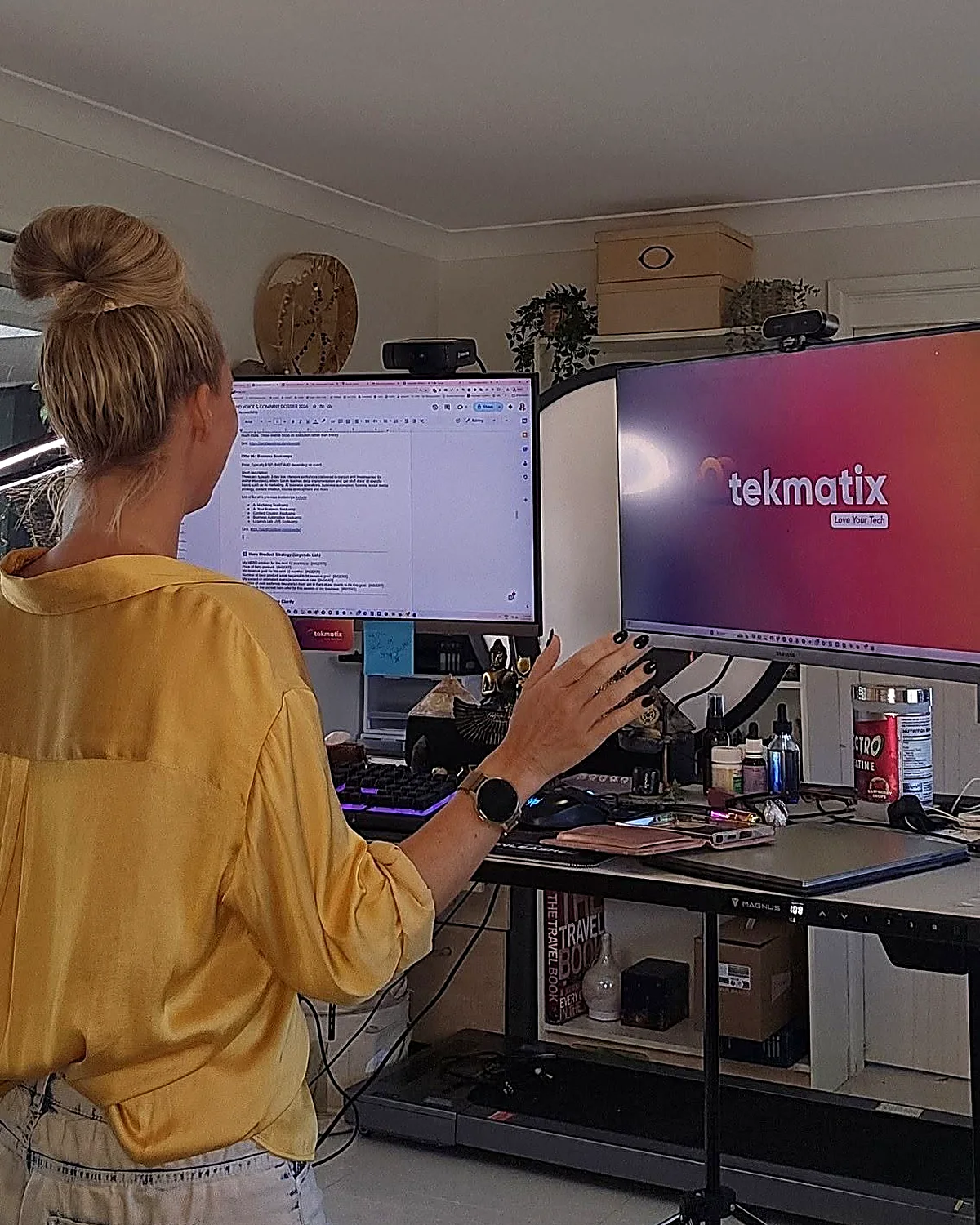
Sarah Cordiner at her desk showing the Tekmatix platform on screen
I built it.
I run my business on it.
1,000+Businesses in Australia and 30+ countries
  • 5.0 on Google from 100+ reviews
  • 98% recommended on Facebook
  • 1,000+ businesses in 30+ countries
  • Award-winning 24/7 support
  • 3 free live training calls every weekday
  • Replace $500 to $1,000+ a month in subscriptions
Sound familiar?

Eight logins. Eight bills. Zero of them talking.

Most business owners I meet are paying for a website here, an email tool there, a booking app, a course platform, a CRM they never open... and then paying someone to glue it all together with duct tape and Zapier.

  • 1Leads fall through the cracks because your forms, inbox and CRM live in different places.
  • 2Every new tool means another login, another bill and another thing to learn.
  • 3You can't see what's actually working because your data is scattered across ten dashboards.
What Tekmatix replaces
Website and hostingWix / Squarespace / GoDaddy
$30+/mo
Sales funnelsClickFunnels / Leadpages
$99+/mo
CRMHubSpot / Salesforce
$50+/mo
Email marketingMailchimp / ActiveCampaign
$40+/mo
Booking calendarCalendly / Acuity
$20+/mo
AI chat and voice agentsVarious
$99+/mo
Social media schedulerHootsuite / Buffer
$30+/mo
Courses and membershipsKajabi / Teachable / Thinkific
$150+/mo
All of it, in TekmatixPlans from $150 AUD / $97 USD a month
The full feature list

Everything your business runs on, under one roof.

Tekmatix is an all-in-one CRM, marketing, sales, course and AI platform. Here's what's inside, grouped by the job it does for you. Tap a category to filter, or scroll the lot.

The bit everyone asks about

AI that does the work

Hand the repetitive stuff to AI that already knows your contacts, calendar and offers.

  • AI Employees that answer chats, DMs and enquiries 24/7
  • Voice AI receptionist that answers your phone and books calls
  • AI booking bot on your website chat widget
  • AI Studio to build apps and tools by describing them (vibe coding)
  • Ask AI assistant built into your account
  • AI website and funnel builder plus content and image AI
  • Connects to Claude and ChatGPT via MCP, so your AI can work inside Tekmatix

Get found and grow your list

Everything you need to get seen, capture leads and build your audience.

  • Unlimited websites with free hosting and your own domains
  • Unlimited funnels, landing pages, sales pages and opt-ins
  • 100+ ready-made templates for sites and funnels
  • Blogging with unlimited posts
  • Social media planner with auto-posting
  • Forms and quizzes, unlimited
  • Surveys with conditional logicPro
  • Reviews and reputation management, incl. Google Business Profile
  • Link-in-bio pages and QR codes

Nurture and convert

Turn strangers into clients with automated follow-up that never forgets.

  • CRM with unlimited contacts and full client records
  • Unified inbox for email, SMS, Facebook and Instagram DMs
  • Email marketing with automated newsletters
  • SMS and phone, incl. missed-call text back
  • Unlimited workflows and automations
  • Sales pipelines so you see every deal
  • Booking calendars for individuals, teams and groups, with 2-way sync
  • Advanced reporting on ads, calls, courses and lead sourcesPro

Sell and get paid

Take money online, in person and on autopilot. Payments go straight to your Stripe or PayPal.

  • Checkouts with upsells and order bumps
  • Invoicing: one-off, recurring and payment plans
  • Tap to pay on your phone (EFTPOS)
  • Request payments by SMS
  • Products and e-commerce, digital and physical, plus coupons
  • Proposals, quotes and contracts with e-signaturesPro
  • Affiliate program with unlimited affiliatesPro
  • Event management with QR code ticketingPro

Courses, memberships and community

Built especially for course creators, educators and coaches. (It's where I teach my own students.)

  • Unlimited courses and memberships
  • Unlimited students and video hosting
  • Assessments and quizzes inside your courses
  • Student mobile app in your branding
  • Communities and groups, unlimitedPro
  • Course certificatesPro

Run the business

The behind-the-scenes admin, organised and in one place for your whole team.

  • Project management and Kanban boards
  • Task manager with deadlines and tracking
  • Unlimited staff users with permission controls
  • Admin mobile app for Apple and Android
  • Business card scanner
  • Integrations with Zapier, Make, WordPress, Google and more
  • Up to 5 sub-accounts for your other businessesMax
ProIncluded on Pro and Max plansMaxMax plan onlyEverything else is included from Starter up.

Want to see it with your own eyes?

Start a 7-day free trial and a Tekspert will jump on a free set-up call with you.

Who it's for

If you sell your expertise or your services, it's built for you.

Solo operators, growing teams and multi-business owners all run on Tekmatix. Here's where it shines brightest.

01

Coaches, course creators and educators

Your website, sales pages, checkout, courses, membership, community and email, all connected. Tekmatix was made especially for you.

02

Consultants, speakers and experts

Bookings, proposals, contracts, invoices and follow-up that makes you look like a big firm, even if it's just you.

03

Health, allied health and NDIS providers

Online bookings, reminders, reviews and client records for clinics, therapists and practitioners.

04

Tradies and local service businesses

Missed-call text back, quotes, tap to pay and review requests, so you win the job while you're still on the tools.

05

Studios, salons and personal trainers

Class bookings, memberships, payments and reminders that cut the no-shows and the admin.

06

Agencies, associations and multi-business owners

Pipelines, staff permissions, reporting and (on Max) up to 5 sub-accounts to run several brands from one login.

Business ownersCoachesCourse creatorsConsultantsTherapistsNDIS providersMedical and allied healthLegal and financial professionalsTradiesSalonsYoga studiosPersonal trainersPhotographersDesignersMarketing agenciesRecruitersOnline storesEvent organisersChurchesCharitiesBusiness associations

Honest moment: if you only need one simple tool and you're genuinely happy juggling logins, you probably don't need Tekmatix yet. But the minute you're copying leads from one app to another, or paying for five subscriptions that don't talk to each other, it's time.

You're never on your own

Most software gives you a login. We give you a team.

I'm an educator first, so Tekmatix was built education-first. Every plan comes with real humans, real training and real templates to get you up and running fast.

Day one

Free one-on-one set-up call

A Tekspert jumps on a call with you to set up your account and connect your integrations.

24/7

Award-winning live chat

Stuck at 11pm? Real support, any time of day or night.

Every weekday

3 free live training calls

Drop in, share your screen and get your questions answered live.

Included

Starter kit and training library

Ready-made templates and automations, a step-by-step help centre, video tutorials and a free Tekmatix training course.

Rather someone just did it for you?

Teksperts are available by the hour, plus fixed-price done-for-you set-up and migration from your old platforms.

See Tekmatix services →
Plans and pricing

Simple pricing that doesn't punish growth.

Unlimited contacts on Starter and Pro, so your bill doesn't jump every time your list grows. Pay in AUD or USD, monthly or yearly (pay yearly and get a month free).

Starter
$150 AUD / month
or $97 USD / month

Everything you need to market, sell and deliver, in one place.

  • Unlimited contacts, staff users and courses
  • Websites, funnels, CRM, email and bookings
  • Payments, invoicing and tap to pay
  • AI Agents, AI booking bot, AI Studio and Ask AI
  • 24/7 live chat and a free set-up call
Start 7-day free trial
Best for course creators Pro
$230 AUD / month
or $149 USD / month

Everything in Starter, plus the tools to build a community and scale.

  • Communities, groups and course certificates
  • Event management with QR ticketing
  • Your own affiliate program
  • Proposals, contracts and e-signatures
  • Unlimited surveys and advanced reporting
Start 7-day free trial
For multi-business owners Max
$497 AUD / month
or $349 USD / month

Everything in Pro, plus more AI, more accounts and a strategist in your corner.

  • Up to 5 sub-accounts
  • AI Employee Growth plan included: 1,000 AI conversation replies and 100 voice AI minutes a month
  • Monthly 60-minute strategy call with a senior Tekspert
  • Early access to Tekmatix Labs
Book a demo

Just starting out? The Launch plan is $75 AUD ($50 USD) a month for up to 1,000 contacts. No lock-in contracts.

Chat about the Launch plan

Emails, SMS, phone calls and AI usage are pay-as-you-go and billed in USD, so you only pay for what you use. See the full rates at tekmatix.com/rebilling. Prices current as at September 2026. Always check tekmatix.com/pricing for the latest.

Sarah Cordiner teaching a funnel diagram on a whiteboard
280,000+Students taught in 181 countries
A note from the founder

I didn't build software. I built the toolbox I needed.

Founder and CEO, Tekmatix20+ years in businessPostgraduate qualified educator

After 20+ years in business and more than 280,000 students, I kept seeing the same thing. Brilliant people with brilliant expertise, drowning in tech. Paying for ten tools, using two of them, and spending their evenings on YouTube trying to make them talk to each other.

So I put everything a business needs into one platform, then wrapped it in the thing I know best: education and support. Tekmatix runs my own websites, courses, funnels, emails and AI agents every single day. I wouldn't recommend it if I didn't use it.

Sarah x

Want me to teach you how to get the most out of it?

Inside the Legends Lab I show you step by step how to use tech, AI and automation to grow your business, with live calls, workshops and templates you can copy.

Join the Legends Lab
Don't just take my word for it

Non-techie people love their tech again.

Tech is hard for non-techie people, and they really get that and make it fun.
Forging Ahead CoachingFacebook review
Yesterday I felt overwhelmed. Now I feel excited and empowered.
Melanie GleesonGoogle review
I have used a number of top CRM systems. This is up there with the very best.
Peter J CroneyFacebook review
Solved problems I have had for weeks, in 50 minutes. Wonderful.
Nicole TurnbullGoogle review
5.0Google rating, 100+ reviews
98%Recommended on Facebook
1,000+Businesses
30+Countries
The rest of my toolkit

The other tools I use and actually recommend.

Tekmatix is the engine. These are the extras that plug in around it for AI, video, design, content and admin. Tap a category to filter.

Some of these are affiliate links, which means I may earn a small commission at no extra cost to you. Thanks for supporting the brand!

AITop pickClaude CoWorkAI agent for non-developers that works across your files, email and apps to automate tasks on your desktop.Check it out → AITop pickChatGPTAI assistant for content, research, brainstorming and custom GPTs for your team.Check it out → AIGoogle GeminiGoogle's multimodal AI assistant, built into Google Workspace.Check it out → AIGoogle AI StudioTest prompts and build with Google's AI models, free to start.Check it out → AIManusAutonomous AI agent that researches and completes multi-step tasks for you.Check it out → AIGensparkAI search and research engine that builds answers from multiple sources.Check it out → AILovableAI app builder. Describe the web app you want in plain English and it builds it.Check it out → Video and audioTop pickDescriptEdit video and podcasts by editing the transcript. Plus screen recording.Check it out → Video and audioCapCutMobile-friendly video editing for Reels, TikToks and short-form content.Check it out → Video and audioTop pickHeyGenAI avatar videos with your own custom scripts and voice.Check it out → Video and audioElevenLabsRealistic AI voiceovers and voice cloning.Check it out → Video and audioSubmagicAI short-form video editing: auto captions, effects and b-roll.Check it out → Video and audioTop pickStreamYardLivestream and multistream to your socials, webinars and virtual events.Check it out → Video and audioLoomQuick screen recordings for tutorials, SOPs and async updates.Check it out → Video and audioCamtasiaScreen recording and video editing for polished course videos.Check it out → Video and audioPodcast.coPodcast hosting and distribution to all the major platforms.Check it out → Design and contentTop pickCanvaDesign for non-designers: social graphics, slides, marketing material and more.Check it out → Design and contentTop pickGammaAI presentation builder for slides, documents and simple web pages.Check it out → Design and contentEnvato ElementsCommercial-use music, video, b-roll, photos and templates.Check it out → Design and contentCreative FabricaFonts, graphics and design assets for your content.Check it out → Design and contentGoogle WhiskGoogle's AI image tool for generating and remixing images.Check it out → Design and contentAdCreative.aiAI-generated ad creatives for your paid campaigns.Check it out → Design and content1of10Viral content research: find the top-performing ideas in your niche.Check it out → Design and contentSyllabyAI social media strategy with video scripts and content ideas for your niche.Check it out → Design and contentTubeBuddyYouTube channel growth, SEO and optimisation.Check it out → ProductivityTop pickMakeVisual automation to connect your apps and build advanced workflows.Check it out → ProductivityOtter.aiRecords, transcribes and summarises your meetings automatically.Check it out → ProductivityWispr FlowAI voice-to-text. Dictate into any text box on your computer.Check it out → ProductivityGoogle WorkspaceEmail, docs, sheets, calendar and team collaboration.Check it out → ProductivityHunter.ioFind business email addresses for B2B outreach.Check it out → ProductivityStunningRecovers failed Stripe payments automatically.Check it out → Money and adminStripePayment processing. Connects to Tekmatix for courses, products, memberships and payment plans.Check it out → Money and adminPayPalConnects to Tekmatix so customers can pay with PayPal.Check it out → Money and adminXeroAccounting for invoicing, payroll, BAS and tax reporting.Check it out → Money and adminAppSumoLifetime deals on software and business tools.Check it out → Money and adminFiverrFreelancers for one-off design, writing and tech jobs.Check it out → Books and publishingPublisher RocketAmazon KDP keyword and category research for authors.Check it out → Books and publishingBookBoltKDP and low-content book publishing research and design.Check it out → Books and publishingMy gear listThe cameras, mics and lighting I recommend, on Amazon.Check it out →

Wondering where the email, booking, course, funnel and CRM tools are? I don't need them any more. Tekmatix does all of that, so I'd rather you didn't pay for them twice.

See what Tekmatix covers ↑
Questions I get asked

Tech stack FAQs.

Still wondering if Tekmatix is right for you? Here are the straight answers.

What is Tekmatix?

Tekmatix is an all-in-one AI business platform. It brings your website, funnels, CRM, email marketing, bookings, payments, courses, memberships, communities, social media scheduling and AI agents together in one connected account, so everything talks to each other.

Do I need to be techy to use it?

No. Tekmatix was built for non-techie business owners. You get a free set-up call, 24/7 live chat, three free live training calls every weekday, a help centre, video tutorials and ready-made templates to get started.

Is there a free trial?

Yes. The Starter and Pro plans come with a 7-day free trial. The Max plan starts with a demo, so the team can make sure it's the right fit.

Can I pay in Australian dollars?

Yes. You can pay your subscription in AUD or USD. Usage charges for emails, SMS, calls and AI are pay-as-you-go and always billed in USD. See tekmatix.com/rebilling for rates.

Will my price go up as my list grows?

No. Starter and Pro include unlimited contacts, so your plan price doesn't increase as your business grows. You also get unlimited courses, students and staff users.

Can you move me off my current platforms?

Yes. Tekmatix Teksperts offer fixed-price migration and done-for-you set-up services, or can help you integrate the tools you want to keep. See tekmatix.com/services.

Can I run courses, memberships and communities in it?

Yes. Tekmatix was made especially for course creators, educators and coaches. Courses and memberships are included on every plan, and communities and certificates come with Pro and Max.

Which plan should I choose?

Starter suits most service businesses and solo experts. Pro is best if you run courses with a community, events, contracts or an affiliate program. Max is for people running more than one business or who want more AI and a monthly strategy call. Not sure? Book a demo.

Your move, legend

Stop juggling your tech. Start loving it.

One login. One bill. One platform that runs your marketing, sales, courses and AI, with a real team behind you. Try it free for 7 days and see how much simpler business gets.

7-day free trial on Starter and Pro / Free set-up call / Cancel anytime

See you inside. Sarah x
Latest Articles by Sarah Cordiner